
If sleep hygiene has not helped your sleep problems during cancer treatment, the issue may not be effort. It may be sorting. A dark room, a regular bedtime, and fewer late-night screens can help when the sleep system is basically intact. During cancer treatment, the sleep system may be pushed off track by pain, steroids, hot flashes, nocturia, fear, disrupted daily rhythms, or inflammation. Those are not the same problem, and they do not point to the same fix.
Sleep disturbance is common in cancer care, but “common” is too blunt to be useful by itself. The National Cancer Institute describes sleep problems as frequent among people with cancer, and the American Cancer Society notes that sleep problems can occur before, during, and after treatment.[1][2] A review of cancer-related sleep disturbance reports estimates ranging from 30% to 75% of patients, compared with about 10% of the general population; in one survey of more than 1,000 cancer patients, 31% reported insomnia, 28% excessive sleepiness, and 41% restless legs.[3] Those are different complaints, not interchangeable versions of “bad sleep.”
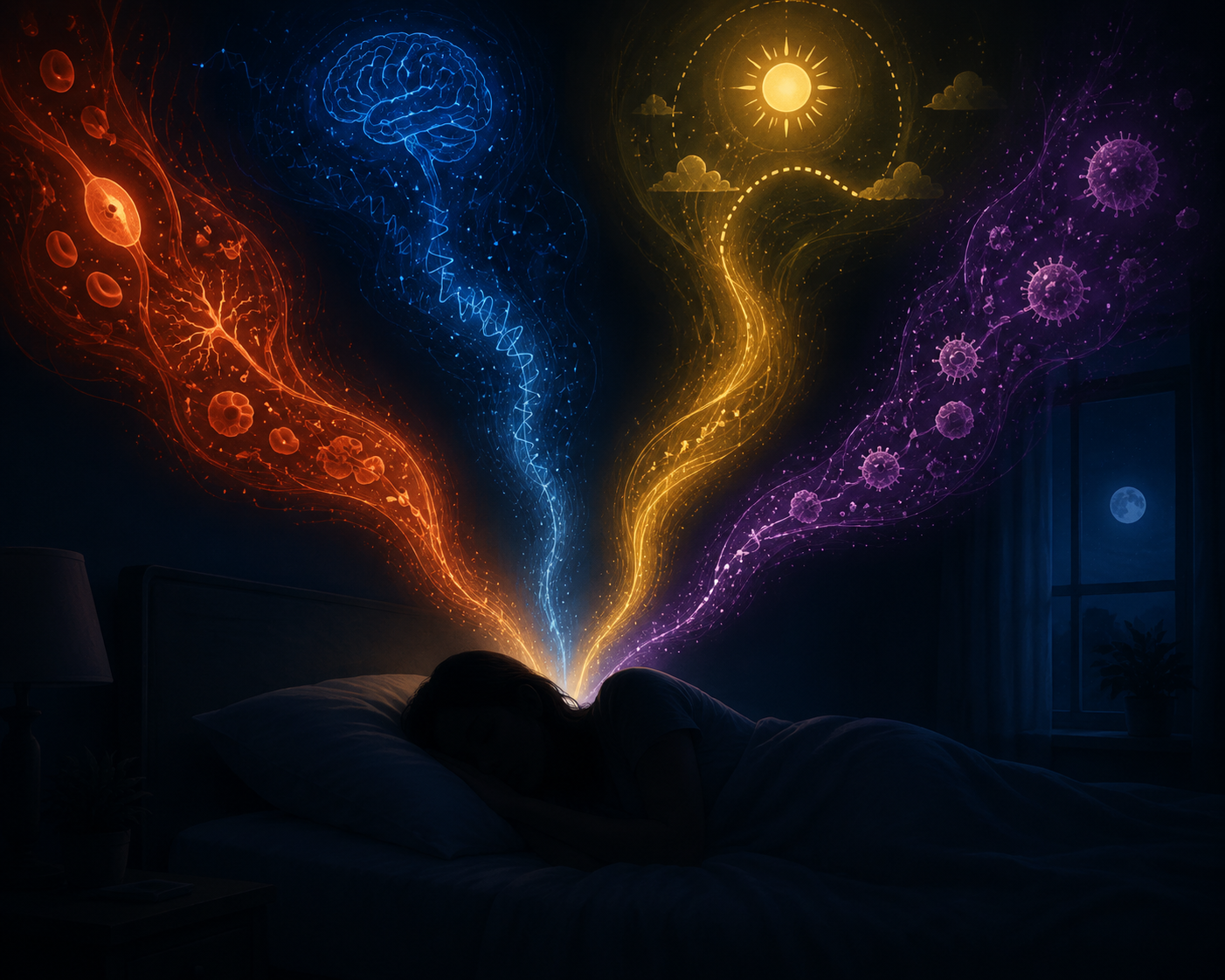
The useful question is which pathway is active
A patient who says, “I’m exhausted, but I still can’t sleep,” may be describing several mechanisms at once. One person is awake because pain flares when they lie down. Another is alert at midnight after a steroid dose. Another falls asleep but wakes in waves of heat. Another feels sleepy all day and restless at night because their body clock has lost its anchor. Another gets into bed and immediately starts scanning for recurrence, appointments, scan results, or the next symptom.
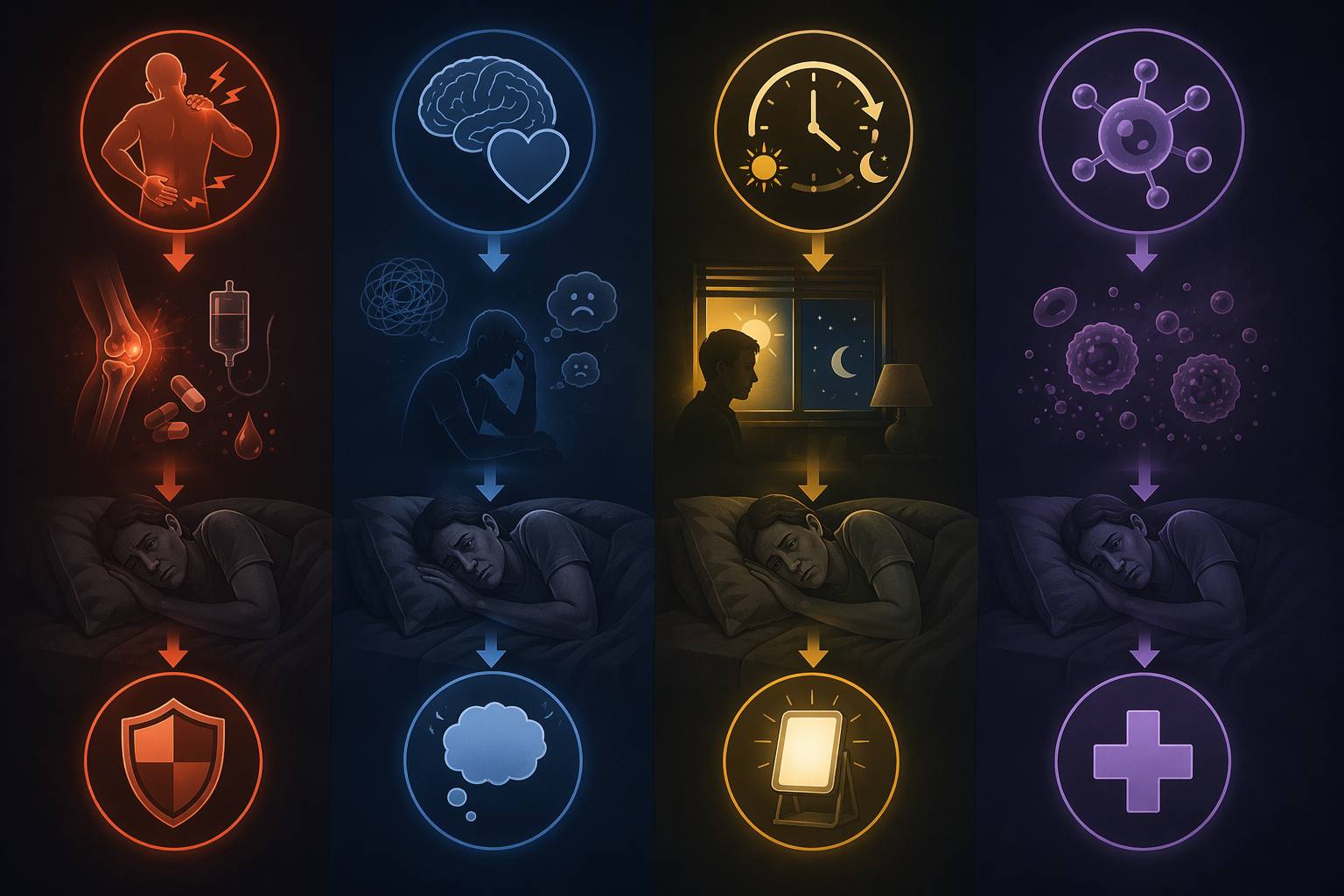
A pathway frame does not diagnose the cause on its own, but it gives the appointment a better starting point:
| Pathway | Pattern a patient may notice | Intervention category it points toward |
|---|---|---|
| Physiological | Sleep is interrupted by pain, nocturia, hot flashes, nausea, shortness of breath, medication timing, or other body symptoms. | Treat the symptom or adjust the treatment schedule when clinically appropriate. |
| Psychological | The body is tired, but the mind becomes alert in bed; worry, fear, low mood, or conditioned wakefulness takes over. | CBT-I and mental health support, with medication considered selectively. |
| Circadian | Sleep and wake times drift; nights are fragmented and days become inactive or sleepy. | Light, activity timing, and circadian-focused treatment such as bright light therapy when appropriate. |
| Inflammatory | Sleep feels biologically altered: heavy fatigue, unrefreshing sleep, daytime malaise, and disrupted sleep depth. | Supportive management and medical review; no approved cytokine-targeting insomnia treatment currently follows directly from this mechanism. |
The same person can move between pathways over a treatment course. Steroid timing may dominate one week. Nocturia or hot flashes may dominate the next. After a scan or a new symptom, the psychological pathway may become louder. That changing pattern is one reason a single sleep tip often stops working.
Physiological disruption: when the body keeps waking you
The physiological pathway is the most concrete: something happening in the body repeatedly interrupts sleep. Pain may become more noticeable when the room is quiet. Nocturia may break the night into short segments. Hot flashes can wake a person abruptly, sometimes with sweating and a racing sensation. Steroids, often used in chemotherapy regimens and supportive care, can cause insomnia; Dana-Farber notes that taking steroids earlier in the day may help reduce nighttime disruption when the prescribing team agrees.[4]
This is where generic sleep hygiene can feel especially unfair. A patient may be keeping a consistent bedtime and still waking five times because urination, pain, or temperature surges are driving the night. The practical question is not whether the patient has tried hard enough to relax. It is whether the symptom waking them has been named and treated directly.
Useful details for the care team are specific and time-stamped: “I fall asleep, then wake every 90 minutes to urinate,” “pain is worst after I lie on my side,” “hot flashes start around 2 a.m.,” or “sleep worsened after the steroid schedule changed.” These observations point toward different conversations: pain control, bladder symptoms, vasomotor symptom management, medication timing, or treatment-specific side effects. For a treatment-by-treatment breakdown, see how cancer treatments disrupt sleep and what helps.
Psychological disruption can begin before treatment does
Stress is not a throwaway explanation. It is also not a complete one. In oncology sleep complaints, the psychological pathway deserves precision because it can start before chemotherapy, radiation, surgery, or hormone therapy has had a chance to disturb sleep biologically.
One finding makes that hard to ignore: in a study of women with breast cancer before treatment began, 88% reported difficulty sleeping.[3] That does not mean all later insomnia is psychological, and it does not make sleep loss “just anxiety.” It shows that diagnosis itself can be a powerful precipitating event. The bed can become the place where the mind finally has no appointment, no infusion chair, no lab result to track — and therefore nowhere left to put the fear.
This pathway often has a recognizable shape. The patient may feel sedated by fatigue during the day, then become sharply alert at bedtime. They may fall asleep on the couch but wake when they move to bed. They may sleep after treatment days but lie awake before scans, oncology visits, or symptom checks. Over time, the original trigger can become less important than the learned loop: bed means effort, monitoring, calculation, and failure.
That loop is one reason cognitive behavioral therapy for insomnia, or CBT-I, matters. CBT-I is not general reassurance and it is not simply “think positive.” It targets the behaviors and associations that keep insomnia going: too much time awake in bed, irregular sleep windows, compensatory napping that weakens sleep drive, clock-watching, and the fear of another bad night. The NCI lists cognitive behavioral therapy among approaches used for sleep problems in people with cancer, and Mass General Brigham describes CBT-I as a treatment that helps people change thoughts and behaviors that interfere with sleep.[1][5]
The distinction matters because a patient with an active insomnia loop may not improve just by adding more comfort measures. They may need a clinician trained to adjust sleep scheduling safely, especially during treatment-related fatigue. CBT-I also needs judgment in cancer care: a rigid sleep-restriction plan may be inappropriate for someone with severe fatigue, high symptom burden, or medical instability. The method should be adapted, not treated as a self-punishment program.
Mental health screening belongs in this conversation, too. Anxiety, depression, trauma symptoms, and fear of recurrence can all make sleep harder, and sleep loss can worsen emotional regulation the next day. If worry or low mood is driving the night, the right care may include psycho-oncology, counseling, medication for anxiety or depression, a support group, or coordinated behavioral sleep treatment. For a closer look at the role of screening, see how mental health screening affects sleep quality.
What to tell the team if this pattern fits
- “I am sleepy during the day but become alert as soon as I get into bed.”
- “My worst nights happen before scans, appointments, or treatment days.”
- “I am spending hours awake in bed trying to force sleep.”
- “I have started dreading bedtime because I expect to fail.”
- “I want to know whether CBT-I or psycho-oncology support is appropriate for me.”
For readers who want the insomnia treatment itself explained in more depth, CBT-I explained is the more focused place to go.
Circadian disruption: when night and day lose their shape
Some cancer-related sleep problems are less about a single awakening and more about the whole 24-hour rhythm. Treatment schedules, hospital visits, reduced daylight exposure, lower activity, naps, symptom flares, and medications can all weaken the cues that tell the brain when to be awake and when to sleep. The result may be a drifting sleep schedule, daytime dozing, fragmented nights, or a feeling that the body no longer recognizes night as night.
This pathway is not only self-reported. In actigraphy research summarized by Liu and Ancoli-Israel, women with breast cancer were asleep for 77% of the night before chemotherapy and 74% during chemotherapy, showing measurable sleep disruption across the treatment period.[3] Actigraphy cannot explain every cause of an awakening, but it makes the rest-activity disturbance visible.
The Mormont colorectal cancer findings are often cited because they connect rest-activity rhythm strength with a serious clinical signal: patients with more robust rhythms had fivefold higher 2-year survival than those with desynchronized rhythms.[3] That should be read carefully. It does not prove that fixing sleep rhythms produces a survival benefit. It does show that circadian organization is not a decorative wellness concern; it tracks with meaningful differences in illness context and function.
When the circadian pathway seems active, the intervention conversation shifts. The care team may ask about daytime light exposure, wake time, activity timing, naps, steroid or anti-nausea medication timing, and whether bright light therapy is appropriate. Bright light is not just “open the curtains when you remember.” It is a timed signal to the circadian system, so the timing, intensity, and safety considerations matter, especially for patients with eye conditions, bipolar disorder, photosensitizing medications, or complex treatment schedules.
Inflammatory disruption: when sleep feels biologically changed
The inflammatory pathway helps explain a complaint that is easy to minimize from the outside: “I slept, but it did not feel like sleep.” Cancer and cancer treatment can involve immune signaling that affects fatigue, sleepiness, mood, and sleep architecture. Liu and Ancoli-Israel describe inflammatory cytokines including IL-1, TNF, and IL-6 as contributors to sickness behavior and sleep regulation changes; the same review notes that elevated VEGF correlated with poorer sleep during chemotherapy cycles.[3]
This is mechanistically important, but it has a boundary. It does not mean a patient can ask for a specific cytokine-blocking insomnia drug and expect an approved cancer-related sleep treatment. The pathway is useful because it validates that some sleep disruption is not merely behavioral or emotional. It also warns against blaming the patient when sleep feels heavy, fragmented, and unrefreshing despite reasonable routines.
In practice, inflammatory sleep disruption is usually handled indirectly: review active symptoms, infection, anemia, medication effects, pain, depression, fatigue severity, and treatment toxicity; coordinate supportive care; and consider short-term sleep medication only when the expected benefit outweighs risks. Pharmacotherapy can be a bridge during a severe stretch, not a substitute for identifying the driver.
How to match the problem to the next clinical question
The most useful sleep note is not a perfect sleep diary. It is a pattern that points to the right part of the care team. Oncology, primary care, palliative care, psycho-oncology, survivorship care, nursing, pharmacy, physical therapy, and sleep medicine may all be relevant, but not for the same reason.
| If the pattern is... | Ask about... |
|---|---|
| Awakenings from pain, hot flashes, urination, nausea, cough, shortness of breath, or medication effects | Direct symptom treatment, medication timing, and whether a treatment-specific side effect needs adjustment |
| A tired body with an alert mind, scan-related insomnia, dread of bedtime, or hours awake in bed | CBT-I, psycho-oncology, anxiety or depression screening, and whether short-term medication is appropriate |
| Drifting sleep hours, long daytime naps, low daylight exposure, or fragmented rest-activity rhythm | Wake-time anchoring, activity timing, light exposure, and bright light therapy if clinically suitable |
| Unrefreshing sleep with heavy fatigue, malaise, and treatment-cycle worsening | Medical review for inflammation-related contributors, treatment toxicity, anemia, infection, pain, mood, and medication effects |
Short-term sleep medication may have a place, especially when insomnia is severe, safety is at risk, or the patient needs a temporary bridge through a destabilizing period. The decision is different for someone at risk of falls, delirium, breathing problems, medication interactions, or next-day sedation. Supplements also deserve the same medication-level honesty: “natural” does not mean interaction-free, especially during active treatment.
Basic sleep hygiene still has a role. A regular wake time, a dark bedroom, reduced late caffeine, and a wind-down routine can support the system. But when symptoms, conditioned insomnia, circadian drift, or inflammatory signaling are driving the night, sleep hygiene is background support rather than the main treatment. If you want that foundation separated from cancer-specific mechanisms, see sleep hygiene fundamentals.
For a deeper look at the biological mechanisms behind cancer-related sleep disruption, see why cancer treatment disrupts your sleep.
The next useful question is not, “What sleep tip should I try?” It is, “Which pathway is active for me, and who on my care team can help address that pathway?”
References
- Sleep Problems in People with Cancer — NCI
- What are Sleep Problems? — American Cancer Society
- Sleep Disturbances in Cancer — PMC Psychiatric Annals
- Tips for Managing Insomnia During Cancer Treatment — Dana-Farber Cancer Institute
- Improving Sleep During and After Cancer Treatment — Mass General Brigham
Comments
Join the discussion with an anonymous comment.