
Introduction: Two Different Problems, One Bed
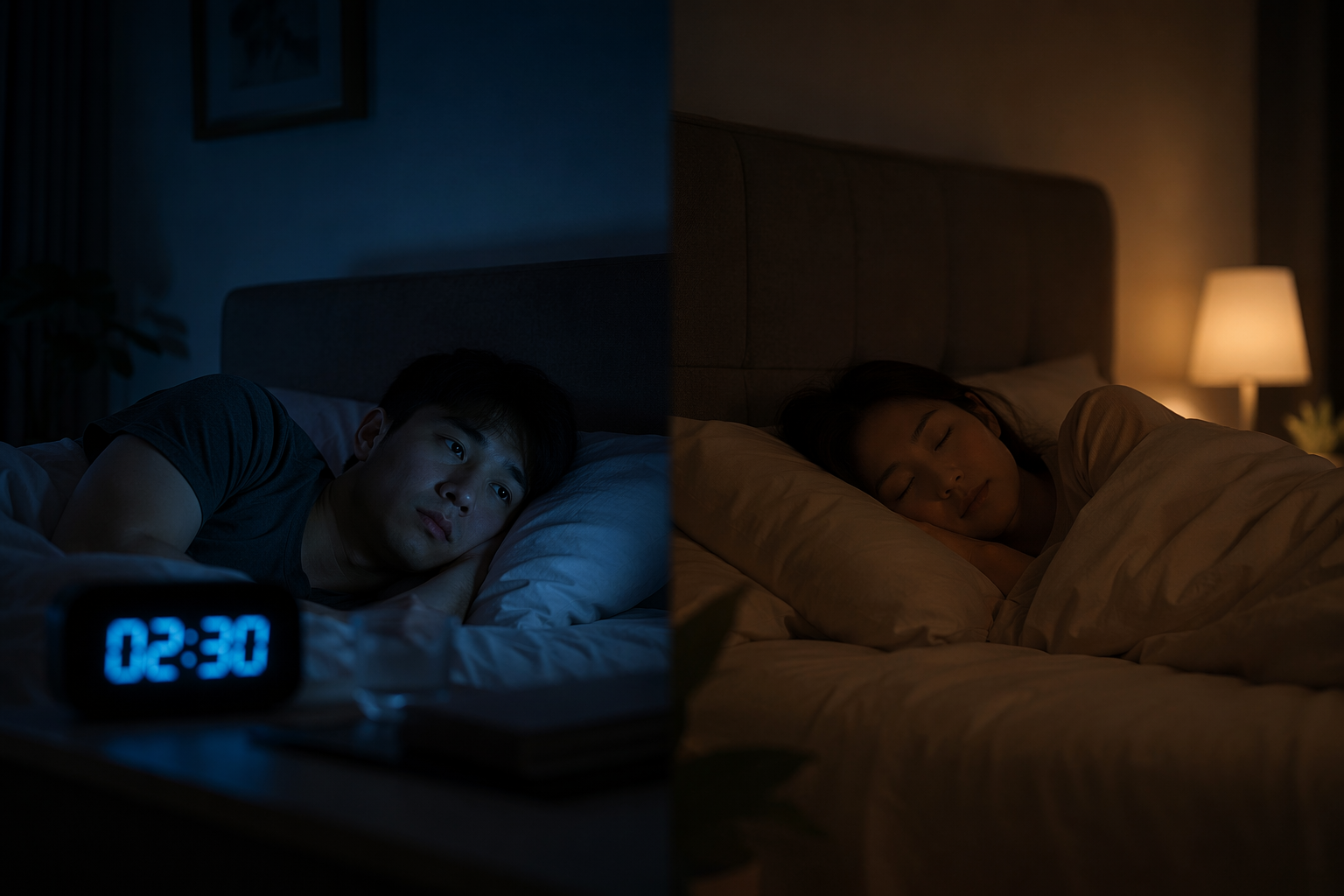
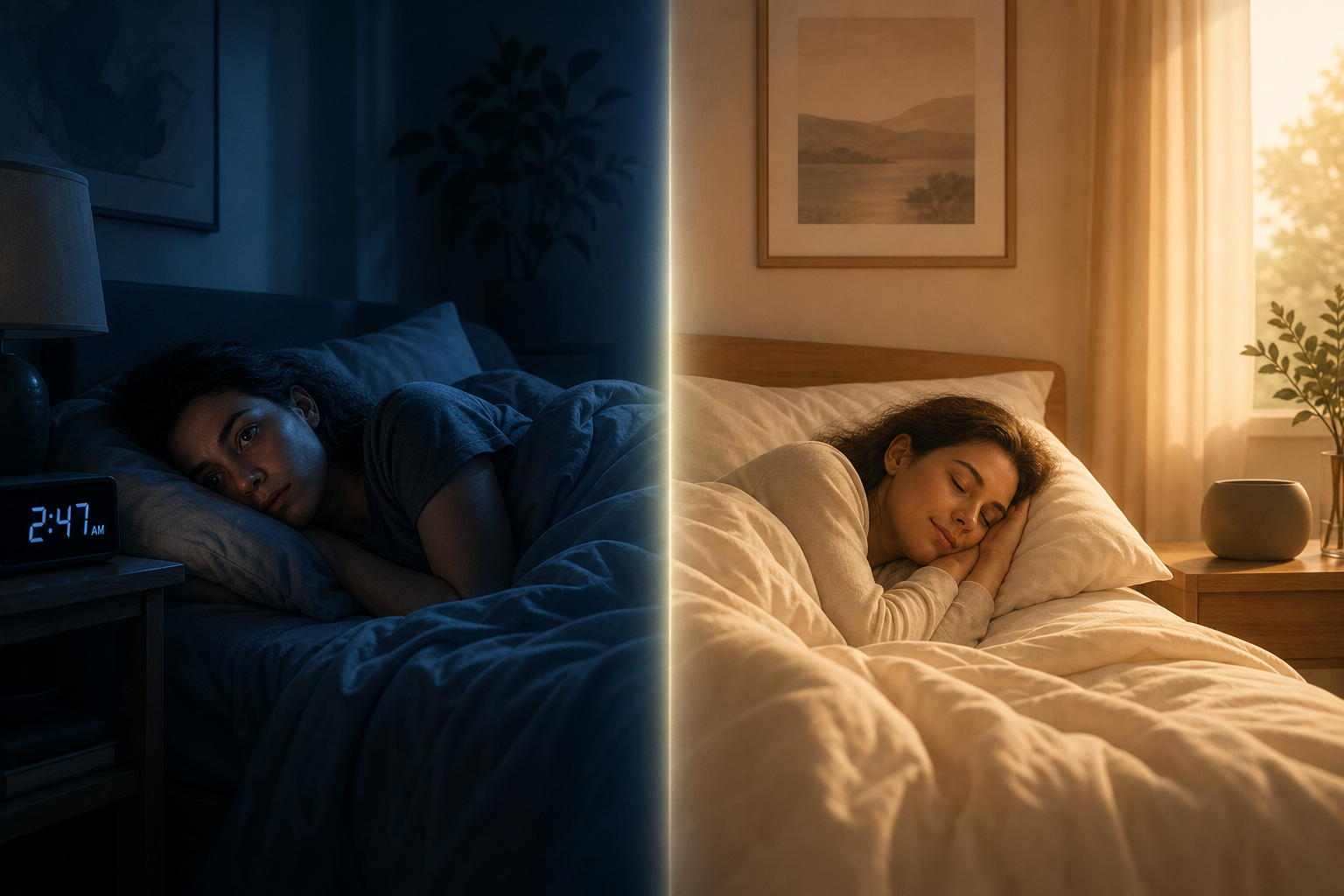
If you have trouble sleeping at night, the first question worth asking is not "why can't I sleep?" but rather "when exactly does the problem happen?" The answer changes everything — from what is likely causing your sleeplessness to which treatment has the best chance of working.
According to the CDC's 2024 National Health Interview Survey, 15.4% of adults have trouble falling asleep most days or every day, while 18.1% have trouble staying asleep. These are not just two ways of describing the same problem. They follow opposite age trends, have different root causes, and respond to different treatment strategies.
| Sleep Difficulty | Prevalence (All Adults) | Age Trend |
|---|---|---|
| Trouble falling asleep | 15.4% | Decreases with age (18.3% at ages 18–34 → 12.8% at ages 65+) |
| Trouble staying asleep | 18.1% | Increases with age (12.7% at ages 18–34 → 21.7% at ages 65+) |
This article will help you identify your specific sleep pattern, understand the mechanisms behind it, and choose a treatment path that matches your actual problem — not the generic advice that treats all insomnia as one condition.
Sleep Onset Insomnia: When You Can't Fall Asleep
Sleep onset insomnia is the experience of lying in bed, often for 20 to 30 minutes or longer, unable to transition from wakefulness to sleep. Your mind may be racing, your body may feel tense, or you may simply feel "wide awake" despite being tired.
Who experiences it most
Trouble falling asleep is more common in younger adults and women. The CDC data shows that 18.3% of adults ages 18–34 report this difficulty, compared to 12.8% of those 65 and older. Women are affected at significantly higher rates: 18.5% of women report trouble falling asleep versus 12.2% of men.
Primary causes
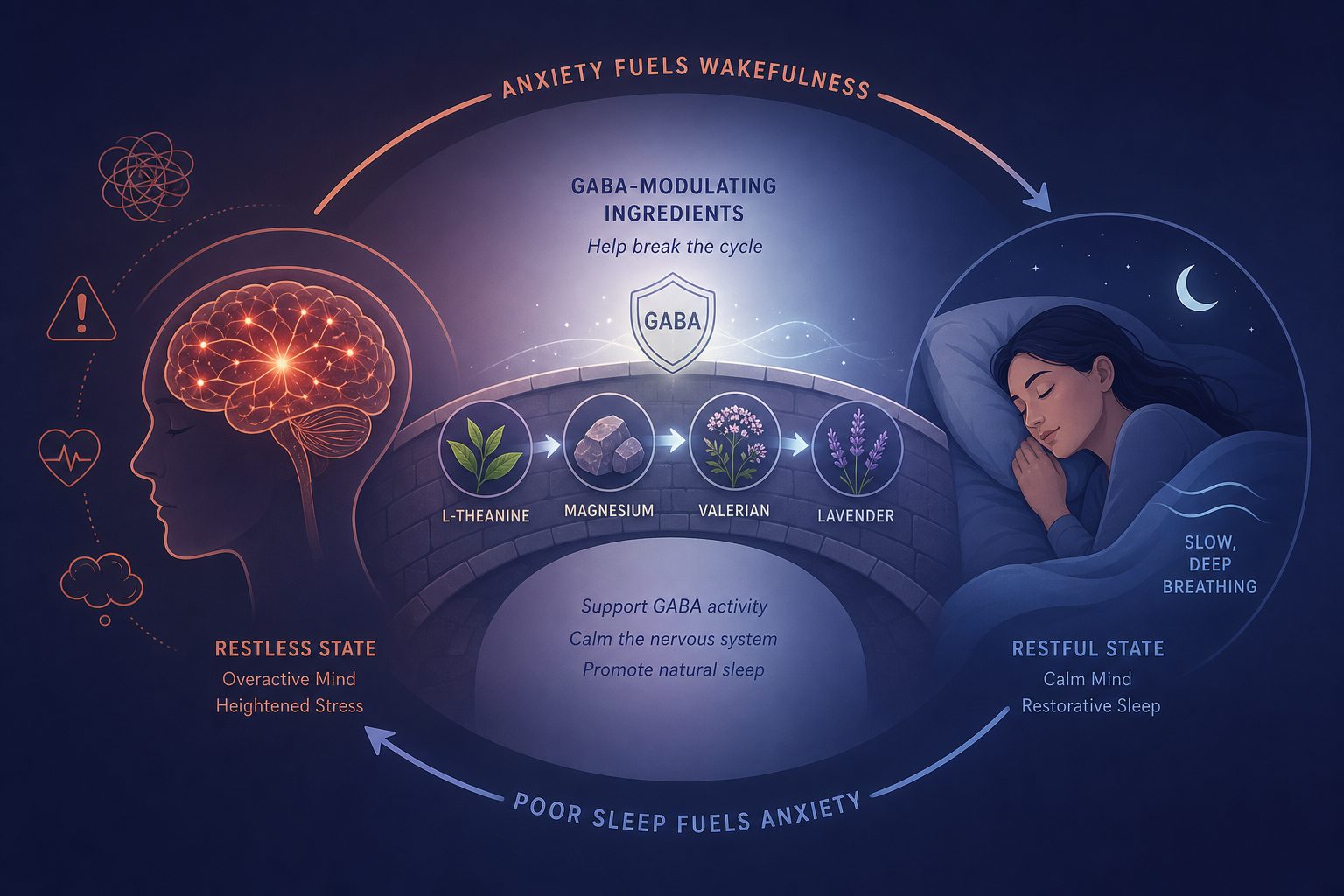
- Anxiety and conditioned hyperarousal. 54% of adults say stress and anxiety are the top reasons they have trouble falling asleep, according to Sleep Foundation data. When the brain learns to associate the bed with worry rather than rest, it creates a self-reinforcing cycle: the harder you try to sleep, the more awake you become.
- Delayed circadian phase. Some people have a natural body clock that runs late, making it physiologically impossible to fall asleep at a conventional bedtime. This is especially common in adolescents and young adults, whose circadian rhythms naturally shift later during puberty and early adulthood.
- Caffeine sensitivity. Caffeine blocks adenosine, the brain chemical that builds sleep pressure throughout the day. Even afternoon coffee can interfere with sleep onset hours later, particularly in people who metabolize caffeine slowly.
- Poor sleep habits. Irregular bedtimes, using phones or watching TV in bed, and spending too much time in bed awake all weaken the brain's association between bed and sleep.
The common thread in sleep onset insomnia is hyperarousal — a state where the nervous system is too activated for sleep to begin. This can be psychological (anxiety, stress), physiological (caffeine, delayed circadian timing), or both.
Sleep Maintenance Insomnia: When You Can't Stay Asleep
Sleep maintenance insomnia describes the experience of waking up at least once during the night and struggling to get back to sleep for 20–30 minutes or more. It also includes early morning awakening — waking up hours before your alarm and being unable to return to sleep.
Who experiences it most
Unlike sleep onset insomnia, trouble staying asleep increases with age. The CDC data shows that only 12.7% of adults ages 18–34 report this difficulty, but the rate climbs to 21.7% among those 65 and older. Women are again more affected: 21.4% of women report trouble staying asleep versus 14.6% of men.
Primary causes
The causes of sleep maintenance insomnia are more varied and often involve medical or physiological factors that disrupt sleep after it has begun.
| Cause | How It Disrupts Sleep | Notes |
|---|---|---|
| Age-related sleep architecture changes | Lighter, more fragmented sleep; earlier circadian timing | Older adults naturally spend less time in deep sleep and may feel sleepy earlier, leading to early morning awakening |
| Nocturia (nighttime urination) | Wakes you to use the bathroom; difficulty returning to sleep | 69% of men and 76% of women ages 40+ get up at least once per night (Sleep Foundation) |
| Alcohol rebound | Helps you fall asleep but fragments the second half of the night | More than 2 drinks/day (men) or 1 drink/day (women) can decrease sleep quality by 39% |
| Sleep apnea | Repeated breathing interruptions cause micro-arousals | Older women are just as likely to develop sleep apnea as men (Yale Medicine) |
| Chronic pain | Pain signals interrupt sleep continuity | Common in older adults; arthritis, neuropathy, and back pain are frequent drivers |
| Hormonal shifts | Progesterone drop removes natural sedative effect; hot flashes disrupt sleep | 39–47% of perimenopausal and 35–60% of postmenopausal women report sleep disorders (NCBI) |
| GERD / heartburn | Lying down allows stomach acid to travel upward, causing discomfort | Eating within a few hours of bedtime increases risk |
A key distinction: alcohol is often used as a sleep aid because it helps with falling asleep, but it backfires for sleep maintenance. Alcohol suppresses REM sleep in the first half of the night, and as it metabolizes, it causes lighter, more fragmented sleep and more frequent bathroom trips in the second half.
Mixed Insomnia: When Patterns Shift Over Time
Many people do not fit neatly into one category. You might have trouble falling asleep during a stressful work period, then develop maintenance insomnia months later as the stress resolves but new factors — like age-related sleep changes or a new health condition — emerge. The Sleep Foundation notes that people with insomnia often find their symptoms shift over time, and mixed insomnia — a combination of onset, maintenance, and early morning awakening problems — is common.
This fluidity is normal, but it makes the self-assessment process even more important. If you are currently experiencing both onset and maintenance problems, the question becomes: which pattern is primary, and what is the most likely driver right now?
Why the Distinction Directs Treatment
Cognitive behavioral therapy for insomnia (CBT-I) is the first-line treatment for both sleep onset and sleep maintenance insomnia. The Cleveland Clinic confirms that CBT-I is the recommended first-line approach, typically involving six to eight sessions. However, the specific components of CBT-I that work best depend on your primary sleep pattern.
Stimulus control for sleep onset insomnia
Stimulus control therapy is the most direct treatment for trouble falling asleep. It works by breaking the conditioned association between your bed and wakefulness. The core rules are simple: only go to bed when sleepy; get out of bed if you cannot fall asleep within 20–30 minutes; use the bed only for sleep and sex; and keep a consistent wake time every day.
For a detailed breakdown of how each rule works and why it targets conditioned hyperarousal, see our Stimulus Control Therapy for Insomnia guide.
Sleep restriction for sleep maintenance insomnia
Sleep restriction therapy addresses the mismatch between the time you spend in bed and the amount of sleep you actually get. By temporarily limiting time in bed to match your average sleep duration, you build stronger sleep drive and reduce the fragmented, light sleep that characterizes maintenance insomnia. This technique is particularly effective for people who spend 8–9 hours in bed but only sleep 5–6 hours.
If you have tried sleep restriction and hit a plateau, our Sleep Restriction Therapy Troubleshooting Guide covers common stalls and how to work through them.
When to screen for underlying conditions
Sleep maintenance insomnia often has a medical driver that CBT-I alone cannot address. If you have persistent maintenance insomnia, consider screening for:
- Sleep apnea — especially if you are over 50, postmenopausal, or have a history of snoring. The STOP-BANG questionnaire is a validated self-screening tool.
- GERD or acid reflux — if you wake with a sour taste, heartburn, or a cough.
- Nocturia — if you wake to urinate more than once per night. Limiting fluids before bed and addressing underlying bladder or prostate issues can help.
- Chronic pain — if pain is waking you, treating the pain itself may be necessary before sleep-focused interventions can work.
- Hormonal changes — if you are perimenopausal or postmenopausal, hormonal fluctuations may be disrupting sleep continuity.
For people with comorbid conditions, CBT-I can still be effective but may need tailoring. Our article on CBT-I for Comorbid Insomnia explains how the protocol is adapted when another health condition is present.
Morning light exposure for delayed circadian phase
If your primary difficulty is falling asleep at a conventional bedtime and you feel most alert late at night, a delayed circadian phase may be the underlying cause. Morning light exposure — 20–30 minutes of bright light within 30 minutes of waking — is the most effective way to shift your internal clock earlier. This is covered in detail in our Circadian Rhythm Mechanisms article.
| Insomnia Subtype | Primary CBT-I Component | Additional Considerations |
|---|---|---|
| Sleep onset | Stimulus control therapy | Morning light exposure for delayed circadian phase; limit caffeine after noon |
| Sleep maintenance | Sleep restriction therapy | Screen for sleep apnea, GERD, nocturia, chronic pain; avoid alcohol before bed |
| Mixed | Combination of stimulus control and sleep restriction | Address the most disruptive pattern first; screen for underlying medical conditions |
Summary: A Self-Assessment for Your Sleep Pattern
To identify your sleep pattern, ask yourself these three questions over the course of a week:
- Do I lie awake for 20–30 minutes or more before falling asleep? If yes, sleep onset insomnia is likely. Focus on stimulus control, morning light exposure, and reducing caffeine and evening screen use.
- Do I wake up at least once during the night and struggle to get back to sleep, or wake up too early and cannot return to sleep? If yes, sleep maintenance insomnia is likely. Focus on sleep restriction, avoiding alcohol before bed, and screening for underlying medical conditions.
- Do I experience both? If yes, identify which pattern is more frequent or disruptive, and start with the treatment that targets that pattern first.
For those who want to try CBT-I techniques at home without a therapist, our self-directed CBT-I techniques guide provides a structured, step-by-step approach.

Comments
Join the discussion with an anonymous comment.