
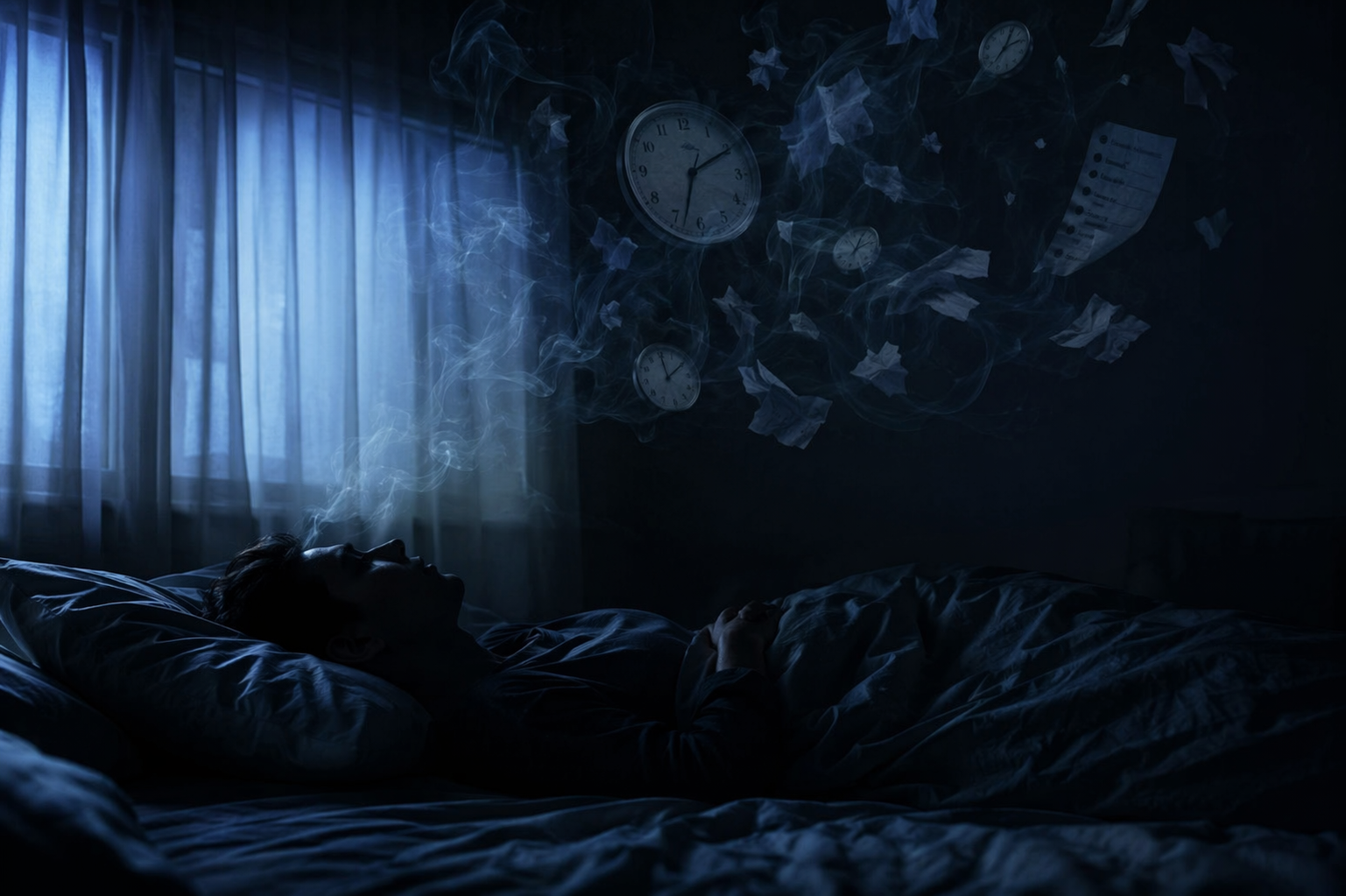
Having a restraining order in place can make danger formally recognized. It does not automatically tell your nervous system that the danger is over. That is why restraining order anxiety and sleep quality can feel so brutally disconnected: on paper, something has changed; at 2 a.m., your body may still be listening for footsteps, messages, car doors, court consequences, or the next thing you might have to prove.
This is not ordinary “I’m stressed, so I should relax” insomnia. Hypervigilance is a threat-detection state. The body keeps scanning for danger, with sympathetic nervous system activation and stress hormones such as cortisol and adrenaline helping keep attention sharpened when it should be softening toward sleep.[1][2] The result is often a night that never fully begins: you lie down, but part of you stays on duty.
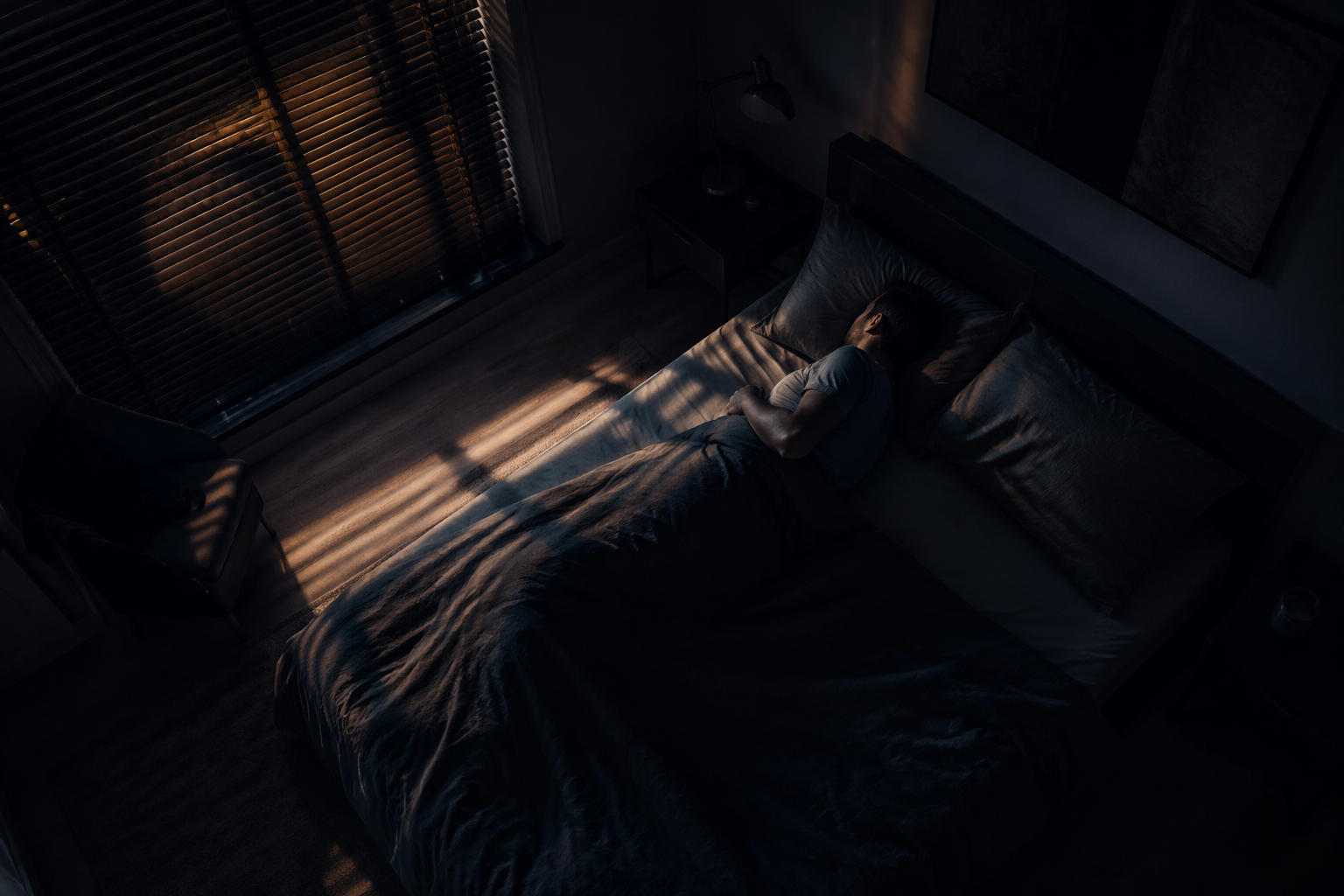
The Sleep Problem Starts Before Sleep
Sleep requires a temporary lowering of guard. Restraining order proceedings can ask for the opposite. You may be tracking hearing dates, service status, violations, documentation, custody exchanges, housing, phone settings, routes to work, who knows your address, or whether a single message should be saved, ignored, reported, or shown to counsel. Even if you are the person served with an order, the stakes can keep your body rehearsing consequences long after the courthouse closes.
At night, that load becomes physical. Hypervigilance can delay sleep onset, make ordinary sounds feel meaningful, and pull you awake during the lighter parts of sleep. Then the next day begins with less emotional bandwidth, worse concentration, and a more reactive threat system. Poor sleep does not just follow vigilance; it feeds it.
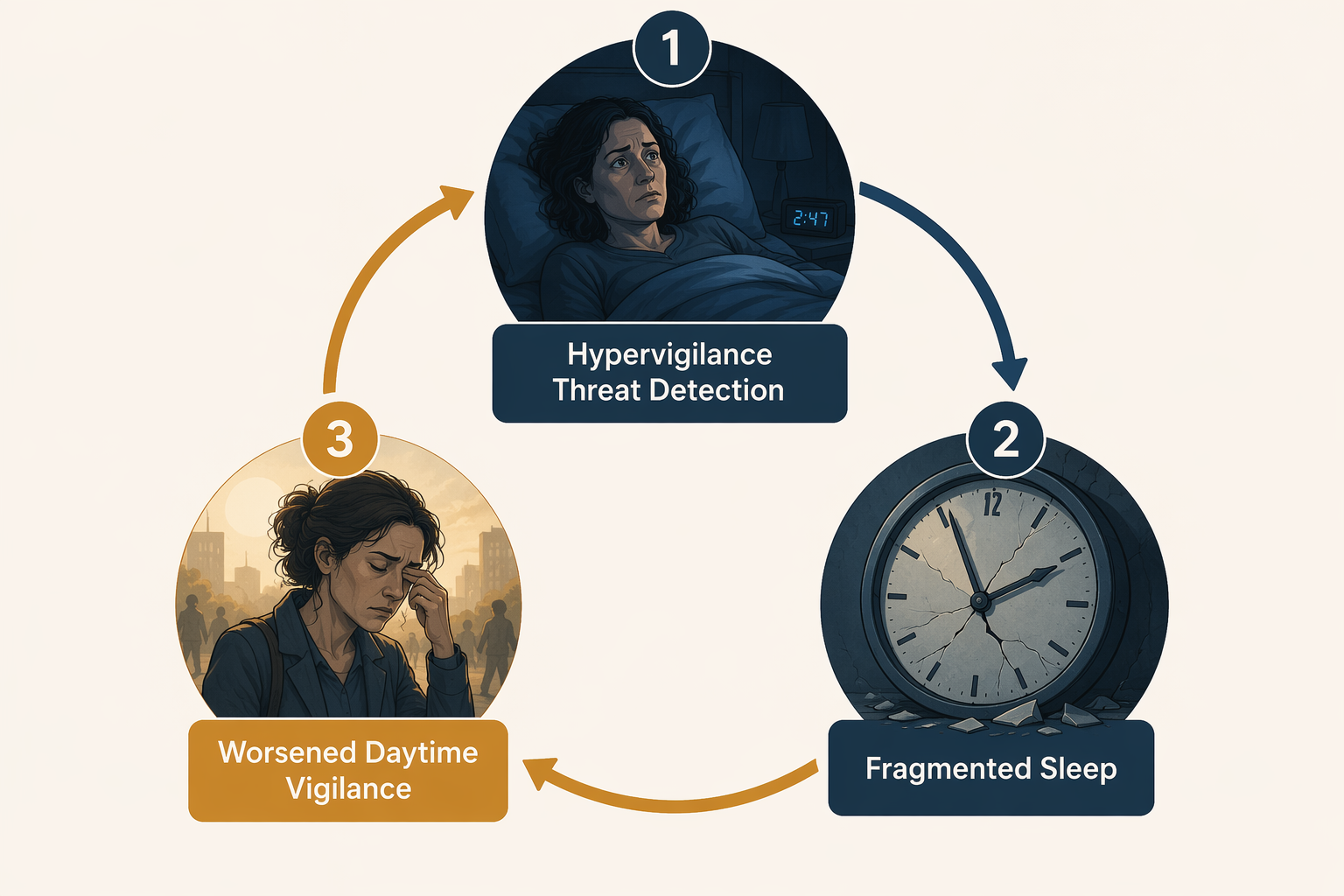
| Part of the loop | What it can feel like at night | What it can do the next day |
|---|---|---|
| Threat detection | Listening for sounds, checking locks, replaying interactions, watching the phone | More scanning, more irritability, more difficulty trusting quiet moments |
| Fragmented sleep | Waking repeatedly, sleeping lightly, having nightmares, feeling half-awake | Less regulation, more startle response, less ability to think through risk calmly |
| Daytime depletion | Going to bed already exhausted but still unable to stand down | The nervous system treats fatigue as one more reason to stay alert |
That loop matters because sleep deprivation weakens the very regulation people need when they are navigating a high-stakes legal and safety situation. Trauma-related hyperarousal is commonly tied to insomnia, with 63% to 70% of people with trauma-related hyperarousal describing insomnia as a significant problem, and sleep loss can worsen hypervigilance by making it harder for the prefrontal cortex to regulate amygdala-driven threat responses.[2]
Why the Bedroom May Stop Feeling Neutral
Generic sleep advice often treats the bedroom as if it is naturally safe and only needs a few improvements: dim the lights, put the phone away, keep the room cool. For someone navigating a restraining order, that assumption can be wrong.
If fear, monitoring, conflict, violence, unwanted contact, or urgent decision-making happened in the home, the bed can become linked with danger rather than rest. Learned insomnia models describe how the sleep environment can become conditioned to wakefulness and arousal instead of sleep; in this context, the association may be sharper because the room is not merely “where I worry,” but “where I learned I might not be safe.”[2]
That is why “make your bedroom a sanctuary” can land badly. A sanctuary is not made by declaring it one. If the body has learned that the bedroom is a place to listen, brace, hide, document, or stay ready to leave, scented lotion and a calming playlist may not touch the actual problem. In some cases, they may even make the person feel more trapped: now the room is supposed to feel peaceful, and it still does not.
The more useful goal is narrower and more honest: reduce the danger cues your body has to process at bedtime, and add visible safety cues that do not interfere with a real safety plan. The same principle shows up in other threat-related sleep problems, such as earthquake anxiety, where the goal is not pretending risk has disappeared but giving the body fewer reasons to stay in fight-or-flight. See How to Sleep With Earthquake Anxiety Tonight for a related safety-cue approach.
The Best Direct Evidence Comes From Protection Order Petitioners
One of the most relevant studies did not look at sleep in the abstract. Pigeon and colleagues studied 121 women filing for protection orders in a New York family court. In that sample, 46% met criteria for clinically significant insomnia, 32% met criteria for nightmare disturbance, and 53% had some form of insomnia: 24.1% mild, 19.0% moderate, and 9.9% severe.[3]
The most common insomnia subtype was middle-of-the-night insomnia, reported by 57% of participants.[3] That detail is important. This is not only the familiar problem of lying awake at the start of the night. It is also the body surfacing again and again after sleep begins, as if it cannot safely hand over the night.
The same study found that insomnia was associated with an 8.64-fold increased risk of depression, independent of PTSD and abuse severity.[3] That does not mean insomnia alone caused depression in those women. It does mean sleep disruption was not a minor side effect that disappeared once researchers accounted for other trauma-related factors. It carried its own signal.
The study has boundaries. It came from a single family court in New York State, had a 50% response rate, and retained 64% of participants.[3] It also studied women filing for protection orders, so it should not be stretched to describe every petitioner, every respondent, or every restraining order context. Still, it gives a grounded picture of what many people already know from their own nights: legal protection and physiological sleep safety are not the same thing.
The Legal Process Can Keep the Alarm System Running
A restraining order is not just an event. It can be a sequence: filing, service, temporary orders, hearings, evidence, testimony, cross-allegations, continuances, compliance concerns, violations, custody questions, workplace safety planning, housing decisions, and waiting. Waiting is not passive when the outcome changes where you can go, who you can contact, where your children sleep, or whether you feel believed.
Research on legal proceedings supports treating the justice system itself as a stressor. Clemente and Padilla-Racero found measurable mental health deterioration among people involved in legal proceedings, including both plaintiffs and defendants, with longer exposure associated with greater health decline.[4] Their study was conducted in Spain and involved family law civil proceedings, so it should not be treated as a one-to-one map of the U.S. restraining order process. The psychological point still matters: legal exposure can extend the stress window.
That helps explain why sleep may worsen around court dates or after paperwork is filed. Testimony can require reliving events. Uncertainty can keep the brain rehearsing possible outcomes. Documentation can mean looking again at messages, photos, incidents, or timelines that the body would rather avoid. If you are defending against an order, fear of missteps, contact restrictions, reputation damage, housing disruption, employment consequences, or parenting limitations may keep the same threat system activated.
Legal practitioners also describe emotional turbulence around restraining orders, including relief mixed with guilt, confusion, dread, and anxiety about future hearings.[5][6] Those descriptions are useful context, not the same thing as peer-reviewed evidence. They do, however, name something that often shows up at bedtime: the mind starts cross-examining the day when the room finally gets quiet.
When Standard Sleep Hygiene Backfires
Standard sleep hygiene is built for relatively ordinary insomnia. It assumes the main obstacles are habits, stimulation, caffeine, inconsistent schedules, and unhelpful bedtime routines. Those can still matter. But they are not enough when the obstacle is active threat monitoring.
A person who is worried about contact, retaliation, court consequences, or safety cannot simply be told to stop checking the phone. That phone may hold evidence, emergency contacts, violation documentation, attorney messages, childcare coordination, or alerts from trusted people. A person who checks locks repeatedly may not be “irrational”; they may be trying to create enough certainty to lie down. A person who sleeps with lights on may be choosing orientation over darkness.
The adjustment is not to shame the behavior. It is to separate safety-relevant actions from fear loops. A safety-relevant action has a clear purpose and endpoint: confirm the door is locked once, place the phone where it can be heard, save necessary documentation, make sure keys and essentials are accessible. A fear loop keeps expanding: re-reading everything, checking the same lock many times, scanning social media, imagining testimony until the body is fully awake.
| Before bed, ask | If yes | If no |
|---|---|---|
| Does this action improve immediate safety or preserve important information? | Do it deliberately and once if possible. | Do not give it the authority of a safety task. |
| Can I define when this action is complete? | Write down the endpoint or say it out loud. | Move it to a daytime planning window if it is not urgent. |
| Will delaying this create real risk tonight? | Keep it inside the safety plan. | Let it wait; the night does not need another courtroom. |
What Helps a Threat-Sensitive Nervous System Stand Down
The aim is not to convince yourself everything is fine. That can feel false and, in some situations, unsafe. The aim is to help the body distinguish between a real safety task and an alarm that has no new information.
Use visible safety cues before relaxation cues
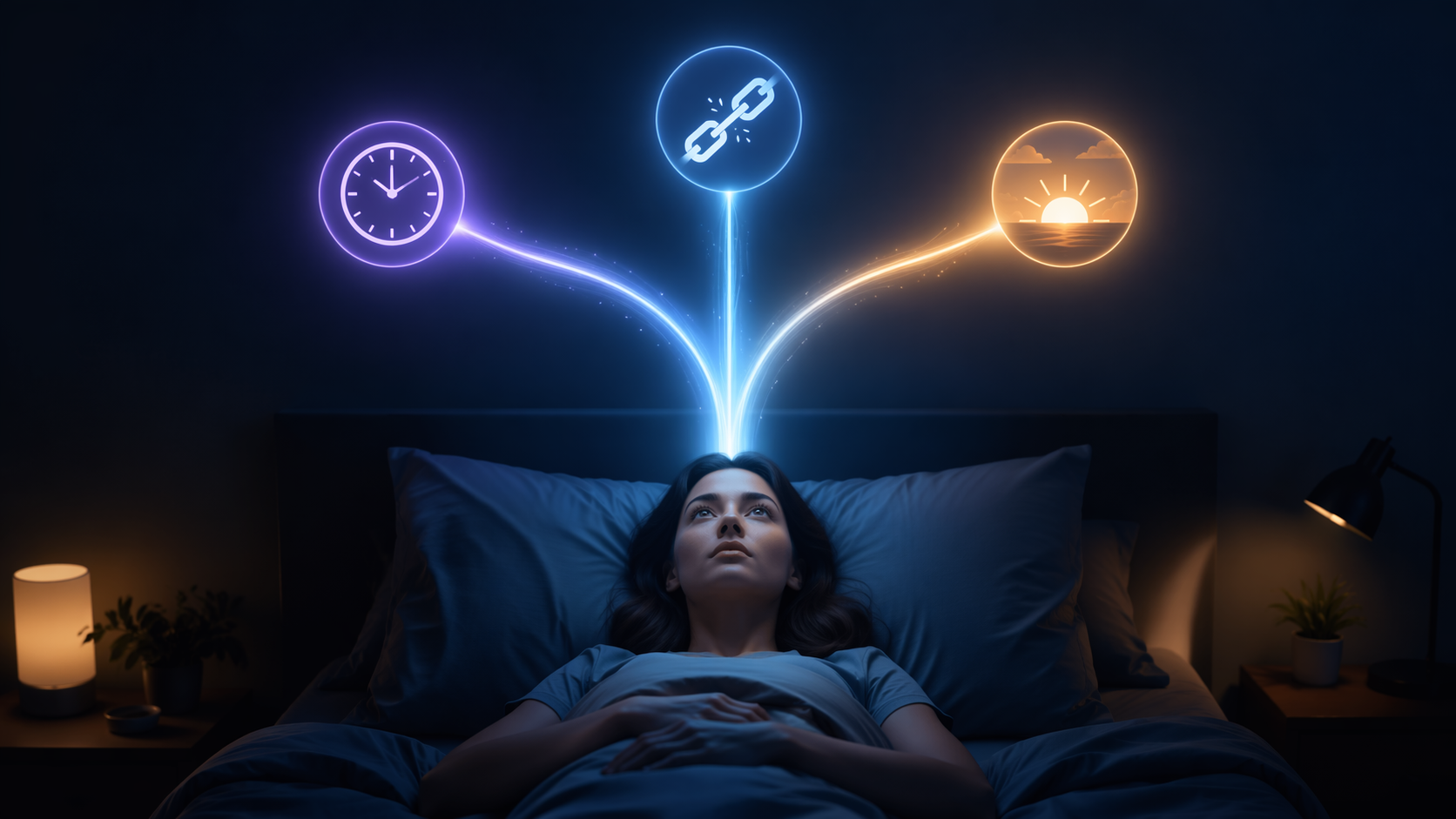
A visible safety cue is something your body can verify without restarting the entire threat scan. It might be a locked door you check once, a charged phone placed within reach, a small bag with essentials in a known spot, a written plan for who to call, or a note that says “door checked, phone charged, next legal task is tomorrow at 10.” The exact cue depends on your situation. The point is that the cue answers the body’s safety question before you ask it to relax.
For some people, this also means changing the sleep location or the room setup for a while. That does not have to be dramatic. Facing the door, adding a low light, moving the bed, sleeping in a different room, or staying with someone trusted may reduce enough scanning for sleep to start. If a change increases exposure risk or violates a court order, it is not a sleep strategy; it is a safety problem to address with qualified help.
Contain legal thinking without pretending it is optional
Court-related thoughts often surge at night because daytime structure falls away. A containment practice can help if it respects reality. Set a specific earlier window for legal and safety administration: messages, documentation, questions for counsel, schedule checks, transportation planning, childcare logistics, or support calls. End that window by writing the next concrete step and when it will happen.
At night, the phrase is not “I won’t think about this.” It is more practical: “This has a place, and that place is already scheduled.” If a genuinely urgent safety issue appears, respond to it. If the thought is a replay, prediction, or self-interrogation, point it back to the scheduled container.
Treat nightmares and awakenings as part of the injury, not a personal failure
Nightmares were not rare in the protection-order study: 32% of participants met criteria for nightmare disturbance.[3] Waking after a nightmare and immediately scanning the room is a nervous system doing what it learned to do. The response should be simple and repetitive: orient to the present room, name the date, notice where the exits are, confirm the chosen safety cue, and avoid turning the awakening into a full case review.
If nightmares are frequent, violent, or tied to trauma memories, this is worth bringing to a trauma-informed clinician. It is also worth mentioning sleep directly, not only anxiety. The Pigeon study’s depression-risk finding is one reason to be precise: sleep disturbance in this context deserves clinical attention in its own right.[3]
Use CBT-I, but adapt it for trauma and safety
Cognitive behavioral therapy for insomnia, or CBT-I, is often the first-line behavioral treatment for chronic insomnia. In a restraining order context, it should be trauma-adapted. That means the clinician does not treat all nighttime checking as a bad habit, does not require darkness if darkness increases fear, and does not push sleep restriction in a way that worsens dissociation, driving safety, caregiving, or legal functioning.
A trauma-adapted approach can still use CBT-I tools: a steadier wake time, reducing time spent awake in bed when safe to do so, rebuilding the bed-sleep association, and working with catastrophic sleep thoughts. The difference is sequencing. Safety cues come first. Then the sleep intervention has a chance to work.
If Anxiety Turns Into Crisis
Sleep disruption can sit inside a larger risk picture. A 2025 study using a Chinese national sample examined links among family and domestic violence, sleep disturbance, anxiety, and suicidal and self-harm ideation; because the sample and cultural context differ from U.S. restraining order proceedings, it should be read as supporting evidence for a broader pathway rather than a direct estimate for this reader.[7] The practical takeaway is still serious: if sleep loss is combining with fear, despair, panic, or thoughts of self-harm, do not treat it as a private willpower problem.
If you are in immediate danger, call 911 or your local emergency number. If domestic violence or coercive control is part of your situation, the National Domestic Violence Hotline is available at 800-799-7233. If you are thinking about harming yourself or need urgent emotional support, text HOME to 741741 to reach Crisis Text Line.
This article is not legal advice. Court orders, contact rules, custody terms, firearm restrictions, housing decisions, and documentation choices need qualified legal guidance. Sleep advice should never ask you to ignore a credible safety risk or violate an order.
A Small Safety-First Night Plan
The plan should be boring enough to repeat. At night, novelty often wakes the alarm system back up.
- Choose one safety check with an endpoint: door, phone, documents, route, medication, child-related item, or another situation-specific need.
- Create one visible cue that the check is complete: a note, a placed object, a phone setting, a packed essential item, or a written next step.
- Move nonurgent legal thinking into a daytime window and write down the next action so your brain does not keep assigning it to bedtime.
- If you wake in the night, orient first: name where you are, the date, what has already been checked, and what would count as a real reason to act.
- If insomnia, nightmares, panic, depression, or self-harm thoughts are escalating, involve a trauma-informed clinician or crisis resource rather than trying to outlast it alone.
For people navigating restraining order proceedings, that evidence often has to be built in two places at once: in the nervous system’s arousal pattern and in the room where sleep is supposed to happen.
References
- Hypervigilance in PTSD and other disorders, Verywell Mind
- Hypervigilance and sleep: breaking the cycle of restlessness, ANCSleep
- Sleep disturbances and their association with mental health among women exposed to intimate partner violence, Journal of Women's Health, 2011
- The effects of the justice system on mental health, Psychiatry, Psychology and Law, 2020
- Restraining order emotional impact, LLG National Law Group
- Restraining order impact, Wolf Law
- Association among family and domestic violence, sleep disturbance, anxiety, suicidal and self-harm ideation, 2025
Comments
Join the discussion with an anonymous comment.