
The Cost Confusion Problem
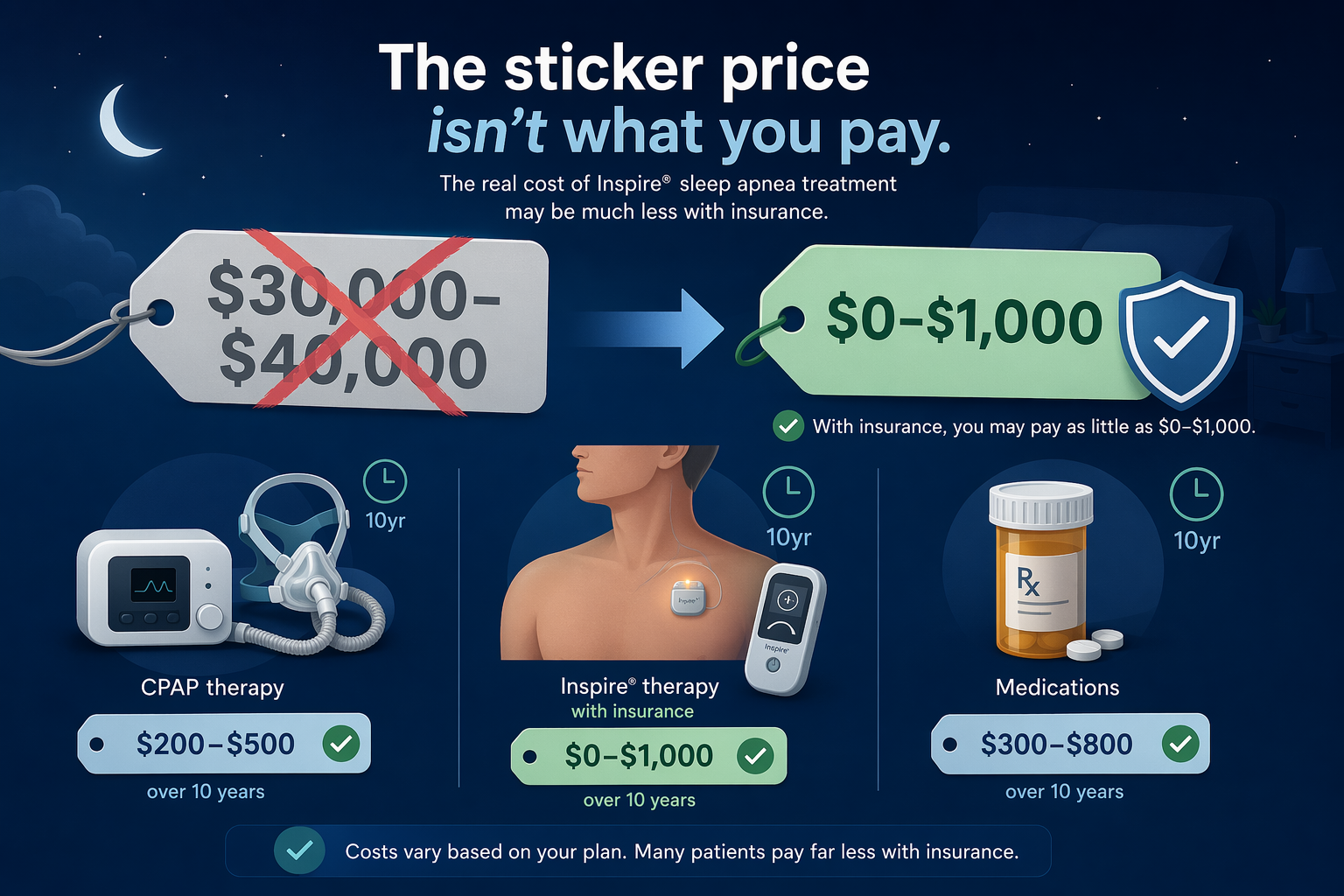
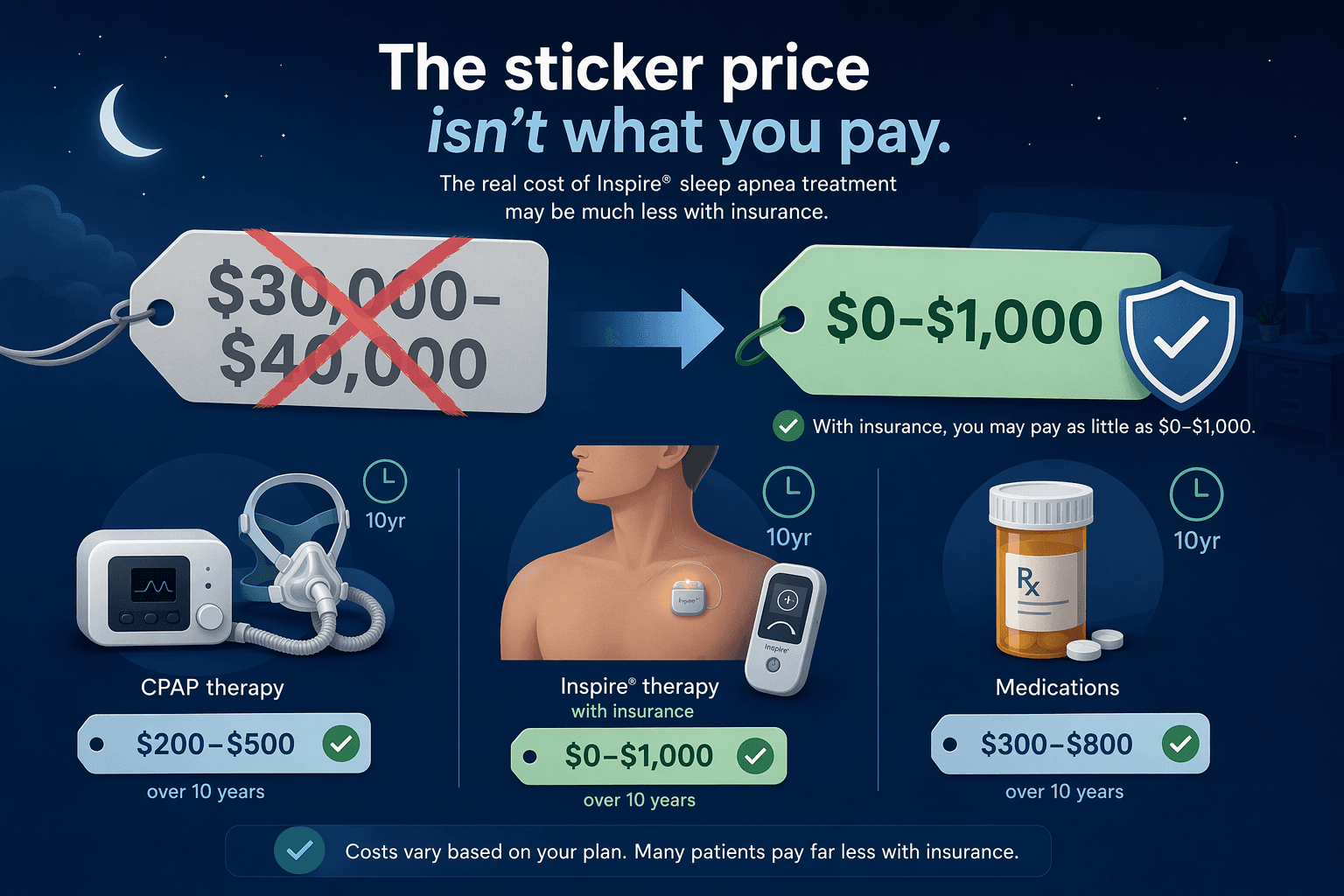
If you have moderate-to-severe obstructive sleep apnea and have struggled with CPAP, you have likely heard about the Inspire implant. You have also likely seen the price tag: $30,000 to $40,000. That number stops most people cold. It sounds like a second mortgage, not a medical procedure.
Here is the problem with that sticker price: it is almost never what insured patients actually pay. The official Inspire cost page reports that many eligible patients end up paying between $0 and under $1,000 out-of-pocket after insurance. The gap between the list price and the real cost is enormous, and understanding why that gap exists is the key to making an informed decision.
This article breaks down the full financial picture of Inspire therapy. You will learn exactly where the $30,000–$40,000 goes, what insured patients typically pay by insurance type, the four variables that determine your specific out-of-pocket cost, and the long-term expenses that are easy to overlook. By the end, you will have a clear framework for getting a personalized cost estimate before you commit to anything.
Sticker Price Breakdown: Where the $30,000–$40,000 Goes
Before we talk about what you will pay, it helps to understand what the total cost actually covers. The $30,000–$40,000 figure is not a single charge — it is an aggregate of several distinct components, each billed separately.
- The device itself: The Inspire implantable pulse generator and the stimulation lead account for roughly $20,000 to $25,000 of the total. This is the hardware that is surgically placed under the skin of the chest.
- Surgeon fees: The ENT surgeon who performs the implantation charges a professional fee, typically several thousand dollars.
- Hospital or surgical center fees: The facility where the procedure is performed charges for the operating room, nursing staff, equipment, and recovery. These fees vary significantly depending on whether the procedure is done at a hospital outpatient department or an independent surgical center.
- Anesthesia: The anesthesiologist or nurse anesthetist bills separately for their services during the procedure.
These four components are negotiated separately between each provider and your insurance company. That is why the final allowed amount — the price your insurance actually pays — can be dramatically lower than the billed charges. The device alone is priced at roughly $20,000, but the negotiated rate with an insurer may be far less.
Sources vary on the exact breakdown. Verywell Health reports the device cost at about $20,000, while North Mississippi Health Services puts the device cost at approximately $25,000. The total procedure cost (device plus hospital and doctor fees) ranges from $30,000 to $40,000. The Doctronic blog estimates a higher total of $40,000–$60,000, with the device at $30,000–$45,000 and surgery at $10,000–$15,000. These differences reflect geographic variation and different billing methodologies.
What Insured Patients Actually Pay: Real-World Examples
Inspire's official cost page shares patient ambassador examples to illustrate the range of out-of-pocket costs. These are self-reported and may not be representative of every patient's experience, but they demonstrate that many eligible patients pay far less than the sticker price.
- Lisa G. (age 59, BMI 28, BCBS, Arizona): Paid $0 out-of-pocket.
- Nathan U. (age 39, BMI 36, Tricare, Tennessee): Paid $0 out-of-pocket.
- Nancy H. (age 66, BMI 27, Medicare supplement Part G, Florida): Paid $0 out-of-pocket.
- Suzanne H. (age 51, BMI 34, BCBS, California): Paid less than $1,000 out-of-pocket.
These examples span different insurance types — commercial plans (BCBS), Tricare, and Medicare with a supplemental plan — and different states. The common thread is that all four patients met the eligibility criteria and had coverage that significantly reduced their financial exposure.
Detailed Insurance Breakdown: Medicare, Commercial, and VA/Tricare
Insurance coverage for Inspire therapy varies significantly by payer type. Understanding how your specific insurance handles the procedure is the single most important step in estimating your out-of-pocket cost.
Medicare Part B
Medicare Part B covers Inspire therapy for eligible patients. According to SleepApnea.org, the eligibility criteria for Medicare coverage include: moderate to severe OSA (AHI 15–100), documented CPAP intolerance or failure, BMI less than 35, and no complete concentric collapse on a drug-induced sleep endoscopy (DISE).
For 2026, the Medicare Part B deductible is $283. After the deductible is met, you pay 20% coinsurance on the Medicare-approved amount. The average patient cost varies significantly by facility type:
- Hospital outpatient department: Average patient cost of $1,839.
- Outpatient surgical center: Average patient cost of $5,329.
The large difference between hospital and surgical center costs is due to different Medicare payment rates. Hospital outpatient departments are generally more expensive because they include facility fees and higher overhead. Working with a provider who "accepts assignment" — meaning they agree to accept the Medicare-approved amount as full payment — can lower your out-of-pocket costs.
If you have a Medicare supplement plan (Medigap), your out-of-pocket costs may be even lower or zero, as demonstrated by the patient ambassador example of Nancy H. who paid $0 with a Medicare supplement Part G plan.
Commercial Insurance Plans
Most commercial insurance plans cover Inspire therapy for eligible patients. The official Inspire cost page states that over 300 million people are covered by plans that include Inspire. However, the specific coverage terms vary by plan.
Typically, commercial plans cover 70–80% of the allowed amount after you meet your deductible. This means your out-of-pocket cost depends heavily on:
- Your annual deductible: If you have not met your deductible, you may owe the full negotiated rate for the procedure until the deductible is satisfied.
- Your coinsurance or copay: After the deductible, you typically pay 20–30% of the allowed amount until you reach your out-of-pocket maximum.
- Your out-of-pocket maximum: Once you hit this limit, the insurance pays 100% for the rest of the plan year.
The patient ambassador examples of Lisa G. ($0 with BCBS) and Suzanne H. (less than $1,000 with BCBS) show that commercial coverage can result in very low out-of-pocket costs, especially if the procedure is done after the deductible is met and within the same plan year.
VA and Tricare
The Department of Veterans Affairs (VA) and Tricare (military health insurance) both cover Inspire therapy. The patient ambassador example of Nathan U. (Tricare, Tennessee) shows $0 out-of-pocket. VA coverage may also result in $0 out-of-pocket for eligible veterans, though specific costs depend on the individual's VA priority group and facility.
| Insurance Type | Typical Out-of-Pocket Range | Key Variables |
|---|---|---|
| Medicare Part B (no supplement) | $1,839 (hospital) to $5,329 (surgical center) | $283 deductible, 20% coinsurance, facility type, provider assignment |
| Medicare Part B + Medigap | $0 to $1,000 | Supplement plan type, deductible status |
| Commercial insurance (e.g., BCBS) | $0 to $1,000 (common examples) | Deductible status, coinsurance rate, out-of-pocket maximum, network status |
| VA / Tricare | $0 (common) | VA priority group, Tricare plan type |
The Four Key Cost Drivers (and the Questions You Need to Ask)
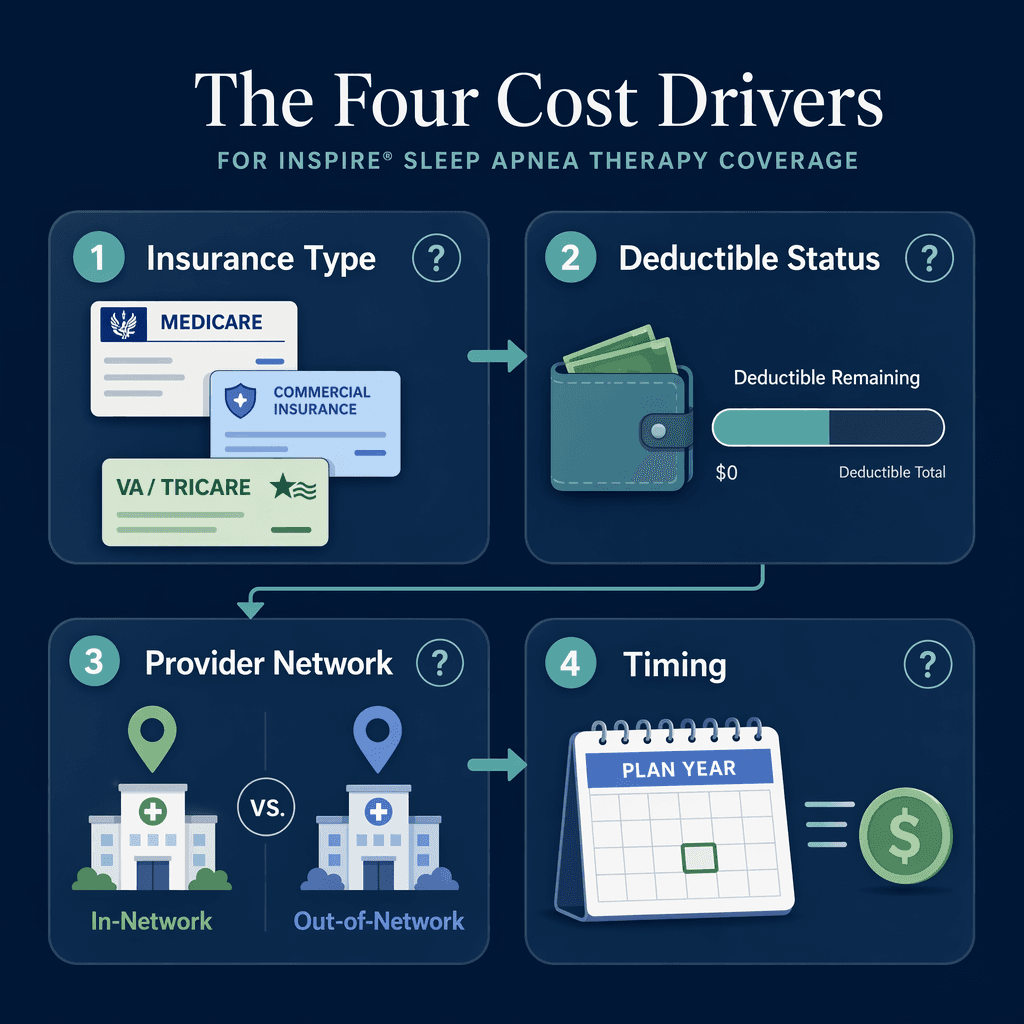
Your actual out-of-pocket cost for Inspire therapy is determined by four variables. Understanding each one — and asking the right questions — can prevent bill shock.
1. Insurance Type
As detailed above, Medicare, commercial plans, VA, and Tricare all cover Inspire, but the cost-sharing structure differs. Medicare uses a deductible plus 20% coinsurance. Commercial plans vary widely. VA and Tricare often result in $0 out-of-pocket.
Ask your insurance: "Does my specific plan cover Inspire therapy for sleep apnea? What are the prior authorization requirements?"
2. Deductible Status
If you have not met your annual deductible, you may owe the full negotiated rate for the procedure until the deductible is satisfied. For Medicare, the 2026 Part B deductible is $283. For commercial plans, deductibles can range from $500 to $5,000 or more.
Ask your insurance: "Have I met my deductible for this plan year? How much of the Inspire procedure will apply toward my deductible?"
3. Provider Network Status
Using an in-network surgeon, hospital, and anesthesiologist can dramatically reduce your out-of-pocket costs. Out-of-network providers may not be covered at all, or may result in higher coinsurance and balance billing.
Ask your provider's billing office: "Are the surgeon, the hospital/surgical center, and the anesthesiologist all in-network with my insurance plan?"
4. Timing Within the Plan Year
If you schedule the procedure early in the plan year, you may owe the full deductible and coinsurance. If you schedule it later in the year — after you have already met your deductible and possibly your out-of-pocket maximum — your cost could be much lower.
Ask yourself: "Have I already met my deductible or out-of-pocket maximum this year? If not, can I wait until later in the plan year to schedule the procedure?"
Pre-Operative Costs: Sleep Studies and DISE
Before you can receive the Inspire implant, you need to complete a diagnostic workup to confirm eligibility. These pre-operative evaluations add $2,000 to $5,000 to the total cost, though they are typically covered by insurance as part of the diagnostic process.
- Diagnostic sleep study: You will need a recent in-lab polysomnogram to confirm your AHI and rule out other sleep disorders. If you have not had one in the past year, you may need a new study.
- Drug-induced sleep endoscopy (DISE): This is a critical eligibility test. During a DISE, you are sedated and the surgeon uses a small camera to examine your airway. The test determines whether you have complete concentric collapse of the airway — a condition that makes Inspire ineffective. If you have complete concentric collapse, you are not a candidate for Inspire.
The DISE procedure is typically covered by insurance as part of the pre-operative evaluation, but you should confirm coverage with your plan. Some patients may need to pay a copay or coinsurance for these tests.
Long-Term Costs: Battery Replacement, Follow-Ups, and Remote
The upfront cost of Inspire therapy is only part of the financial picture. The device has a finite battery life, and there are ongoing costs for follow-up care and equipment replacement.
Battery Replacement Surgery
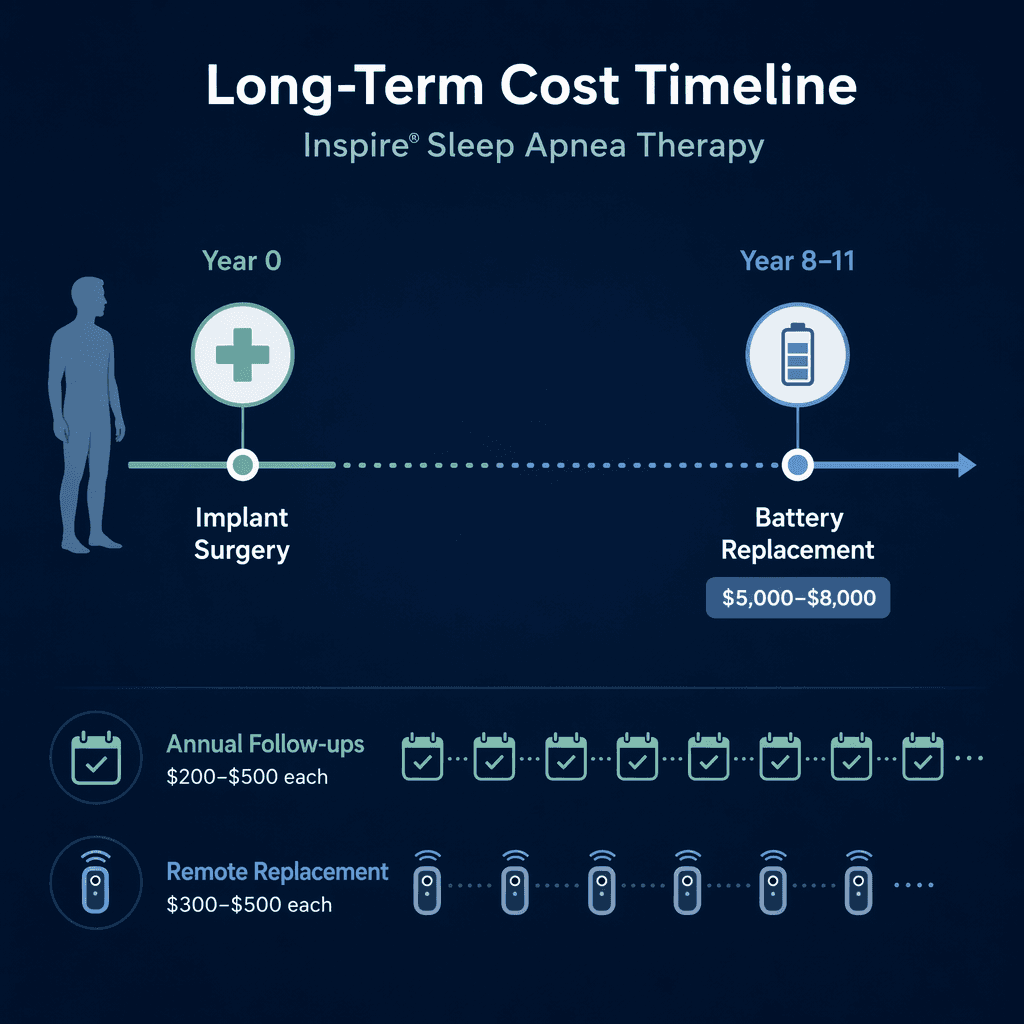
The Inspire device is powered by a non-rechargeable battery that is implanted under the skin. The battery life is designed to last 7 to 11 years, depending on the source. SleepApnea.org states the battery needs replacement every 7 to 10 years. North Mississippi Health Services reports a design life of 9 to 11 years. The Doctronic blog estimates 8 to 11 years.
When the battery runs out, you need a replacement surgery. This is a less invasive procedure than the initial implantation — the surgeon makes a small incision, replaces the pulse generator, and closes the incision. The cost for battery replacement surgery is estimated at $5,000 to $8,000.
Annual Follow-Up Visits
After the initial implantation and programming, you will need annual follow-up visits to monitor your progress and adjust the device settings if needed. These visits typically cost $200 to $500 each, depending on your insurance coverage and whether the provider is in-network.
Remote Control Replacement
You use a handheld remote control to turn the device on and off and adjust the stimulation level. If the remote is lost, damaged, or needs replacement, a new one costs approximately $300 to $500.
| Cost Category | Estimated Cost | Frequency |
|---|---|---|
| Initial procedure (device + surgery) | $30,000–$40,000 (list price) | One-time |
| Pre-operative evaluations (sleep study + DISE) | $2,000–$5,000 | One-time (before implant) |
| Battery replacement surgery | $5,000–$8,000 | Every 7–11 years |
| Annual follow-up visits | $200–$500 each | Annual |
| Remote control replacement | $300–$500 | As needed |
Cost Comparison: Inspire vs. CPAP vs. Oral Appliance vs. Medication
To put the cost of Inspire therapy in context, it helps to compare it against the other treatment options for obstructive sleep apnea. Each option has a different upfront cost, recurring expense profile, and long-term total.
| Treatment | Upfront Cost | Annual Recurring Cost | Estimated 10-Year Total (Before Insurance) |
|---|---|---|---|
| Inspire therapy | $30,000–$40,000 (list price) | $200–$500 (follow-ups) + battery replacement at year 8–11 ($5k–$8k) | ~$55,000 (Doctronic estimate) |
| CPAP | $300–$3,000 (machine + mask) | $300–$800 (supplies: masks, tubing, filters) | ~$8,500 |
| Oral appliance | $1,800–$2,000 | Minimal (replacement every 3–5 years) | ~$2,500–$4,000 |
| GLP-1 medication (Zepbound/tirzepatide) | $299–$450/month | $3,588–$5,400/year | ~$36,000 |
CPAP is by far the least expensive option upfront. A CPAP machine costs $300 to $1,000 or more, and masks should be replaced every 3 months ($85–$165 each). Mask cushions need replacement every 2–4 weeks ($40–$70). Heated tubing ($25–$60) and standard tubing ($10–$35) should be replaced every 3 months. Reusable filters cost $5–$10 every 6 months, and disposable filters cost $4 every 2–4 weeks. Over 10 years, the total cost of CPAP is roughly $8,500.
However, cost is not the only factor. Almost 50% of CPAP users cannot tolerate it long-term. If CPAP is not working for you, the cost of continuing to use it is irrelevant — you need an alternative that you will actually use.
Oral appliances cost $1,800 to $2,000 upfront and have minimal recurring costs, making them a cost-effective alternative for mild to moderate OSA. GLP-1 medications like Zepbound (tirzepatide) are a newer option, with monthly costs of $299–$450, but they are primarily indicated for weight management and may not be covered for sleep apnea alone.
A 2015 cost-effectiveness analysis published in the journal SLEEP found that upper airway stimulation (Inspire) has a lifetime incremental cost-effectiveness ratio of about $40,000 per quality-adjusted life year (QALY), well within the accepted threshold of $50,000–$100,000/QALY. The analysis used STAR trial data showing 66% of patients achieving dramatic improvement or resolution. However, this analysis is now over a decade old and may not reflect current pricing or updated outcomes.
How to Get a Cost Estimate Before Committing
The most important step you can take is to get a personalized cost estimate before you schedule the procedure. Here is a step-by-step action plan:
- Contact your insurance company directly. Ask: "Does my specific plan cover Inspire therapy for obstructive sleep apnea? What are the prior authorization requirements?"
- Ask about your deductible status. "Have I met my deductible for this plan year? How much of the Inspire procedure will apply toward my deductible?"
- Confirm network status. "Are the surgeon, the hospital/surgical center, and the anesthesiologist all in-network with my plan?"
- Request a pre-determination of benefits. This is a written estimate from your insurance company that shows what they will pay and what you will owe. It is not a guarantee of payment, but it gives you a reliable estimate.
- Ask the provider's billing office for a cost estimate. They can often provide a detailed breakdown of the expected charges and what your insurance is likely to cover.
- Consider timing. If you have already met your deductible or out-of-pocket maximum this year, scheduling the procedure before the end of the plan year could result in much lower costs.
If you are still early in your diagnostic journey and have not yet confirmed that you have sleep apnea, start with our Sleep Apnea FAQ for an overview of symptoms, diagnosis, and treatment options. You can also read our comprehensive guide to obstructive sleep apnea for a deeper understanding of the condition and its treatment options.
Key Takeaways
- The $30,000–$40,000 sticker price for Inspire therapy is misleading. Most eligible insured patients pay $0 to $1,000 out-of-pocket after insurance.
- Your actual cost depends on four variables: insurance type, deductible status, provider network status, and timing within the plan year.
- Medicare Part B covers Inspire for eligible patients, with average patient costs of $1,839 at hospital outpatient departments and $5,329 at outpatient surgical centers (plus the $283 Part B deductible and 20% coinsurance).
- Long-term costs include battery replacement surgery every 7–11 years ($5,000–$8,000), annual follow-up visits ($200–$500 each), and potential remote replacement ($300–$500).
- CPAP has a lower upfront cost ($300–$3,000) but recurring expenses of ~$300–$800/year for supplies. However, nearly 50% of CPAP users cannot tolerate it long-term.
- Always get a personalized cost estimate from your insurance company and provider before committing to the procedure. Ask about prior authorization, deductible status, and network status.


Comments
Join the discussion with an anonymous comment.