
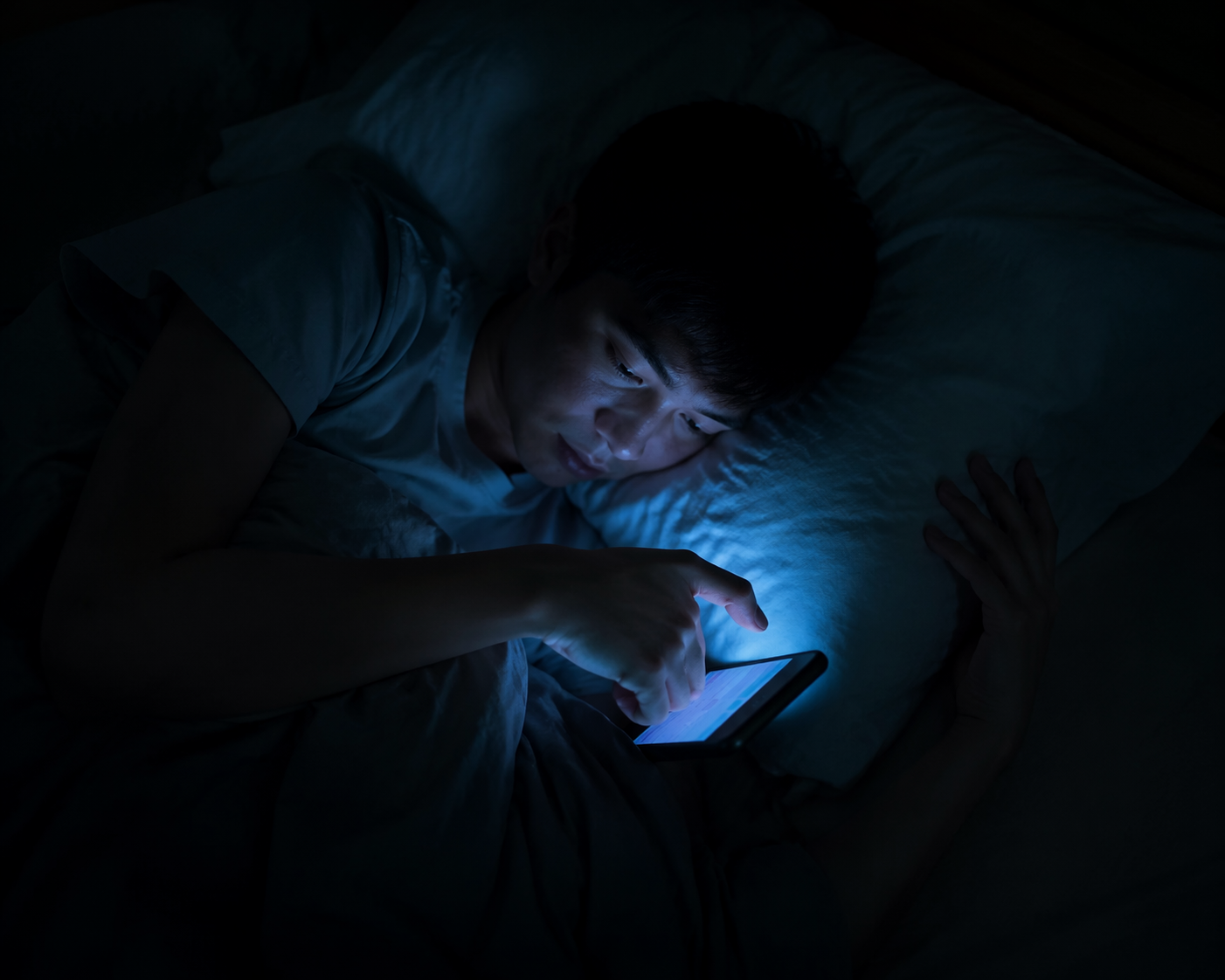
Thumb pain from phone use affecting sleep usually does not start as one clean problem. It starts in a familiar position: lying on your side or back, phone above the chest or beside the pillow, one hand doing most of the work, thumb reaching across the screen, wrist dipped, elbow folded. The hand finally stops moving when you try to sleep, and that is when the ache, tingling, or stiffness becomes harder to ignore.
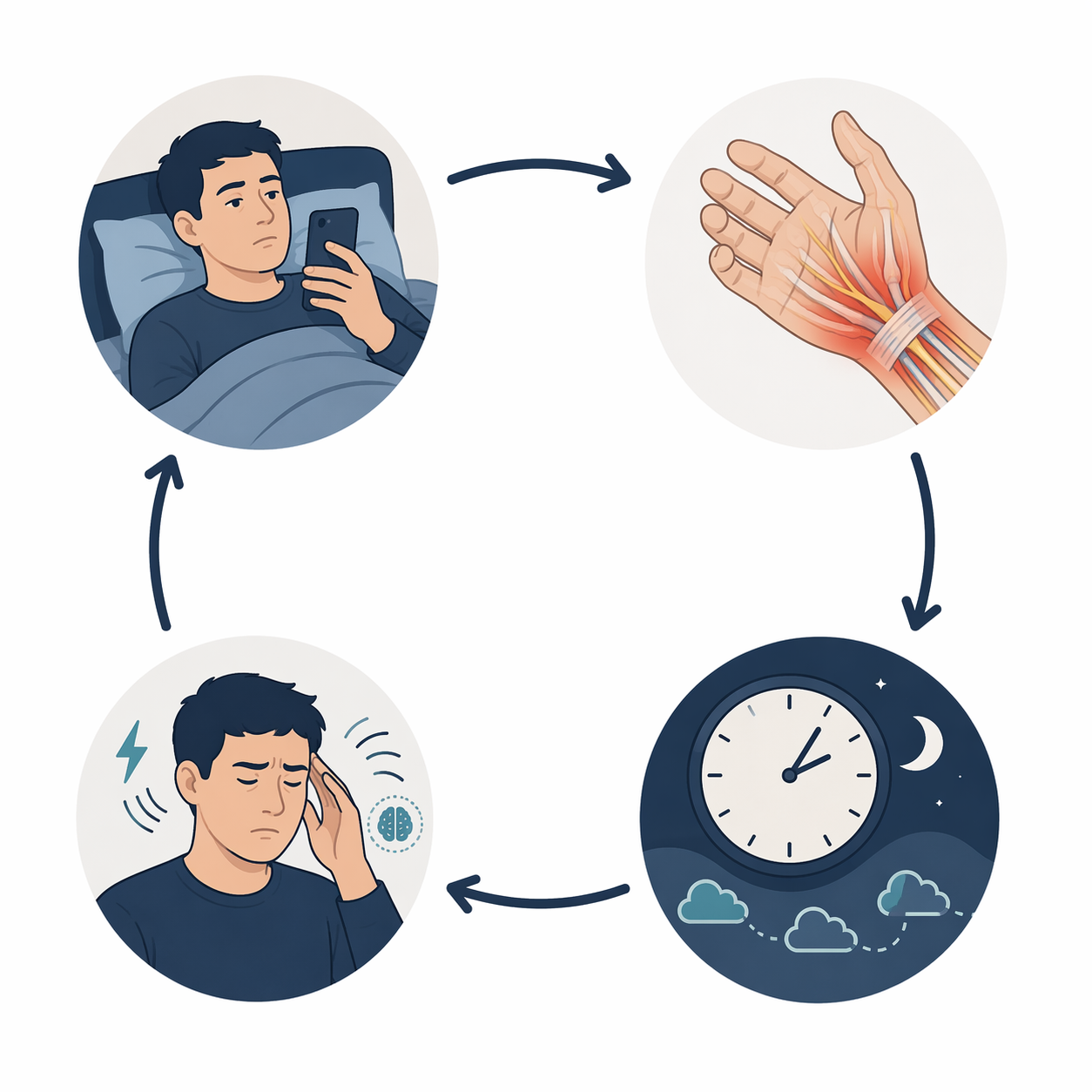
That timing can make the pain feel mysterious, but the loop is physical. Bedtime phone use can load the thumb tendons and wrist nerves at the same time it delays sleep. Pain then becomes more noticeable in the quiet of bed, and poor sleep can make the same discomfort feel sharper the next night. Wakefulness sends the hand back to the phone for distraction, and the same posture repeats.
In one general-population study of 811 smartphone users, 39.7% reported thumb or wrist pain, and using a smartphone for more than 5 hours a day was significantly associated with pain. The same study found that 90% of smartphone users with thumb pain used the phone while lying down, 42% kept the wrist bent downward in a maximally strained position, and 66.77% held the phone with one hand.[1] Those numbers do not prove that every aching thumb came from a phone, but they make the bedroom posture hard to dismiss.
Other populations point in the same direction without being interchangeable. A 2025 study of medical students reported texting thumb in 34% of participants.[2] A UK survey cited by TOI Health found that 43% of respondents had experienced thumb pain in the previous 5 years, but that figure is survey-based rather than a peer-reviewed prevalence estimate.[3] Taken together, the evidence is strongest as a pattern: heavy phone use, one-handed grip, and bent-joint positions often travel with hand symptoms.
The Nighttime Loop Starts Before the Pain Does
Scrolling in bed asks the thumb to do a job it was not built to do for long stretches: repeatedly reach, tap, flick, and stabilize the phone against the fingers. Active texting and scrolling are different from passively watching a video. A video may still involve a bent wrist or propped elbow, but rapid scrolling and typing add repeated thumb motion and grip force.
The tendons around the thumb can become irritated from that repetition, especially near the thumb base and wrist. At the same time, a flexed wrist can narrow space around the median nerve, and a deeply bent elbow can stress the ulnar nerve. The phone does not need to be heavy for this to matter; the problem is duration, angle, repetition, and the fact that the same small tissues keep doing the whole job.
Sleep is being pressured from the other side, too. Phone light is not the entire story, but it is part of it: blue light exposure can suppress melatonin and delay sleep onset.[4] The content itself also matters. A thumb that aches during an argument, a shopping comparison, a game, or an endless feed is attached to a nervous system that is still being asked to respond.
Once the phone goes down, the room gets quiet and the hand stops moving. Inflammation and nerve irritation that were easier to override while you were engaged become easier to feel at rest. If the discomfort keeps you awake, the phone is sitting within reach as the easiest available coping tool. That does not make the behavior irrational. It makes the loop efficient.
Where It Hurts Matters More Than the Label
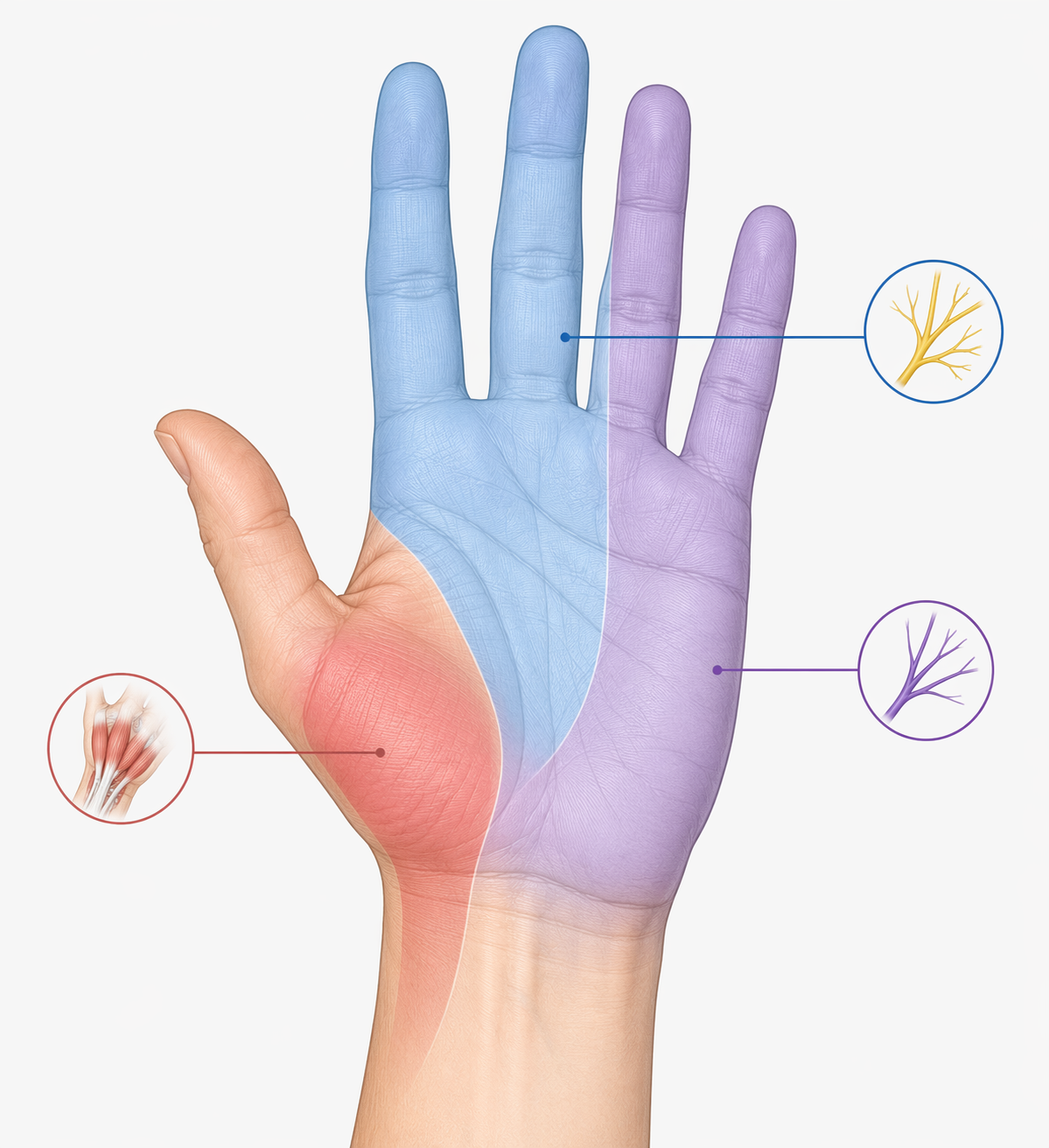
“Texting thumb” is useful shorthand, but it hides several different patterns. The distinction matters because thumb-base tendon pain, median nerve symptoms, and ulnar nerve symptoms call for different nighttime changes.
| What you notice at night | What it may suggest | Phone posture that can feed it |
|---|---|---|
| Aching or sharp pain near the thumb base or inner wrist | Thumb tendon irritation or a De Quervain’s-type strain | One-handed grip, repeated thumb scrolling, reaching across a large screen |
| Tingling or numbness in the thumb, index finger, or middle finger | Median nerve compression, similar to carpal tunnel symptoms | Wrist bent downward while holding the phone or sleeping with the wrist flexed |
| Numbness or tingling in the ring finger and pinky | Ulnar nerve irritation, similar to cubital tunnel symptoms | Elbow bent tightly while holding the phone or kept flexed during sleep |
Carpal tunnel symptoms commonly worsen at night because wrist-flexed sleep postures can narrow the carpal tunnel and increase pressure on the median nerve.[5] Cubital tunnel symptoms follow a different route: the ulnar nerve is vulnerable at the elbow, so a bent-elbow phone posture can become a nighttime numbness problem if the elbow stays flexed after the phone is put away.[6]
This is why a person can do the seemingly sensible thing—stop typing, set the phone down, close their eyes—and still feel worse. Stopping the motion does not instantly undo tendon irritation. Changing from phone posture to sleep posture may even keep the same nerve compressed.
Break the Loop at Both Ends
The cleanest first move is not a perfect digital detox. It is a 30-minute pre-bed phone curfew because it removes two loads at once: the mechanical load on the thumb and wrist, and the light and content load on sleep onset. If 30 minutes feels unrealistic, the useful version is still specific: choose a time when the phone stops being handheld in bed.
That distinction matters. Putting the phone on a bedside table but continuing to hold it until the last minute keeps the hand in the pattern. Moving the phone out of reach changes the motor habit. If you use the phone as an alarm, place it across the room. If you use it for audio, start the audio before bed and leave the screen down. If you need a wind-down replacement, choose something that does not require thumb repetition: a paper book, an audiobook, a breathing track, or a brief written list for tomorrow.
The curfew also makes the next decision clearer. If thumb pain drops when the phone leaves the bed, the hand was probably being irritated by the nighttime routine. If numbness still wakes you after the phone habit changes, the sleep posture or an underlying condition may be playing a larger role.
Match the Night Support to the Symptom Pattern
Splinting is most useful when it is matched to the anatomy. For pain at the thumb base or along the thumb-side wrist, a thumb spica splint can rest the thumb and reduce aggravating motion; Cedars-Sinai describes splinting as part of care for texting-thumb-type tendon problems.[7] For thumb, index, or middle-finger tingling, a neutral wrist splint aims to keep the wrist from folding during sleep. For ring-and-pinky numbness, the target is usually the elbow, not the wrist; Rush notes that cubital tunnel symptoms are tied to ulnar nerve pressure at the elbow.[6]
A cubital-tunnel-style night setup should limit deep elbow flexion rather than clamp the arm straight. Northwestern Medicine describes elbow splinting and phone-use changes among strategies for smartphone-related tendinitis and nerve irritation.[8] The goal is boring but important: make it harder to sleep in the same compressed position that the phone encouraged.
If You Still Use the Phone in Bed, Change the Job Your Thumb Is Doing
Some nights, the phone will still end up in bed. The harm-reduction version is to reduce grip force, thumb reach, and bent-joint time instead of pretending the habit will disappear immediately.
- Use two hands or switch to index-finger scrolling so the thumb is not doing every reach and flick.
- Use voice-to-text for longer messages; Kaiser Permanente includes voice input among ways to reduce texting strain.[9]
- Add a phone ring, strap, or grip if it lets you hold the device with less pinch force, but do not use it as permission to scroll longer.
- Prop the forearm on a pillow so the wrist can stay closer to neutral instead of hanging downward.
- Avoid lying with the elbow tightly folded under the head or pillow, especially if the ring finger and pinky go numb.
The medical-student study found that forearm support was associated with texting thumb, but that kind of association needs cautious reading: it may reflect the way students already using phones for long periods brace themselves, not proof that support alone causes the problem.[2] In practice, support helps only if it reduces strain rather than locking the wrist or elbow into another bad angle.
A Short Pre-Bed Hand Reset
A few minutes of hand movement before lights-out can help some readers downshift the hand from phone posture to sleep posture. It should feel gentle, not like a test of pain tolerance.
- Open the hand fully, then relax it. Repeat slowly several times.
- Do a thumb pull-away stretch: gently draw the thumb away from the palm and hold for 30 seconds, a stretch described in AP News guidance on texting and scrolling pain.[10]
- Move through tendon glides only within a comfortable range; Highbar Health describes tendon-gliding progressions for phone-related hand pain.[11]
- Try simple hand flips—palms up, palms down—rather than aggressive wrist bending; Kaiser Permanente includes this kind of movement in its advice for avoiding texting thumb.[9]
Stretching is not a cure for a nightly overload pattern. It works best as a transition: phone down, hands out of the gripping position, wrist and elbow placed neutrally for sleep.
When Pain Starts Shaping Sleep
There is a difference between noticing discomfort at bedtime and having pain reorganize your sleep. If the thumb ache mainly delays sleep onset, the first target is the pre-bed routine: less handheld phone time, less late content stimulation, and a calmer hand position before lights-out. If numbness or pain wakes you after you have fallen asleep, the problem has moved into sleep maintenance, and the position of the wrist, elbow, neck, and shoulder deserves more attention.
If you are not sure which pattern fits, it can help to separate sleep-onset trouble from middle-of-the-night waking. The insomnia-pattern guide on not being able to sleep is useful when pain has become part of the timing problem rather than a separate complaint.
Poor sleep can also make the next day’s pain harder to tolerate. That does not mean the pain is imagined. It means the nervous system has had less recovery, and the threshold for noticing discomfort is lower. The next night then begins with a more irritable hand and a stronger urge to use the phone for distraction.
When to Stop Self-Managing
Most people try to solve this themselves first. In the general-population smartphone study, only 13.66% of people with thumb or wrist pain sought medical treatment, while 81.68% made their own adjustments.[1] That makes sense for mild, recent discomfort, but self-management has limits.
Get medical advice if numbness wakes you from sleep, the thumb locks or catches, pain lasts more than 2 weeks despite changing the phone routine, or weakness makes you drop objects. Also be cautious if symptoms do not match your phone use, involve the neck or radiate down the arm, appear during pregnancy, or come with joint swelling and morning stiffness. Arthritis, cervical radiculopathy, pregnancy-related carpal tunnel, trigger thumb, and other conditions can overlap with phone-related pain.
Treating only the thumb while keeping the same bedtime phone pattern leaves the sleep side of the loop intact. Trying only to sleep earlier while ignoring tendon or nerve irritation leaves the hand to wake you back up. The useful reset is narrower and more honest: reduce the phone load before bed, protect the irritated structure at night, and escalate when numbness, locking, persistence, or an atypical pattern suggests this is no longer just a scrolling problem.
References
- Prevalence of Thumb and Wrist Pain Among Smartphone Users… — PMC10893880
- Prevalence of texting thumb among medical students… — BMJ Open, 2025
- Effects of Smartphones on our Fingers, Hands and Elbows — TOI Health
- Is Your Smartphone Hurting You? — CHI Health
- Is There a Link Between Hand Pain and Smartphone Use? — Yale Medicine
- Digital Discomfort: When Tech Hurts Your Hands — Rush
- Ask a Doc: 'Texting Thumb' Real? — Cedars-Sinai
- What Is 'Smartphone Tendinitis'? — Northwestern Medicine
- How to avoid texting thumb and other hand injuries — Kaiser Permanente
- One Tech Tip: How to soothe thumb pain when texting and scrolling — AP News
- A Clinician's Guide to Hand Pain From Holding a Phone — Highbar Health



Comments
Join the discussion with an anonymous comment.