
When leg pain wakes an athlete at night, the first useful question is not how bad it feels. It is what pattern it follows. A calf that locks into a hard knot asks for a different response than legs that feel unbearable at rest until you move them. Soreness that arrives after a hard session is not the same problem as diffuse pain that keeps escalating while sleep, mood, and performance slide.
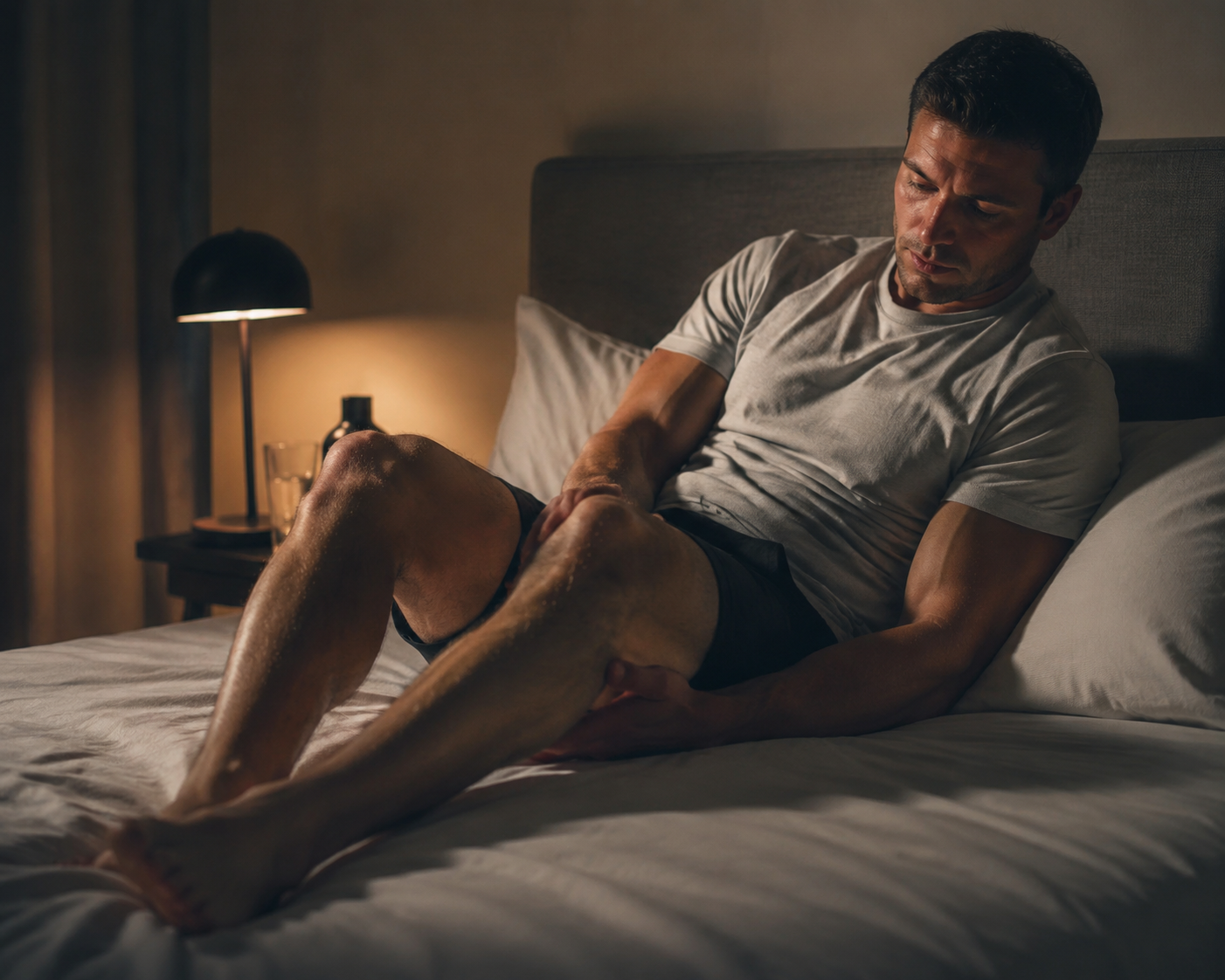
For athletes, leg pain sleep disruption usually falls into one of four buckets: nocturnal leg cramps, restless legs syndrome, delayed-onset muscle soreness, or overtraining-related pain. They can overlap in the same training season, but they do not behave the same way at 2 a.m.
| Nighttime pattern | What it most resembles | First response that fits the pattern |
|---|---|---|
| A sudden, tight, painful contraction; often calf or foot; the muscle may feel hard | Nocturnal leg cramp | Gently stretch the cramped muscle, then build a nightly calf and hamstring stretching routine |
| An urge to move the legs, worse at rest and in the evening; movement gives partial or temporary relief | Restless legs syndrome | Stop treating it like ordinary tightness; review triggers and consider clinical evaluation if it persists |
| Aching or tenderness after unusually hard, long, or new training; usually delayed rather than immediate | DOMS | Reduce load temporarily and protect sleep while the soreness runs its course |
| Worsening, diffuse, or persistent leg pain alongside poor recovery, sleep disruption, and declining training tolerance | Possible overtraining-related pain | Back off training and seek medical guidance if rest does not clearly improve it |
The cramp-versus-restlessness question
Cramps are usually easy to recognize once they fully declare themselves. The muscle contracts suddenly, tightens, and hurts. The athlete is not pacing because stillness feels intolerable; they are trying to get a locked muscle to release. Calves, feet, and hamstrings are common places to notice the problem.
Restless legs syndrome is different. The defining clue is an urge to move the legs, usually with uncomfortable sensations that begin or worsen during rest, are worse in the evening or night, and improve at least partly with movement. Cleveland Clinic describes these timing and relief patterns as central features of RLS, not side details.[1]
That distinction matters because many athletes respond to both problems with the same move: stretch harder. Stretching may help a cramp release. It may also feel briefly soothing with RLS because movement helps. But if the main issue is the urge-to-move pattern, repeated calf stretching is not addressing the condition that is waking you up.
Use the moment of relief as your clue. With a cramp, relief often comes when the contracted muscle lengthens and the spasm settles. With RLS, relief tends to come while you are moving, walking, shifting, or rubbing the legs, and the discomfort can return when you lie still again. That is why RLS often steals sleep in a more drawn-out way: not one sharp event, but repeated failed attempts to stay still long enough to fall asleep.
What to try first if it behaves like a cramp
During the cramp, the practical target is simple: lengthen the muscle without yanking it. For a calf cramp, that usually means pulling the toes toward the shin or standing carefully with the heel down. After the episode, the better question is whether the pattern is recurring often enough to justify a nightly prevention habit.
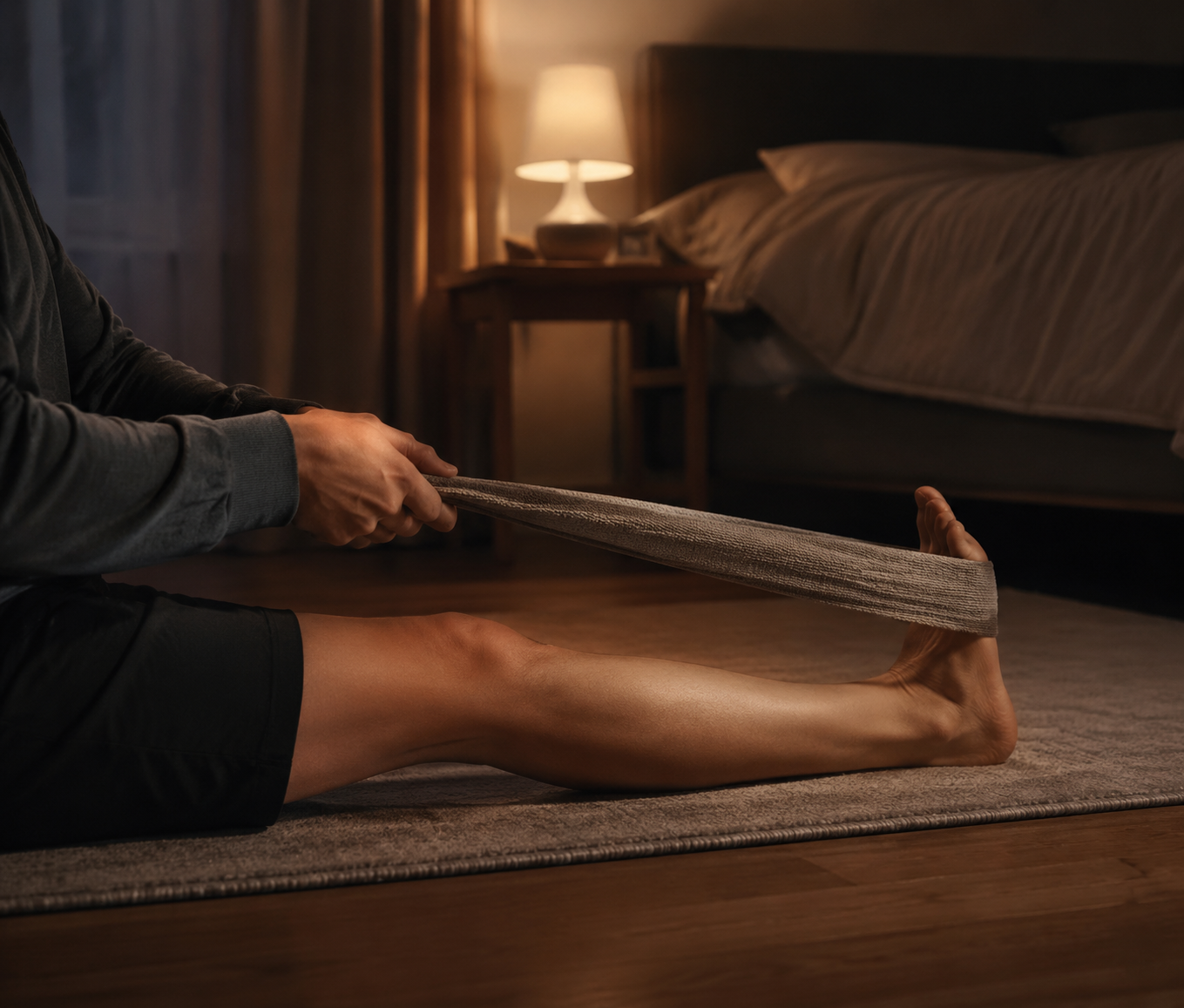
The American Academy of Sleep Medicine’s patient education site notes that daily calf and hamstring stretching before bed can reduce nocturnal cramp frequency after about six weeks of consistent practice.[2] The time frame is important. If you stretch for two nights and declare it useless, you have not really tested the intervention described.
Hydration advice also needs more precision than “drink more water.” In research summarized by the Gatorade Sports Science Institute, rehydrating with plain water after sweat loss of at least 2% of body mass made muscles more susceptible to electrically evoked cramps, while electrolyte-containing drinks reversed that effect. The same review reports that cramp-prone football players had higher sweat sodium concentrations and consumed more of their fluid as plain water.[3]
That does not prove every nighttime calf cramp is an electrolyte problem. It does mean an athlete who trains hard, sweats heavily, replaces fluid mostly with water, and then wakes with recurrent cramps should look at sodium-containing rehydration rather than simply increasing total water intake.
What to do if it behaves like restless legs
If the strongest clue is an urge to move at rest, treat that as a separate signal. RLS is not just “tight calves with a nervous system attached.” Mayo Clinic describes sensations such as crawling, pulling, throbbing, aching, itching, or electric feelings, with symptoms commonly occurring when someone is resting and often worsening at night.[4]
Athletes should pay attention to this pattern because RLS does not appear to be rare in sport. A study of runners reported an RLS prevalence of about 13%, compared with about 7% in the general population.[5] A sleep and athletic performance review also cites higher figures in endurance athletes, including 15.8% in cross-country skiers, while noting that sport, sex, training demands, and study methods can change the estimate.[6]
The runner who keeps getting out of bed to walk around may call it “tightness” because tightness is a familiar athletic word. But if walking is the thing that quiets the discomfort, and lying still reliably brings it back, the next step is not another aggressive mobility drill. It is to review common aggravators, medication and supplement use, iron status when clinically relevant, and whether the pattern meets RLS criteria with a clinician.
Soreness after training has a clock
Delayed-onset muscle soreness usually makes more sense when you place it on the training calendar. It follows a hard session, a new exercise, a return after time off, more eccentric work, a downhill run, higher volume, or intensity your legs were not ready to absorb. It tends to be tender, achy, and movement-related rather than a sudden knot or an urge to move.
DOMS can still wreck sleep. A lifter may be able to tolerate quad soreness all day, then find that every turn in bed pulls on the irritated tissue. A runner may be fine while walking around, then notice heavy, tender calves once the room is quiet. The fact that soreness is expected does not make the lost sleep irrelevant, especially if the next day’s plan assumes normal recovery.
The useful response is modest: reduce load, avoid stacking another hard leg session on top of the soreness, and make sleep easier to protect. That may mean moving a late workout earlier, choosing a lighter session, or adjusting the next day’s run rather than trying to erase soreness with gadgets. If the pain fits the training event and begins to fade as recovery catches up, it is behaving like ordinary soreness.
When soreness stops looking ordinary
Overtraining-related pain is the branch that deserves less patience. The clue is not one sore muscle after one ambitious workout. It is a broader recovery failure: legs that feel persistently painful or heavy, sleep that keeps fragmenting, performance that does not rebound, and training that starts to feel more expensive than it should.
Sleep and pain can push each other in the wrong direction. A 2026 scoping review on sleep disorders in high-level athletes reported that sleep restriction reduced pain threshold by about 8% in one cited study and that other studies found 5–10% increases in generalized pain; it also reported that poor sleep is associated with a two- to threefold increased risk of pain.[7] Those figures should not be stretched into a simple formula, but the practical message is hard to miss: once pain is repeatedly breaking sleep, the athlete may become more pain-sensitive the next night.
This is where “push through” becomes a poor sleep strategy. If pain is escalating, spreading, lasting beyond the expected recovery window, or arriving with unusual fatigue and declining training tolerance, the first move is to reduce training load. If rest does not bring clear improvement, medical evaluation is the safer next step.
Nighttime pain also matters because it can feed the broader sleep-injury loop. For a fuller look at that connection, see how poor sleep increases your risk of sports injury.
Why athletes are vulnerable at night
Athletes do not bring a neutral body to bed. Training loads the tissues, drains fluid and sodium, raises arousal, and compresses the recovery window. A review by Charest and Grandner reports that athletes average about 6.5 hours of sleep per night, below the commonly recommended seven to nine hours, and that 28–50% have poor sleep quality on the Pittsburgh Sleep Quality Index.[6]
Even training timing can matter. The same review reports that exercise within three hours of bedtime delayed melatonin secretion by about 30 minutes compared with morning or afternoon exercise.[6] That does not mean evening workouts are forbidden. It means a late hard session plus sore legs plus a shortened sleep window is not a mystery; it is a stacked deck.
Cramps are also not just a fringe complaint. The GSSI review notes that exercise-associated muscle cramps have been reported in up to 18% of marathon runners in a single event, while also warning that rates vary widely depending on definitions and assessment methods.[3] The exact number is less important than the pattern: endurance and high-sweat athletes have enough cramp exposure that nighttime episodes deserve a specific history, not a shrug.
A narrower decision rule for tonight
- If the muscle suddenly locks, hardens, and releases with stretching, treat it like a cramp: gentle acute stretching, then consistent bedtime calf and hamstring stretching, plus smarter electrolyte replacement if sweat losses are high.
- If the main problem is an urge to move that worsens at rest and improves while moving, treat it like possible RLS: stop chasing it as simple tightness and consider clinical evaluation if the pattern repeats.
- If the pain follows a clear training spike and feels like delayed tenderness, treat it like DOMS: reduce load temporarily and protect the next sleep opportunity.
- If the pain is persistent, escalating, diffuse, or tied to broader recovery failure, treat it as a warning sign: rest is not optional, and medical evaluation is appropriate if symptoms do not improve.
The important move is to stop blending these patterns together. Nighttime leg pain that is clearly a cramp can be handled like a cramp. Restlessness should not be forced into a muscle-tightness explanation. Ordinary soreness should fade as training stress settles. Pain that does not fit those patterns, or keeps worsening despite rest, deserves a clinician rather than another round of trial-and-error recovery hacks.
References
- Restless Legs Syndrome, Cleveland Clinic
- Sleep Leg Cramps, AASM Sleep Education
- Exercise-Associated Muscle Cramp, Gatorade Sports Science Institute
- Restless Legs Syndrome, Mayo Clinic
- Prevalence of RLS in Runners, PubMed
- Sleep and Athletic Performance, Charest & Grandner
- Sleep and Sleep Disorders in High-Level Athletes: a Scoping Review, Springer, 2026
Comments
Join the discussion with an anonymous comment.