
The tired young athlete rarely looks dramatic at first. A jump shot starts landing short. A defender arrives half a step late. A swimmer’s turns lose their snap. In the bleachers or on the sideline, adults often reach for familiar explanations: focus, toughness, effort, confidence, conditioning. Sometimes those explanations are fair. Often, they are also too convenient.
The evidence-based answer to how much sleep young athletes need is not mysterious: adolescents should get 8 to 10 hours of sleep per night, with the CDC commonly stating 9 to 10 hours for this age group.[1] The problem is that many young athletes are nowhere near that target. A review of adolescent athlete sleep research reports an average of roughly 6.3 hours per night, and only about 52% of adolescent athletes reaching at least 8 hours.[2]
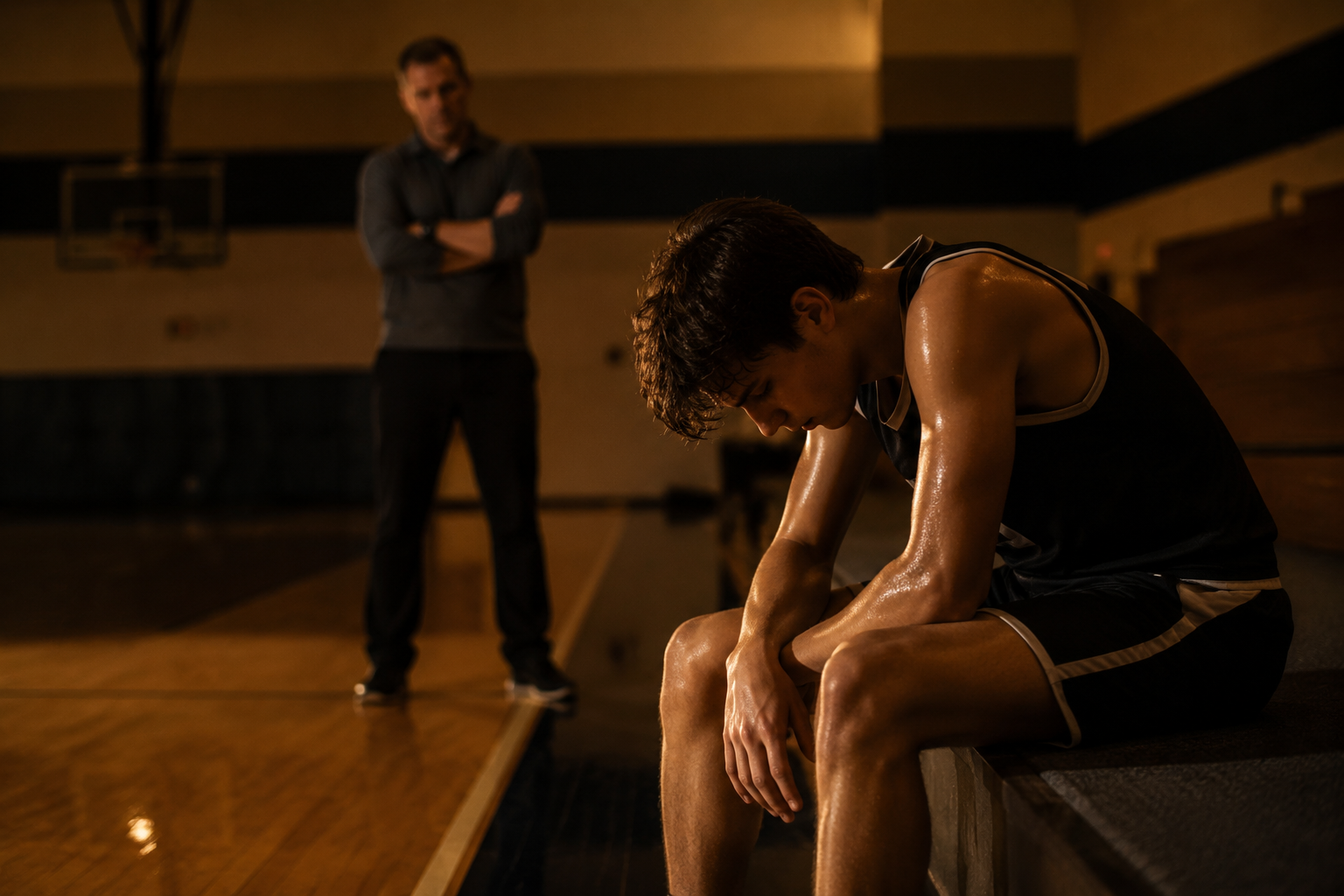
That gap is the part adults should sit with. A player who needs 8 to 10 hours and gets a little over 6 is not simply missing a pleasant recovery bonus. Night after night, that athlete is training, learning, reacting, healing, and managing school inside a 2- to 4-hour deficit.
The Recommendation Is Clearer Than The Reality Around It
The 8- to 10-hour recommendation is not a special sleep rule invented for athletes. It is the adolescent sleep target endorsed across major sleep and public health guidance because teenagers are still developing, learning, and recovering at a pace that makes sleep biologically expensive to cut.[1] Sport adds load on top of that baseline. Practice, games, strength work, travel, and injury recovery do not replace the adolescent need for sleep; they increase the consequences of not meeting it.
| What the evidence points to | What many young athletes report |
|---|---|
| Recommended sleep for adolescents: 8 to 10 hours per night | Average reported sleep among adolescent athletes: roughly 6.3 hours per night |
| A full night for sport participation should usually clear at least 8 hours | Only about 52% of adolescent athletes reach at least 8 hours |
| Sleep need may vary by athlete, age, training load, and season | A chronic 6-hour pattern sits well below the credible range for safe, serious youth sport |
The 6.3-hour figure should be read carefully. It comes from synthesized adolescent athlete literature, not from one national device-based census of every sport and age group. Individual studies vary by sport, age, season, and measurement method, with many relying on questionnaires or sleep diaries rather than objective tracking.[2] That limitation matters, but it does not make the gap disappear. Even if a particular team sleeps somewhat more than the average, the practical question is whether its schedule regularly allows teenagers to reach the bottom of the recommended range.
A coach does not need a perfect sport-by-sport formula before noticing a harmful pattern. If athletes are leaving late tournaments, finishing homework after evening practice, waking before sunrise for school or training, and repeating that cycle for months, the environment is making a promise the body cannot keep.
What A Short Night Looks Like In Performance
Sleep loss is easy to moralize because it often appears as something else. A tired player hesitates, so an adult calls it indecision. A shooter’s legs fade, so someone asks for more reps. A runner cannot hold pace, so the explanation becomes conditioning. The cleaner test is to ask what happens when athletes actually sleep more.
One of the most useful performance studies followed collegiate basketball players during a sleep-extension period in which they were asked to spend about 10 hours in bed each night. After sleep extension, free-throw accuracy improved by 9%, three-point accuracy improved by 9.2%, and sprint times improved by 0.7 seconds.[3] Those are not abstract wellness outcomes. They are the exact things coaches track in practice: the ball going in, the first steps being sharper, the body getting to a spot sooner.
This does not mean every teenage basketball player will improve by the same amount if bedtime moves earlier for a week. The Mah study was conducted with collegiate athletes, not a broad sample of middle-school and high-school players.[3] But it gives adults a useful correction: when shooting fades, the answer is not always another late-night shooting session. Sometimes the extra reps are being layered on top of the very deficit that is flattening the shot.
Endurance shows the same basic vulnerability. Children’s Hospital Colorado summarizes research in which sleep deprivation decreased time to exhaustion by about 10% in elite cyclists, and notes that the effect may be greater in adolescents.[4] Again, the important point is not that cycling data can be pasted onto every young athlete in every sport. It is that fatigue from sleep loss can show up as a visible performance ceiling: the legs empty sooner, the last repeat slows, the final shift gets sloppy.
Parents and coaches already respect these outcomes when they come from training. They chart shooting percentages, sprint splits, playing time, and conditioning tests. Sleep deserves the same seriousness because the deficit is measurable in the same currency.
The Injury Data Should End The Shrugging
Performance loss is frustrating. Injury is where the sleep gap becomes harder to excuse. In a prospective cohort of adolescent athletes, Milewski and colleagues found that athletes sleeping less than 8 hours per night were 1.7 times more likely to sustain a sports injury than those sleeping at least 8 hours.[5]
That finding should be handled with both attention and restraint. The study involved 112 athletes and relied on subjective sleep reporting rather than objective sleep measurement.[5] It is not a final universal injury calculator. It does not prove that every injury below 8 hours was caused by sleep loss. But as a warning signal, it is strong enough to change how adults judge chronic short sleep. Below 8 hours is not a harmless inconvenience for a teenager training hard.
A separate study of adolescent elite athletes found that sleeping more than 8 hours was associated with a 61% lower injury risk, while decreasing sleep during high-volume training was associated with a 2.25-times higher likelihood of injury.[6] The exact size of risk will vary by sport, training load, growth stage, and previous injury history. The direction, though, is difficult to wave away: when sleep drops while training demand rises, the athlete’s margin gets thinner.
This is why sleep belongs in the same conversation as workload, warmups, strength, footwear, field conditions, and return-to-play decisions. A teenager who is chronically under-slept may still be disciplined. They may still be coachable. They may still love the sport. The body still has to absorb landings, cuts, collisions, mileage, and growth. For a deeper look at this connection, see how poor sleep increases your risk of sports injury.
Why Teen Athletes Are Pushed Below The Target
It is tempting to treat adolescent sleep as a household discipline problem: put the phone away, go to bed earlier, be responsible. Those habits matter, but the larger pattern is not just a bedtime failure. Teenagers are biologically prone to a later sleep schedule during adolescence, a pattern often described as circadian phase delay or an evening chronotype shift.[7][8] In plain terms, many teens are naturally pushed later at the same age that school, sport, and homework often pull them earlier.
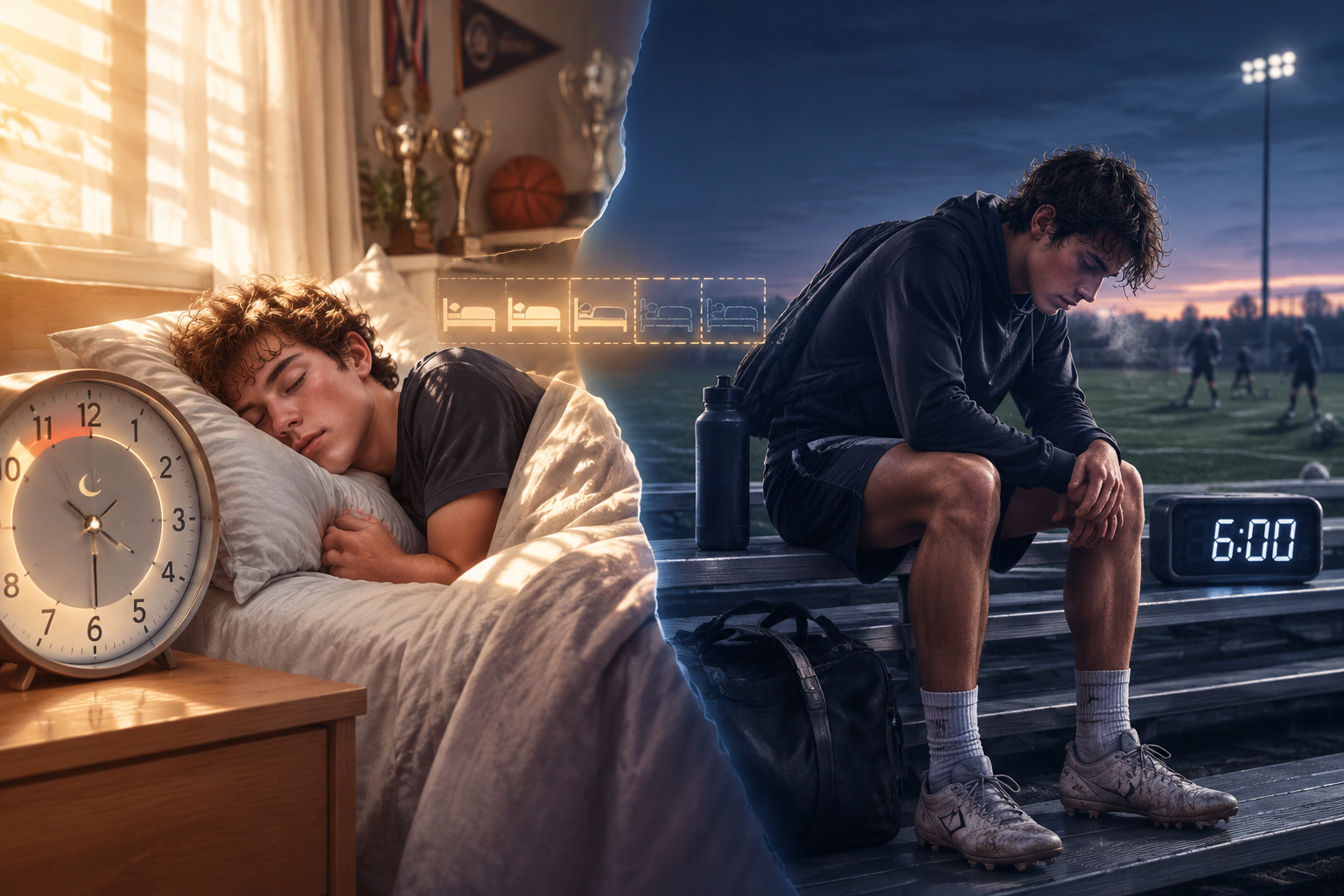
Then youth sports adds its own pressure. Early practices are scheduled before school because facilities are scarce. Evening practices run late because parents are working and gyms are booked. Weekend tournaments turn one game into an all-day wait, then a late drive home. Travel breaks routines. Screens compete for the shrinking time left after homework. Academic pressure does not pause because a team played three games on Sunday.
The adolescent sleep literature describes this as a kind of perfect storm: biological timing shifts later while social schedules demand earlier rising.[7][8] That model is well established for teenagers generally, although it has not been separately validated for every athlete subgroup with different travel loads, training volumes, and competition calendars. Still, it fits what many families already see: the teenager is not choosing between sleep and laziness. Often, they are choosing between sleep, homework, practice, transportation, food, and the next alarm.
Even elite adult athletes do not automatically solve this. A study of elite athletes reported average sleep around 6.7 hours, while the athletes estimated they needed about 8.3 hours to feel rested.[9] That comparison matters because it shows how easily sport culture normalizes a gap between what athletes need and what their schedules allow. If adults with professional support systems fall short, it should not surprise anyone that a high-school athlete with algebra homework and a 6:15 a.m. alarm does too.
What To Do With The Evidence
The practical standard is simple enough to use without pretending the science is more precise than it is. A young athlete should be given a schedule that makes 8 to 10 hours possible on most nights. If a team’s normal routine makes that impossible, the schedule is part of the training load.
- For parents: count backward from the wake time before adding another clinic, late lift, or travel event.
- For coaches: treat repeated short sleep as a risk factor, not as proof that an athlete lacks commitment.
- For athletes: report sleep honestly when performance drops or pain appears; it is training information, not an excuse.
- For teams: examine early practices, late film sessions, tournament travel, and recovery days before blaming inconsistency.
There is still plenty the evidence cannot specify. It cannot yet tell every 13-year-old soccer player and every 17-year-old swimmer their exact sport-specific sleep number. It cannot cleanly separate sleep need by endurance, power, skill, and team sports in adolescents. It cannot remove all error from self-reported sleep studies. Those limits are real.
They do not make chronic 6-hour nights compatible with safe, serious youth athletics. The current evidence is already good enough to reject the laziest interpretation of tired performance. When a young athlete looks slow, inaccurate, emotionally flat, or fragile under load, sleep should be one of the first conditions adults examine.
Sleep is not an optional recovery bonus after the real work is done. For young athletes, it is part of the training environment itself. Ignore the gap, and adults may end up measuring sleep debt while calling it character, effort, or talent.
References
- Recommended Amount of Sleep for Pediatric Populations: A Consensus Statement of the American Academy of Sleep Medicine, Journal of Clinical Sleep Medicine, 2016
- Sleep and the Adolescent Athlete, Sports Health / Nutrients, 2023, https://pmc.ncbi.nlm.nih.gov/articles/PMC10293556/
- The Effects of Sleep Extension on the Athletic Performance of Collegiate Basketball Players, Sleep, 2011, https://pmc.ncbi.nlm.nih.gov/articles/PMC3119836/
- Sleep and student athletes’ performance, Children’s Hospital Colorado, https://www.childrenscolorado.org/just-ask-childrens/articles/sleep-student-athletes-performance/
- Chronic Lack of Sleep is Associated With Increased Sports Injuries in Adolescent Athletes, Journal of Pediatric Orthopaedics, 2014
- Risk Factors for Sports Injuries in Adolescent Elite Athletes, Scandinavian Journal of Medicine & Science in Sports, 2017
- Sleep in Adolescents: The Perfect Storm, Pediatric Clinics of North America, 2011, https://pmc.ncbi.nlm.nih.gov/articles/PMC3130594/
- An Update on Adolescent Sleep: New Evidence Informing the Perfect Storm Model, Journal of Adolescence, 2018, https://pmc.ncbi.nlm.nih.gov/articles/PMC6054480/
- How Much Sleep Does an Elite Athlete Need?, International Journal of Sports Physiology and Performance, 2021, https://pubmed.ncbi.nlm.nih.gov/34021090/

Comments
Join the discussion with an anonymous comment.