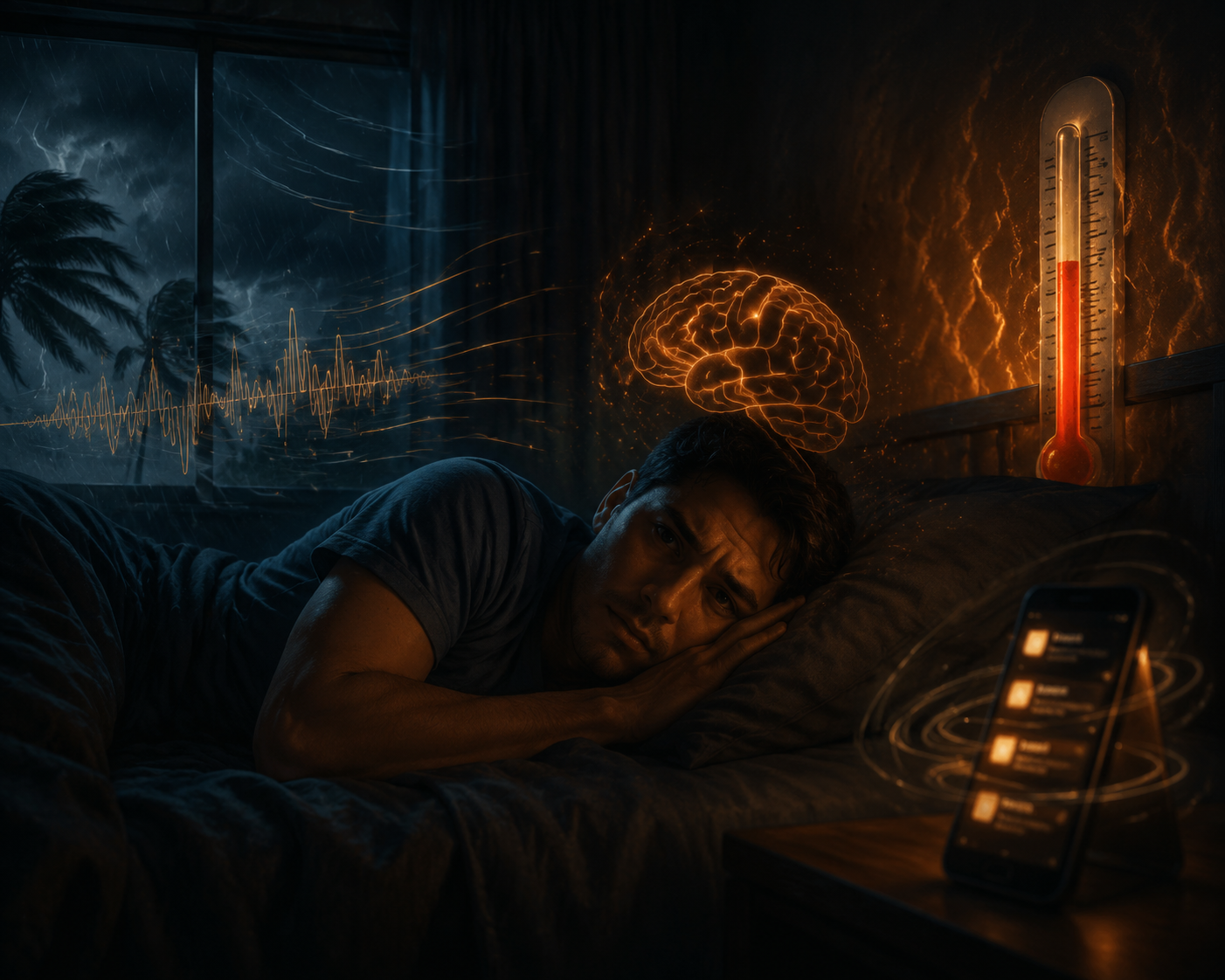
Useful tropical storm sleep tips start with a diagnosis, not a pep talk. If you are awake at 2 a.m. while the rain bands keep rotating through, you may be dealing with four different sleep problems at once: wind noise, heat after power loss, hypervigilance, and alert fragmentation. Each one asks for a different fix. Earplugs will not cool an upstairs bedroom. A breathing exercise will not make a generator safe. Muting every phone alert may buy sleep at the wrong price.
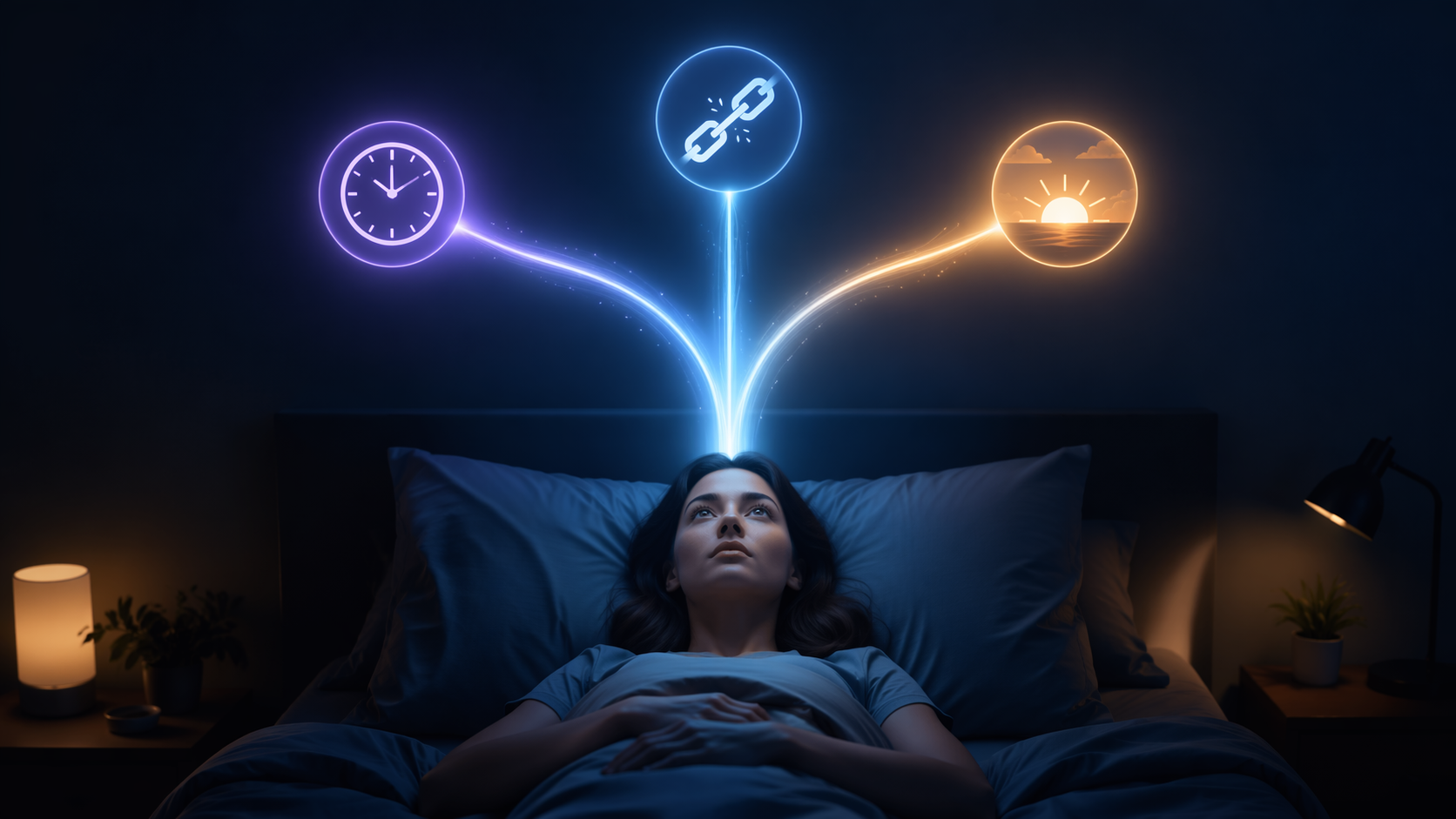
The question to ask tonight is narrower: which pathway is costing you sleep right now? If the windows are rattling and every gust jerks you awake, treat noise. If the room is climbing past tolerable, move your sleep location. If your body feels wired even after the house is secured, treat the stress loop. If everyone is half-waking for every warning, assign alert coverage instead of letting the whole household sleep with one eye open.
Start With the Pathway That Is Loudest Tonight
| What is waking you | What is probably happening | First countermeasure |
|---|---|---|
| Gusts, rattling glass, roof noise, debris impacts | Sound spikes are repeatedly pushing the brain out of stable sleep | Combine a safer interior room, high-quality earplugs, and steady masking noise |
| A room that keeps getting hotter after the power fails | The house is losing mechanical cooling, often unevenly by floor | Move to the coolest safe room, usually lower and interior, before exhaustion makes the move harder |
| You are exhausted but cannot stand down | Cortisol, adrenaline, and threat monitoring are opposing sleep onset | Stop live-scanning updates; use scheduled checks, written plans, and low-stimulation routines |
| Phones, watches, radios, and group texts keep breaking sleep | Alerts are fragmenting sleep across the whole household | Set one alert monitor per shift while others sleep in a quieter room |
This framing matters because storm sleep is usually not a normal bad night with rain in the background. It is a decision-making problem. The goal is not perfect sleep through unsafe conditions; it is enough protected rest that someone can drive carefully, check on a neighbor, handle cleanup, manage medication, or make the next call without fog.
Noise: Lower the Peak, Do Not Expect Silence
Tropical storm noise is not just “rain sounds.” Amerisleep’s hurricane sleep guidance cites National Weather Service wind-noise data showing hurricane-force wind noise can exceed 100 dB, roughly the range many people would associate with power tools rather than sleep-friendly background sound.[1] That figure is useful even with the commercial-source caveat because it changes the plan: ordinary soft rain masking is not built for sharp gusts, loose soffit noise, transformer pops, or a branch dragging across siding.
High-quality earplugs can reduce noise by approximately 25–30 dB, though the actual reduction depends on fit and product quality.[1] That can help, but it does not make a 100 dB sound disappear. It may bring the worst peaks down into a range your sleeping brain can tolerate, especially if you also move away from exterior walls and use a steady masking sound. The practical target is not a silent room. It is fewer sudden spikes.
- Choose an interior room first, especially if it also meets your household’s wind and flood safety plan.
- Use properly fitted foam or silicone earplugs before the loudest bands arrive, not after you are already startled awake.
- Add a battery-powered white-noise machine or phone-based sound only if it can run safely and does not block required alerts.
- Keep the masking sound steady. Sudden music changes, podcasts, or news audio can become another fragmentation source.
- Do not use noise control to ignore evacuation orders, tornado warnings, flood warnings, or household safety checks.
White noise has a ceiling. If wind or impact sounds are strong enough, turning the machine louder can simply add more sound load. The better move is usually physical: more walls between you and the weather, fewer windows nearby, and ear protection that reduces the peaks before masking fills the gaps.
If you want the broader physiology behind storm-related noise, light, pressure, and anxiety, the companion piece on how tropical storms affect sleep goes deeper. In the middle of a storm, the shorter rule is enough: reduce peaks, move inward, and preserve the alerts that matter.
Heat and Power Loss: Pick the Sleep Location Before the House Catches Up
When the power fails, the bedroom that felt fine at 10 p.m. may become the wrong room by 1 a.m. Nest Bedding’s storm-season sleep guide cites NOAA-related guidance that upper and lower floors can differ by 10–15°F during power-loss conditions.[2] Because Nest is a bedding retailer, product suggestions deserve caution, but the floor-to-floor temperature point matches what many storm households already learn the hard way: heat rises, air stops moving, and upstairs rooms can become punishing while a lower interior room remains usable.
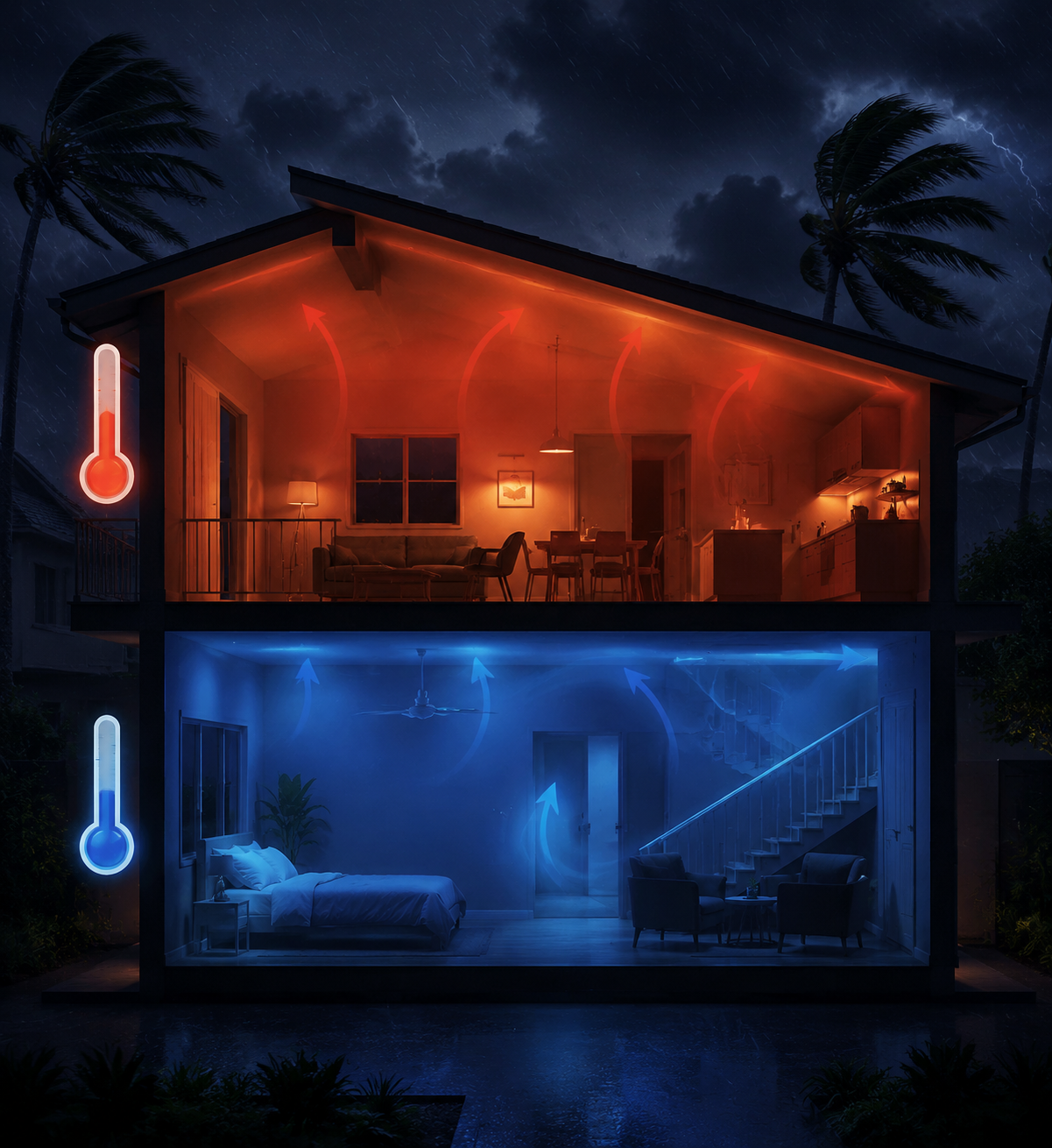
Move earlier than you think you need to. Waiting until the upstairs room is already hot means you are packing bedding, finding flashlights, calming children, moving pets, or relocating medical equipment while sleep-deprived. A lowest-floor interior room may help with both heat and noise, as long as it is not in a flood-prone part of the home and does not conflict with local emergency guidance.
The safety item comes before the comfort items: if you use a generator, the CDC says it should never be operated inside a home, basement, garage, or near open windows, doors, or vents, and it should be kept at least 20 feet away from the house.[3] The CDC also emphasizes carbon monoxide detection because CO is odorless and invisible.[3] A battery-backup carbon monoxide detector belongs in the storm sleep kit before cooling towels, bedding upgrades, or any other comfort gear. Sleeping people cannot reliably notice CO symptoms in time.
- Sleep lower if it is safe from flooding and away from exterior glass.
- Use battery fans only on stable, dry surfaces; Nest Bedding advises keeping fans at least 3 feet from water.[2]
- Put a cool wet towel on pulse points such as the neck, wrists, or ankles when the room is warm but not unsafe.
- Use breathable layers instead of one heavy blanket so you can adjust quickly as the room changes.
- Keep drinking water nearby, but do not overdo fluids right before a protected sleep block if bathroom trips will break it.
For extended power outages, temperature management becomes its own job. The more detailed guide to sleeping during a power outage covers longer-duration cooling choices. During the first storm night, the highest-value decision is usually room choice.
Hypervigilance: Stop Feeding the Threat Loop
A secured house does not automatically produce a calm body. The National Weather Service describes storm stress and anxiety as a real physiological response, not a character flaw.[4] Cortisol and adrenaline prepare the body to notice threat, act quickly, and stay alert. That is useful when a warning requires action. It is miserable when the highest-risk band has passed and your body is still acting as if you need to keep patrol.
Sleep loss can also make the threat system more reactive. Disaster mental health research supports the broader point that storms are not only property events; a 2024 review found that nearly one-third of people affected by natural disasters experience PTSD, anxiety, or depression.[5] Sleep-specific disaster evidence is thinner, but the American Academy of Sleep Medicine reported a post-Katrina shift among people presenting for sleep care: male patients rose from 44% to 62%, and insomnia complaints increased overall.[6] That does not prove what happens inside every active storm night, but it is enough to take the anxiety pathway seriously.
The storm-update habit is where many otherwise prepared people get stuck. Radar loops, live cameras, social feeds, and group texts can feel responsible. Past a certain point, they keep re-triggering the body. Baylor College of Medicine recommends reading storm news rather than watching it and using a written plan to reduce pre-storm anxiety.[7] That is not a soft suggestion. Reading is slower, quieter, and easier to stop than video; a written plan moves decisions out of the 2 a.m. panic channel.
- Replace continuous radar watching with scheduled checks unless an active warning is in effect.
- Write the next three actions on paper: where you sleep, who monitors alerts, and what would trigger relocation.
- Use text-based official updates when possible instead of live video or social feeds.
- Keep one dim light source available so you are not fully waking the room for every check.
- If anxiety stays high, use slow breathing, grounding, or another familiar downshift routine, but do not make relaxation the safety plan.
The Anxiety and Depression Association of America also recommends practical anxiety-reduction strategies around severe storms, including preparation and limiting overexposure to distressing information.[8] The word “limiting” matters. The point is not to become uninformed. The point is to stop making every adult in the house monitor the same threat stream all night.
Weighted blankets belong in the optional category. Harvard Health notes plausible calming mechanisms but also says there are no definitive scientific studies proving their benefit.[9] If you already use one, the room is cool enough, and you can get out of it quickly if an alert requires action, it may help. If the room is hot or you are responsible for fast wakeups, it can be the wrong tool.
For readers whose storm anxiety starts days before landfall, the deeper guide to hurricane anxiety and sleep may be more useful than another storm-night checklist. If the pattern changes before, during, and after warnings, the timeline guide to how hurricane anxiety disrupts sleep at every phase can help separate anticipation from active threat monitoring.
Alert Fragmentation: Let One Person Be Awake on Purpose
Emergency alerts are supposed to interrupt you. The problem is when every phone, watch, weather radio, group chat, and nervous check-in wakes everyone, all night, for alerts that one responsible adult could have handled. Amerisleep’s storm sleep guidance suggests many people should expect only 3–5 hours of broken sleep during active storm conditions.[1] That is expert guidance from a commercial source, not a published tropical-storm sleep trial, but it is a realistic planning number.
The household fix is shift sleeping. One adult keeps the alert role for a defined block while another sleeps in a quieter room with nonessential notifications silenced. Then they switch. The alert monitor needs access to official warnings, a flashlight, shoes, glasses if needed, medication or mobility information for the household, and the written trigger points for waking everyone. The sleeping person needs permission to stop half-monitoring.
| Role | What stays on | What can usually be silenced |
|---|---|---|
| Alert monitor | Official emergency alerts, weather radio, local emergency management updates | Nonessential group chats, social media, duplicate app notifications |
| Protected sleeper | A direct wakeup path from the alert monitor | Extra phone apps, watches, news alerts, casual texts |
| CPAP user or medically dependent sleeper | A direct wakeup path plus medical-device power awareness | Nonessential notifications that do not affect safety |
This is where a lot of households need to be blunt before the weather gets bad. If one person is the lightest sleeper, that does not automatically mean they should be the alert monitor all night. If someone has to drive at first light, manage children, operate equipment, or make insurance and repair calls, protecting part of their sleep may be the safer choice.
CPAP users need a separate plan. CPAP.com’s hurricane preparedness guidance discusses battery backups in the 100–160+ Wh range, but actual needs depend on the device, pressure settings, humidifier use, and outage length.[10] Do not improvise this during the storm. The dedicated guide to CPAP hurricane preparedness and sleep is the better place to work through therapy continuity, battery sizing, and when to seek medical advice.
Sleep aids also deserve caution. A pill that helps someone sleep through ordinary anxiety can become a problem if they need to wake quickly for a warning, move rooms, respond to flooding, or help another person. Half-life, next-day impairment, alcohol interactions, and emergency wakefulness all matter. If you are considering medication or supplements, use the separate guide to safe sleep aids during a tropical storm rather than treating them as a casual storm-night tip.
Build a Storm Sleep Kit Around Function, Not Comfort
A good storm sleep kit is not a bedside spa kit. It is a small set of items that protects alert access, breathing, temperature, noise control, and safe movement in the dark. Comfort matters when it helps one of those jobs. It matters less when it adds clutter to a room where people may need to move quickly.
- Earplugs that fit, plus a battery-powered masking option if your alert plan allows it.
- A battery-backup carbon monoxide detector, especially if any generator may be used nearby.
- Battery fans, spare batteries or charged power banks, and a dry placement plan.
- Breathable layered bedding, a light sheet, and a towel that can be dampened for cooling.
- A flashlight or headlamp, shoes, water, needed medications, and glasses or hearing aids.
- A written alert-shift plan and relocation triggers.
- CPAP battery planning and device-specific backup supplies, if relevant.
If the night is already underway, do not rebuild the whole system. Fix the dominant pathway. Move downstairs if heat is the problem. Put in earplugs and move away from glass if noise is the problem. Hand alert duty to one person if fragmentation is the problem. Stop watching live storm coverage if your body is locked in threat mode and someone else is covering warnings.
During active tropical storm conditions, 3–5 hours of broken sleep may be a realistic outcome rather than a failure.[1] The useful win is turning scattered exhaustion into protected blocks of rest: safe room, lower heat load, fewer sound spikes, one alert monitor, and no carbon monoxide shortcuts. That may be enough to make the next morning safer.
References
- Hurricane Preparedness and Sleep, Amerisleep.
- Storm-Season Sleep Prep for Power Outages, Nest Bedding.
- Hurricane Preparedness, Centers for Disease Control and Prevention.
- Storm Stress and Anxiety, National Weather Service.
- Impact of Natural Disasters on Mental Health: Evidence and Implications, PMC / NIH, 2024.
- Catastrophic Events Can Affect a Person's Sleep, American Academy of Sleep Medicine.
- Navigating Pre-Storm Anxiety, Baylor College of Medicine.
- Severe Storms: How to Reduce Your Anxiety, Anxiety and Depression Association of America.
- Anxiety and stress weighing heavily at night? A new blanket might help, Harvard Health.
- Hurricane Preparedness Plan for CPAP, cpap.com.
Comments
Join the discussion with an anonymous comment.