
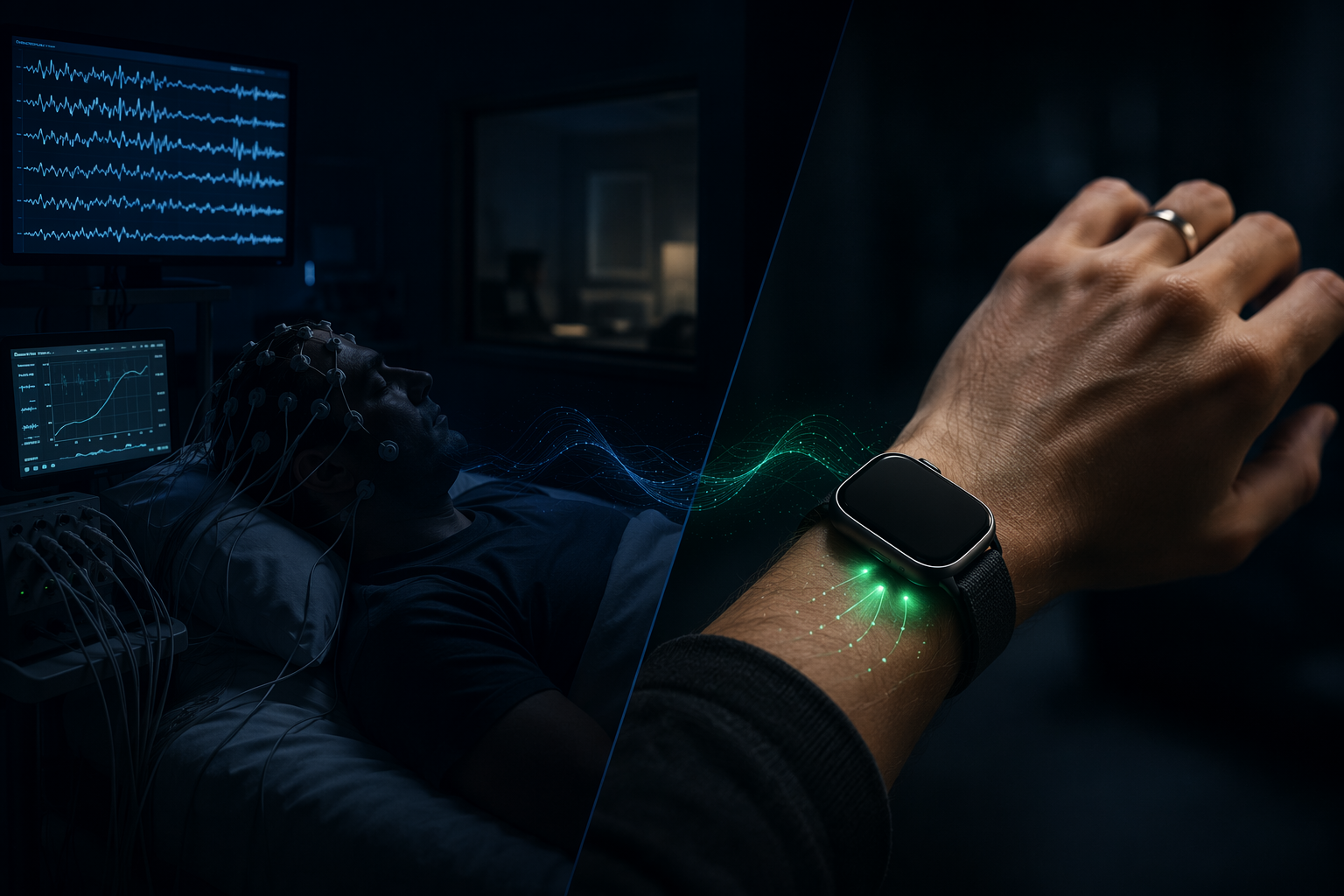
If you are asking which fitness tracker with sleep tracking comes closest to a sleep lab, the important split is not brand but task. In a 2024 scoping review of 62 wearable setups, sleep-versus-wake classification averaged 87.2%, while four-stage sleep classification averaged 65.2%; trained PSG scorers agreed with one another about 80% of the time. That is the frame worth keeping in mind before any "best tracker" label makes the problem sound simpler than it is. [1]
What sleep tracking accuracy actually means
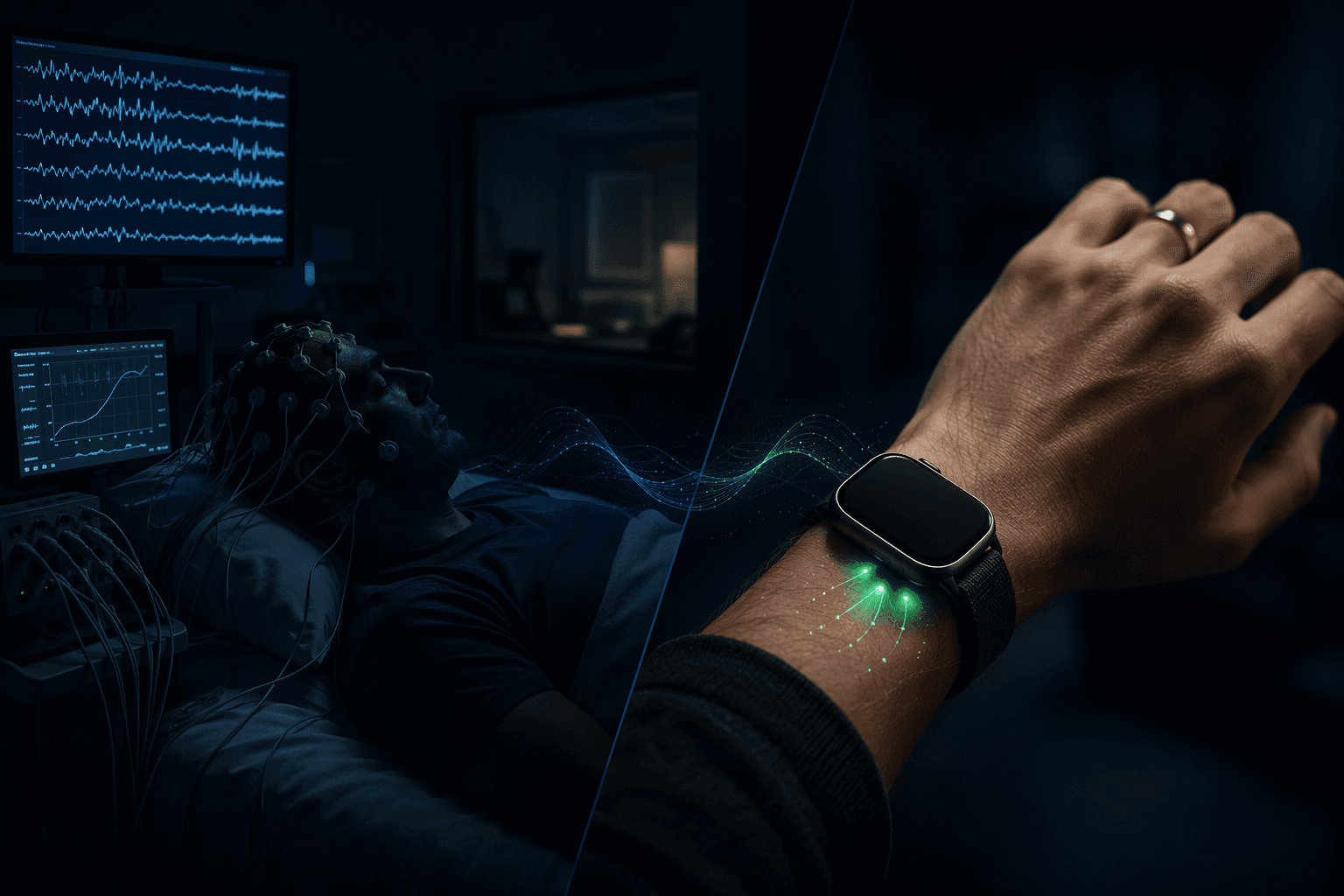
Wearables are still measuring proxies, not brain waves. That makes them useful for trends and patterns, but not the same thing as a sleep study. The devices that pair PPG with accelerometer data generally do better than accelerometer-only systems, and only 17% of PPG-using devices in the review disclosed their sleep-staging algorithms in peer-reviewed literature. [2][1]
| Task | Average result across 62 wearable setups | Why it matters |
|---|---|---|
| Sleep vs. wake | 87.2% accuracy [1] | This is the easier problem and the number many apps make sound like the whole story. |
| Four-stage sleep classification | 65.2% average accuracy [1] | This is the harder problem and the one that produces misleading stage labels. |
| Human PSG scorers | About 80% inter-scorer agreement [1] | Even the sleep-lab reference has disagreement, which sets a ceiling wearables should not be expected to beat. |
That gap explains why a sleep score can look polished while the stage labels underneath it still wobble. A tracker can be directionally right about whether you slept and still be too loose to sort one night into wake, light, deep, and REM with clinical confidence.
How Oura, Fitbit Sense 2, and Apple Watch Series 8 compare
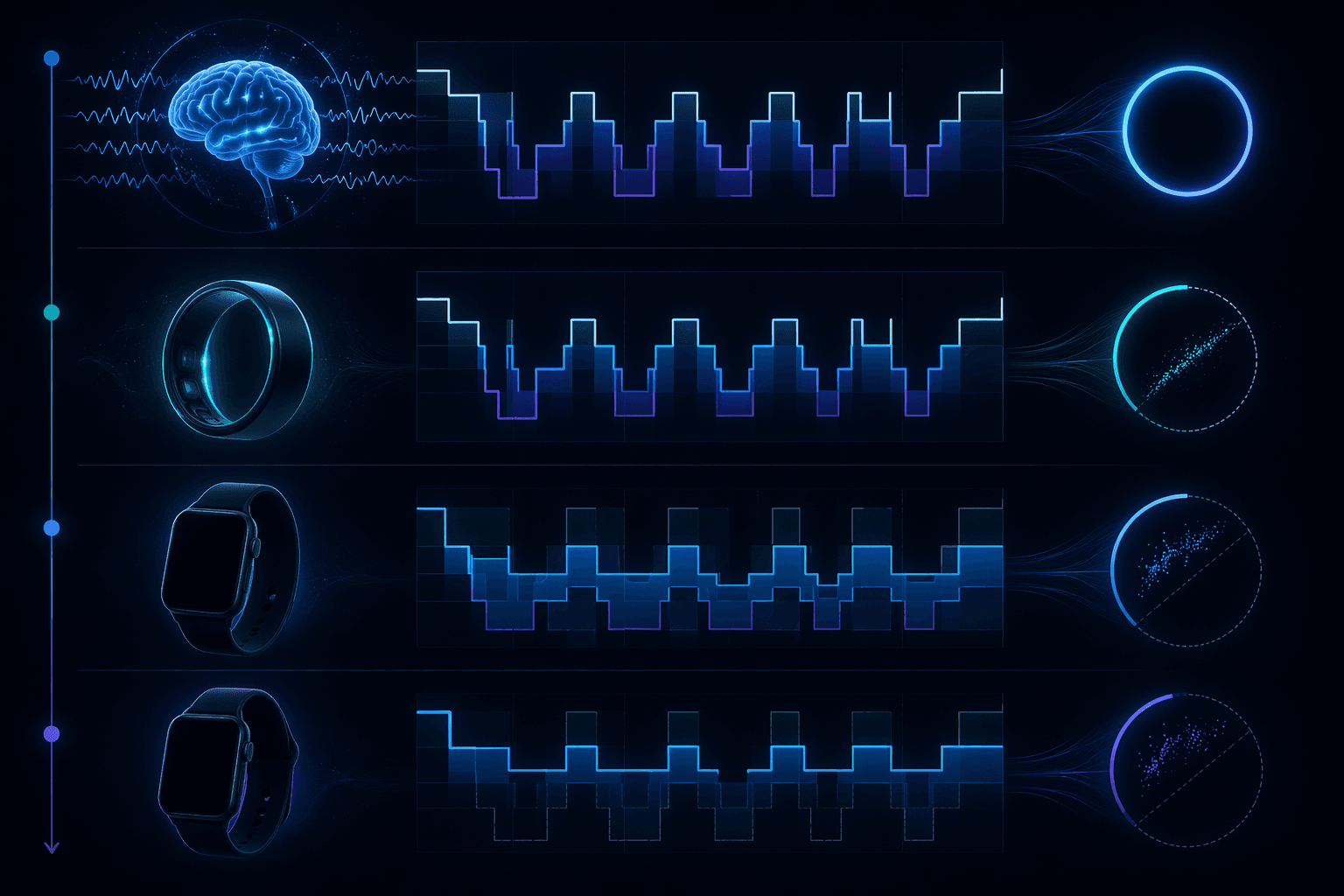
The clearest head-to-head comparison came from Robbins et al. at Brigham and Women's Hospital, which compared Oura Ring, Fitbit Sense 2, and Apple Watch Series 8 against polysomnography in healthy adults. The study was funded by Oura Ring Inc., and several authors disclosed consulting relationships with Oura, so that context should be visible when reading the results. Even with that caveat, it is still the most useful device-level paper in the set. [3]
| Device | What the study found | How to read it |
|---|---|---|
| Oura Ring | 76–79.5% sleep-stage sensitivity; Kappa 0.65; no statistically significant difference from PSG for 7 of 8 nightly measures, including total sleep time, sleep efficiency, light sleep, deep sleep, REM sleep, wake after sleep onset, and sleep onset latency. [3] | Strongest agreement among these tested consumer devices, but still not clinical-grade certainty. |
| Fitbit Sense 2 | Overestimated light sleep by about 18 minutes and underestimated deep sleep by about 15 minutes (p < 0.001). [3] | The stage mix is off enough to matter if you care about how much deep sleep the device says you got. |
| Apple Watch Series 8 | Overestimated light sleep by about 45 minutes and underestimated deep sleep by about 43 minutes (p < 0.001). [3] | The largest light-versus-deep sleep distortion in this comparison. |
On the numbers themselves, Oura has the strongest case among these tested devices. Fitbit and Apple both made the same basic mistake — too much light sleep, too little deep sleep — but the Apple Watch error was larger. That matters because stage errors are not cosmetic: they change how a night looks when someone is trying to judge recovery, training load, or whether a bad week reflects actual sleep disruption.
What to do with the numbers
That is why Johns Hopkins frames sleep trackers as trend tools, not diagnostic devices. [2] Use them to compare your own nights over time, not to interpret one restless night as a sleep-lab verdict. Be especially cautious with single-night REM and deep-sleep labels, since those are exactly where the consumer devices in these studies were most likely to drift.
- Look for patterns across many nights instead of reacting to one score.
- Treat stage labels as approximations, especially when the app sounds more certain than the evidence.
- If symptoms point toward insomnia, sleep apnea, or another disorder, use the tracker as background data and get clinical evaluation instead of trying to diagnose from the graph.
If you want the broader context before choosing a device, the general accuracy guide, the Oura Ring sleep tracking accuracy, the Apple Watch sleep tracking review, the form-factor guide, and orthosomnia cover the next question.
References
- Evaluating reliability in wearable devices for sleep staging — npj Digital Medicine, 2024
- Do Sleep Trackers Really Work? — Johns Hopkins Medicine
- Accuracy of Three Commercial Wearable Devices for Sleep Tracking in Healthy Adults — Sensors, 2024
Comments
Join the discussion with an anonymous comment.