If your Oura app just showed a “Pay Attention” breathing regularity notification, the first thing to know is what it does not mean. It does not mean one rough night automatically triggered a sleep apnea warning. It does not mean Oura has diagnosed you. And it does not mean your health data has already gone to ResMed.
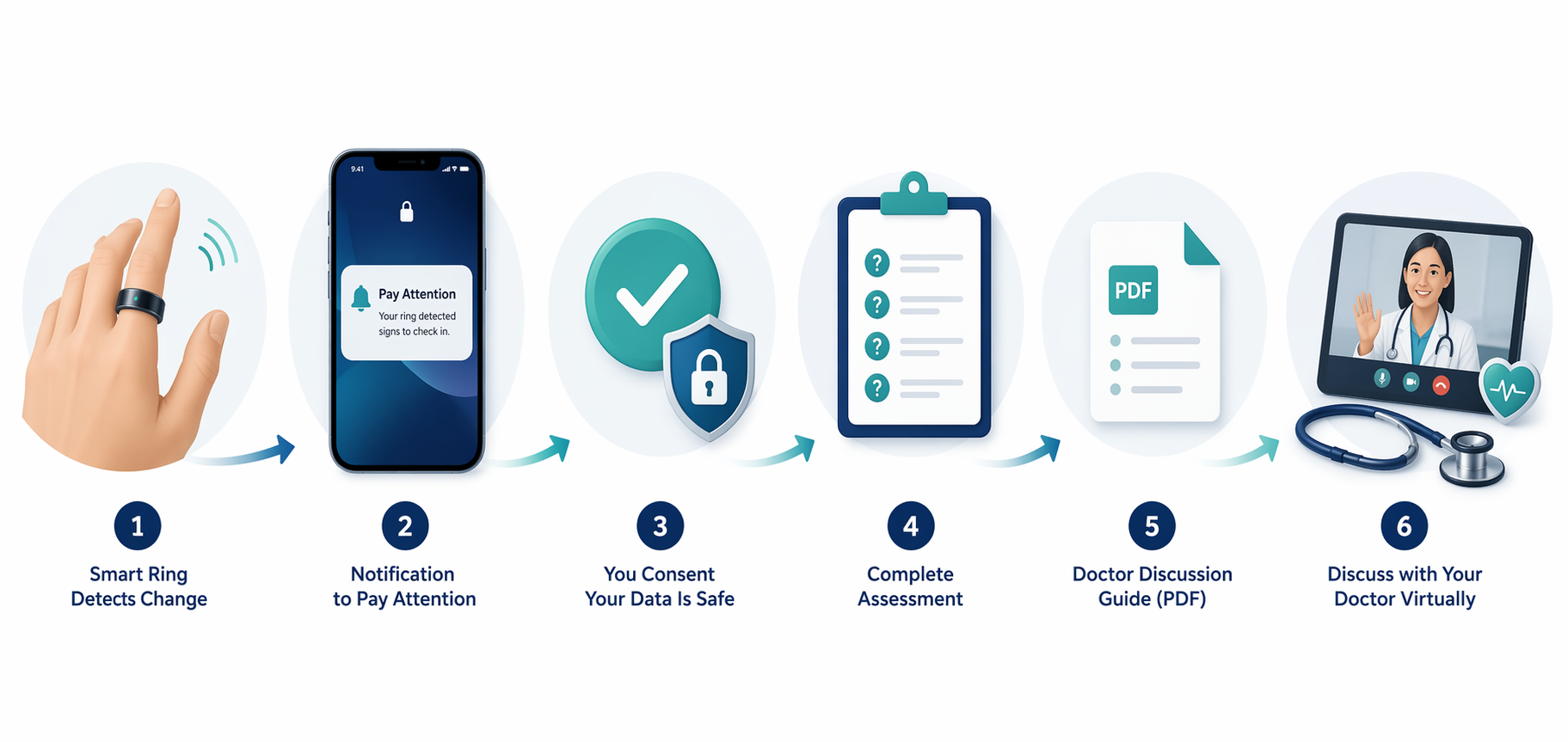
The Oura Ring ResMed sleep assessment pathway starts only after Oura detects persistent, elevated breathing disturbances, using a combination of Breathing Disturbance Index elevation and overnight SpO2 drops below 90% as the app-level signal behind the card.[1] If you choose to continue, Oura says health data is not shared with ResMed unless you separately consent inside the Oura app.[2]
There are also eligibility limits worth checking before you spend time interpreting every screen. The pathway is currently available in the United States for Oura Ring Gen3 and Oura Ring 4 members with active subscriptions.[1] The partnership was announced on May 19, 2026, with rollout beginning April 28, 2026, so published long-term results on diagnostic yield, conversion to testing, or patient satisfaction are not yet available.[1]

What Actually Triggers the ResMed Card
Oura’s breathing regularity feature is watching for repeated breathing-pattern disruptions during sleep. The ResMed home card is not described as a response to a single bad night, a stressful evening, or one odd oxygen reading. It appears when the app detects persistent, elevated breathing disturbances, with the triage signal combining elevated BDI and SpO2 drops below 90%.[1]
That distinction matters because a ring has to infer a lot. Oura’s BDI is not the same as an apnea-hypopnea index, or AHI. AHI comes from a clinical sleep test that scores breathing events under defined criteria. BDI is an Oura metric based on wearable sensor signals; it can flag a pattern that deserves attention, but it cannot tell you whether events are obstructive or central, and it is not a substitute for a home sleep apnea test or in-lab polysomnography.
The practical reading is: “My ring saw a repeated pattern that may be worth screening,” not “I have sleep apnea.” If you are trying to separate ordinary snoring from symptoms that deserve medical review, start with a symptom-focused guide such as how to tell the difference between snoring and sleep apnea. For women and people whose symptoms do not look like the classic loud-snoring stereotype, it is also worth checking atypical sleep apnea symptom patterns before deciding the alert is irrelevant.
The Click That Matters: Separate Consent
The privacy hinge in this workflow is separate consent. Seeing the ResMed card in Oura is not the same as enrolling in ResMed’s assessment, and it is not the same as sending your Oura history to ResMed. ResMed’s professional information page states that no health data is shared unless the user separately consents within the Oura app.[2]
In practical terms, treat the card as an invitation to start a handoff. Before that handoff, you should expect to see a consent step that explains what information is moving and why. This is the moment to slow down, especially if you opened the card while half-awake and worried. If you do not opt in, the pathway should not proceed as a ResMed assessment based on shared Oura data.
The cleanest way to think about the sequence is not “Oura found sleep apnea, then ResMed treats it.” It is: Oura noticed a persistent breathing-related pattern, asked whether you wanted to continue, and only after your separate consent does the ResMed side of the workflow become relevant.
| Stage | What it means for the user |
|---|---|
| Oura breathing regularity alert | The app has seen persistent elevated breathing disturbances, not just one-off night. |
| ResMed card appears | You are being offered a screening pathway, not given a diagnosis. |
| Separate consent | Health data is not shared with ResMed unless you opt in. |
| Online assessment | You answer validated screening questions about symptoms and risk factors. |
| Doctor discussion guide | Your Oura trends are packaged into a PDF you can bring to a clinician. |
| Care options | You may discuss next steps such as virtual consultation, home testing, or an in-lab study. |
What the ResMed Sleep Assessment Asks
Once you choose to continue, the ResMed online sleep assessment is short: ResMed describes it as taking 3–5 minutes.[3] The point is not to re-run Oura’s sensor analysis in questionnaire form. It adds the missing human context: what you experience, what someone else may have observed, and which risk factors make the ring’s pattern more clinically meaningful.
The assessment uses clinically validated screening questions covering snoring, daytime sleepiness through Epworth Sleepiness Scale-style questions, witnessed apneas, and risk factors.[3] Those categories are useful because they ask about consequences the ring cannot observe directly. A ring can estimate disrupted breathing patterns during sleep; it cannot know whether you are nodding off in the afternoon, whether a bed partner has seen you stop breathing, or whether your sleepiness is interfering with driving, work, or caregiving.
- Snoring questions help separate quiet sleep disruption from symptoms another person may hear.
- Daytime sleepiness questions connect the night pattern to next-day function.
- Witnessed-apnea questions ask whether anyone has seen pauses, gasping, or choking.
- Risk-factor questions give the screening result clinical context instead of relying on sensor data alone.
This is where the pathway becomes more useful than a bare notification. An alert can make a person anxious; an assessment can sort the anxiety into answerable clinical questions. It still does not diagnose sleep apnea, but it can help decide whether the next conversation should be with a clinician, a virtual sleep specialist, or a testing provider.
The PDF Guide Bridges the Gap
The most practical part of the Oura-ResMed pathway may not be the notification or the assessment. It is the downloadable doctor discussion guide. Oura says the guide compiles longitudinal Oura data, including breathing disturbance trends and sleep efficiency patterns, so the member can bring organized information into a clinical conversation.[4]
That matters because many sleep appointments begin with fragments: “I snore sometimes,” “my ring says something is off,” “I wake up tired,” “my partner is worried.” A PDF that gathers trends over time does not replace a medical history, but it can make the first conversation less vague. It gives the clinician something more structured than a screenshot and less overconfident than a self-diagnosis.
Used well, the guide should support a conversation like this: here are the dates or periods when breathing disturbances were elevated, here is how sleep efficiency looked across the same window, here are the symptoms reported in the assessment, and here is why the patient is asking whether a sleep test is appropriate. The clinician still has to judge the whole picture: symptoms, medical history, medication use, cardiometabolic risk, nasal obstruction, insomnia, shift work, and other possible explanations.
This is also the point where expectations need to stay realistic. A polished guide does not guarantee a same-week diagnosis or immediate treatment. Care depends on provider availability, insurance or payment arrangements, local testing capacity, and whether the clinician thinks a home test or an in-lab study is the right next step.
What Care Options May Follow
After the assessment and guide, the pathway can point users toward care options rather than leaving them with a generic warning. Available routes described around the partnership include connecting with independent providers virtually, using ResMed’s Sleep Lab Locator, using a Dealer Locator for durable medical equipment, or consulting virtual independent sleep specialists.[5]
Those options are not all the same step. A virtual sleep specialist may help decide whether testing is warranted. A home sleep apnea test may be appropriate for some suspected obstructive sleep apnea cases. An in-lab sleep study may be more appropriate when the clinical picture is complex, when other sleep disorders are suspected, or when a provider needs more complete physiologic measurement. The ring’s role is upstream: it helps surface a pattern and organize the next conversation.
If you already have a primary care clinician, cardiologist, pulmonologist, neurologist, dentist trained in sleep medicine, or another provider who manages your sleep concerns, the guide can go there first. If you do not, the virtual and locator options may reduce the friction between “the app flagged something” and “a qualified person reviewed my symptoms.” That is the strongest version of this partnership: not a device pretending to be a doctor, but a device handing you a better starting packet.
Better Ring Signals Still Have Clinical Limits
Oura Ring 4 gives the pathway better raw material than earlier hardware in one important area. Oura says Ring 4’s Smart Sensing platform delivers a 120% improvement in SpO2 signal quality and 15% more accurate BDI estimation compared with Gen3.[6] For a workflow that depends partly on SpO2 drops and breathing disturbance estimates, cleaner signals are not trivial.
But better signal quality does not turn BDI into AHI. It does not make a ring equivalent to a sleep study. Wearable sleep data is built from indirect signals, and those signals can be affected by motion, fit, skin contact, sensor placement, and the limits of PPG-based measurement. For a broader look at where Oura performs well and where independent validation is more cautious, see this data-driven analysis of Oura sleep tracking accuracy and this discussion of smart ring sleep accuracy limits.
The calibration point is sobering. In a 45-patient sleep lab study published in Nature Scientific Reports in 2025, Oura’s four-stage sleep staging accuracy was 53.18%, with Kappa = 0.31.[7] That study tested rings during first-time use without a calibration period, so it should not be treated as the final word on every at-home use case. Still, it is a useful reminder: consumer sleep tracking can support screening and trend awareness, but diagnostic decisions require clinical evaluation.
The same caution applies across wearable apnea screening. Apple Watch notifications, under-mattress trackers, and smart rings all sit somewhere between consumer awareness and clinical testing. If you are comparing approaches, the useful question is not which device “detects sleep apnea” in the broadest marketing sense. It is what signal the device uses, what threshold triggers an alert, what the user is told next, and whether the handoff leads to appropriate clinical testing. For context, see comparisons on Apple Watch sleep apnea notification accuracy and under-mattress sleep tracker apnea detection.
How to Use the Alert Without Overreading It
If the ResMed card appears, the most useful next step is procedural: confirm you are eligible, read the consent screen, decide whether you want to share the relevant data, complete the 3–5 minute assessment if you opt in, download the doctor discussion guide, and bring both your symptoms and Oura trends to a qualified clinician or virtual sleep specialist.
What you should not do is treat the notification as an emergency diagnosis or dismiss it because a ring is “just a gadget.” Persistent breathing disturbances plus oxygen drops below 90% are worth organizing into a real conversation, especially if you also have snoring, witnessed pauses, morning headaches, daytime sleepiness, high blood pressure, or other relevant risk factors. The app can make the pattern visible; the care pathway can help you ask the next question in a cleaner way.
The boundary is simple but important: “My ring flagged a pattern” is not the same as “I have been diagnosed.” The Oura Ring ResMed sleep assessment is best understood as consent-driven screening and triage. Review the guide, discuss the symptoms and trends with a clinician or virtual sleep specialist, and let that clinical conversation determine whether a home sleep test, in-lab study, or another evaluation makes sense.
References
- Resmed and Oura Are Partnering to Expand Access to Sleep Health Education and Care, Oura, May 19, 2026.
- Resmed & Oura Partnership: Sleep Health Solutions, ResMed.
- Sleep Assessment, ResMed.
- Personalized Care Recommendations, Oura Member Care.
- Strategic Analysis of the ResMed and Oura Partnership: Bridging Consumer Wearables and Clinical Sleep, Healthcare Digital.
- Blood Oxygen Sensing (SpO2) on Oura, Oura.
- Performance of a commercial smart ring to evaluate sleep in a sleep laboratory in patients with suspected sleep disorders, Nature Scientific Reports, 2025.

Comments
Join the discussion with an anonymous comment.