
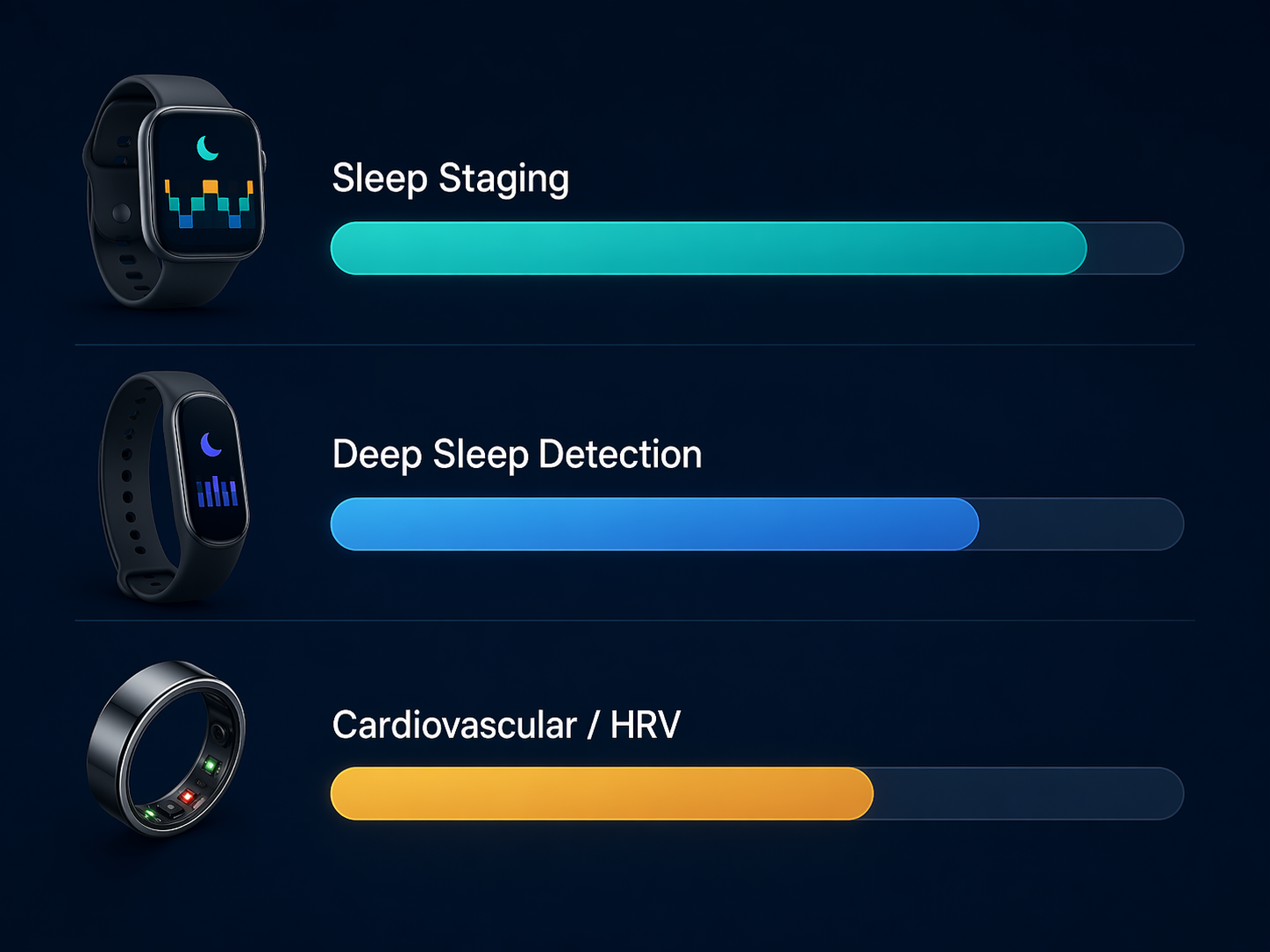
The awkward answer to “what is the best wearable for sleep tracking?” is that the winner changes as soon as you change the metric. In one independent 2025 validation study from Antwerp, Apple Watch had the strongest overall sleep-stage agreement, while Whoop 4.0 led on deep sleep sensitivity.[1] In a 2024 Oura-funded study from Brigham and Women’s Hospital, Oura came out ahead for sleep staging, but only against Apple Watch and Fitbit.[2] A broader Nature Digital Medicine review, meanwhile, found a shared flaw across consumer wearables: they tend to overestimate total sleep time and underestimate wake after sleep onset.[3]
| If this is your priority | What the cited evidence points to | Important catch |
|---|---|---|
| Sleep-stage classification | Apple Watch in the independent Antwerp study; Oura in the Oura-funded Brigham study | Different funders, device sets, and samples produce different leaders |
| Deep sleep detection | Whoop 4.0 in the Antwerp study | That does not automatically make Whoop best for every sleep metric |
| HRV / resting heart rate | Oura Ring Gen 4 has strong concordance data against Polar H10 ECG in the cited compilation | Good cardiovascular signal quality is not the same thing as perfect sleep staging |
| Wakefulness during the night | No consumer device gets a free pass | The broader review found systematic underestimation of wake after sleep onset |
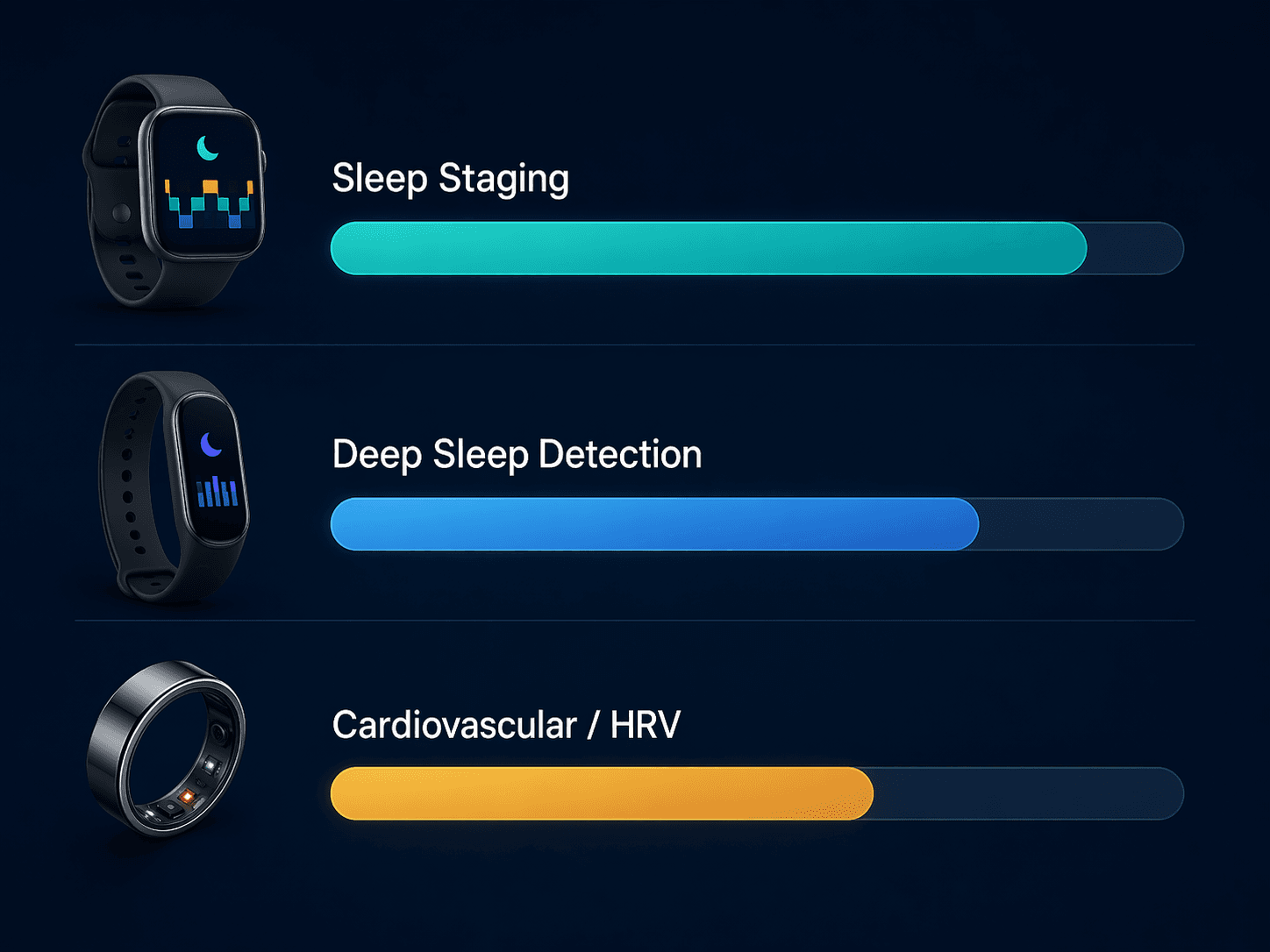
That is not a dodge. It is the useful part. A wearable does not “track sleep” as one clean thing. It estimates sleep and wake, assigns sleep stages, calculates proprietary scores, and often measures cardiovascular signals such as heart rate and heart rate variability. Those are related outputs, but they are not interchangeable.
If you want the simplest honest answer, start here: pick the signal you care about first, then look at the validation study that tested that signal directly. Device names come second.
Sleep staging: Apple Watch in the independent study, Oura in the funded one
Sleep staging is the flashy part of most wearable apps: light, deep, REM, awake. It is also where marketing language tends to get least helpful, because a neat colored chart can hide a lot of uncertainty.
The 2025 Antwerp study is the cleanest anchor here because it compared six consumer sleep trackers against polysomnography and was independently funded through VLAIO. In that study, Apple Watch had the highest sleep-staging agreement, with κ=0.53. Whoop 4.0, Oura Ring Gen 3, Fitbit, Garmin, and other tested devices did not beat it on that overall staging measure.[1]
Then comes the counterweight. In the 2024 Brigham and Women’s Hospital study publicized by Oura, Oura led sleep staging with κ=0.65. That sounds stronger, and on its own terms it is. But the study compared only three devices: Oura, Apple Watch, and Fitbit. It was also funded by Oura.[2]
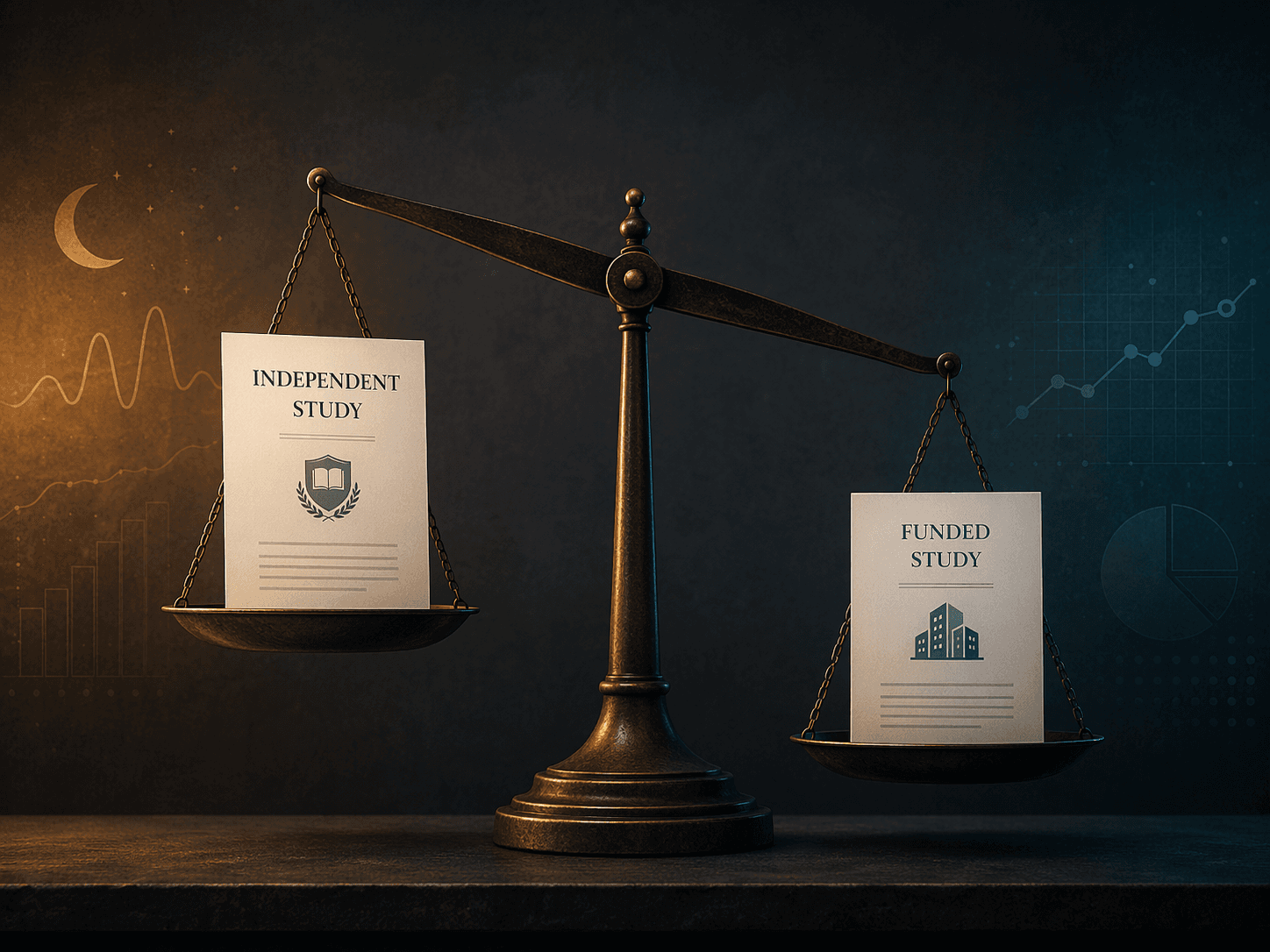
The point is not that the Oura-funded result should be thrown out. Funded studies can still be well designed, and independent studies are not magically universal. The point is that these two findings should not be flattened into the same kind of “best overall” badge. They answer slightly different questions under different conditions.
If you weight independent validation more heavily, Apple Watch has the stronger claim for sleep staging in the evidence cited here. If you are comfortable giving the Oura-funded Brigham study substantial weight, Oura Ring becomes much harder to dismiss for staging. That fork in the road is part of the buying decision.
There is also a hardware-generation problem. The Antwerp study tested devices such as Whoop 4.0 and Oura Ring Gen 3, while buyers in 2026 are looking at newer lines such as Whoop 5.0, Oura Ring 4, Apple Watch Series 11, Pixel Watch 4, and current Galaxy Watch models. Validation evidence often arrives one product cycle late. That does not make it useless; it just makes “current best” a more fragile claim than product pages suggest.
Deep sleep: Whoop has the clearest cited advantage
Deep sleep deserves its own lane because it is where many users obsess and where overall staging accuracy can mislead. A device can be decent at broad staging agreement and still miss a lot of deep sleep, or it can detect deep sleep comparatively well without being the best all-around classifier.
In the Antwerp study, Whoop 4.0 had the highest deep sleep sensitivity at 69.6%.[1] That is a narrower and more useful claim than “Whoop is the most accurate sleep tracker.” It says Whoop performed best among the tested devices for identifying deep sleep epochs in that study.
For someone choosing mainly because they care about deep sleep trends, that matters. It also means the better follow-up question is not whether Whoop’s recovery score feels convincing, but whether its deep sleep detection is the signal you actually intend to use. Readers who want a device-specific dive can compare the evidence in this Whoop sleep tracking accuracy guide.
Wake, light sleep, and the shared flaw most rankings skip
The least glamorous sleep metric may be the most important for people who sleep badly: wakefulness. If you lie awake for long stretches, a tracker that quietly labels that time as light sleep can make the night look less disrupted than it felt.
That is not just an annoyance in the app. It changes the interpretation of everything downstream: total sleep time, sleep efficiency, sleep score, recovery score, and the little congratulatory messages that arrive after a night you know was not good.
The 2024 Nature Digital Medicine review covered 35 studies and 62 wearable setups and found the same general direction of error: devices overestimated total sleep time by 6 to 48 minutes and underestimated wake after sleep onset by 12 to 48 minutes.[3] This is why a pretty hypnogram should be treated as an estimate, not a transcript.
A 2023 Korean multicenter study compared 11 wearable, nearable, and airable devices, which is useful mostly as a reminder that results can shift when the device set and study design change.[4] The field is not short on validation studies. It is short on tidy, stable rankings that survive every metric and every sample.
This is also where Garmin, Fitbit, Pixel Watch, and Samsung Galaxy Watch should be handled carefully. They are real options, and some inherit Fitbit or smartwatch ecosystems that people like. But in the cited head-to-head evidence, they do not all have the same strength of claim for the same sleep outcome. Equal shelf space in a roundup is not the same as equal validation support.
HRV and heart rate: cleaner signals, different question
Cardiovascular signals are often more clinically legible than a proprietary sleep score. Resting heart rate and HRV are still not magic, but at least they are measurable physiological signals rather than a black-box grade that mixes sleep duration, timing, movement, and secret weighting.
For Oura Ring Gen 4, the cited compilation reports concordance correlation coefficients of 0.99 for HRV and 0.98 for resting heart rate against the Polar H10 ECG reference.[5] That is a strong cardiovascular-signal claim. It does not prove Oura is the best sleep stager in every study, and it does not make the sleep score self-explanatory. It does make Oura a serious option for someone who cares most about overnight HRV and resting heart rate trends.
This is where the Oura Ring 4 may be more attractive than the staging fight alone suggests. If your real use case is “I want a comfortable overnight device that gives me stable HRV and resting heart rate trends,” Oura’s claim is stronger than if your use case is “I need the most independently supported sleep-stage classifier.” Readers who choose that route may want a separate explanation of what is actually inside the Oura Ring sleep score.
Apple Watch and Samsung Galaxy Watch also have a different kind of health-feature claim: both have FDA authorization for sleep apnea screening features.[6] That should not be confused with general sleep-stage superiority. Screening for possible breathing-related sleep disturbance is a different task from labeling REM, light, and deep sleep across the night.
Proprietary sleep scores are where the fog rolls in
A sleep score can be useful as a personal trend line, but it is usually the least transparent output. The World Sleep Society’s 2025 recommendations make a useful distinction between fundamental sleep measures and proprietary metrics.[7] That distinction should be printed on the box of every sleep wearable.
Fundamental measures include things like estimated sleep duration, sleep timing, awakenings, heart rate, and HRV. Proprietary metrics are the brand-specific blends: readiness, recovery, sleep score, body battery, or whatever name the app gives to its composite judgment. The first category can be compared more directly across studies. The second category may be helpful, but it is harder to validate from the outside.
That matters because a user often buys the hardware for one thing and ends up obeying another. They think they are buying sleep tracking, then start adjusting their day around a readiness score whose internal weighting they cannot inspect. If you want the sensor-to-score pipeline unpacked, this explainer on how wearable sleep trackers work is the more useful place to linger.
Poor sleepers are exactly where accuracy gets harder
Many validation studies lean toward healthier adults with relatively normal sleep. That is understandable for controlled research, but it leaves a gap for the person most motivated to buy a tracker: the person whose sleep is already fragmented, anxious, delayed, or inconsistent.
Oxford Neuroscience summarizes one of the uncomfortable findings in this area: accuracy degrades when sleep efficiency falls below 85%, and sleep onset latency estimation accuracy can drop to about 38% in poor sleepers.[8] In plainer terms, the tracker may be least reliable when the night is most clinically interesting.
There is also the behavioral side. A 2024 Brain Sciences study reported orthosomnia prevalence between 3.0% and 14.0% among wearable users in a sample of 523 people.[9] That does not mean sleep trackers cause orthosomnia in everyone who uses them. It does mean obsessive checking is not a fringe concern invented by technophobes.
If you already know you become anxious around sleep data, accuracy is not the only purchase criterion. You may need a device that lets you mute scores, reduce notifications, or focus on broad trends. The practical question is not just “which device is most accurate?” It is “which device will I use without making my sleep life smaller?” For that problem, start with this guide to orthosomnia and sleep tracker anxiety, or this comparison of sleep trackers for people who actually can’t sleep.
What about Muse S Athena and EEG headbands?
Muse S Athena deserves a separate, cautious mention because it is not just another wrist wearable or ring. As an EEG headband, it is closer to the signal type used in clinical sleep staging than motion-and-heart-rate wearables are. The cited manufacturer-published material reports 88% to 96% alignment with polysomnography.[5]
That is impressive enough to notice and not independently replicated enough to crown. A headband also asks more of the sleeper than a ring or watch. If you are willing to wear something on your head and your main interest is staging, Muse may belong on your shortlist. If you want a low-friction device you can forget about, it may not.
How to choose without pretending there is one winner
For sleep staging, look first at studies that directly compare stage classification against polysomnography. In the evidence cited here, that means taking the Antwerp Apple Watch result seriously, then deciding how much weight to give the Oura-funded Brigham result. If independent funding matters most to you, your ranking will differ from the ranking produced by a brand-funded summary.
For deep sleep, Whoop has the clearest cited advantage because the Antwerp study reported the highest deep sleep sensitivity for Whoop 4.0. If that is your main metric, do not let a general staging leaderboard distract you.
For HRV and resting heart rate, Oura Ring 4 has strong support in the cited cardiovascular comparison against Polar H10. That makes it easier to defend for overnight physiological trends than for every possible sleep-stage claim.
For sleep apnea screening, Apple Watch and Samsung Galaxy Watch belong in a separate category because FDA-authorized screening features answer a different question from ordinary sleep staging. If breathing disturbance is your concern, that is not the same purchase path as choosing the prettiest sleep-stage chart.
For Garmin Forerunner 165, Google Pixel Watch 4, Fitbit, and Samsung Galaxy Watch Ultra as general sleep trackers, the honest position is narrower: they may be useful, especially if you already live in their ecosystems, but the cited evidence here does not make each of them a metric-by-metric leader. If you want the broader limitations of watch-based tracking, see what a sleep tracker watch can and cannot tell you.
So the best wearable for sleep tracking is not one device for everyone. It is Apple Watch if your priority is independently supported sleep-stage performance in the cited six-device comparison. It is Whoop if deep sleep sensitivity is your main target. It is Oura if you put more weight on the funded Brigham staging study or if overnight HRV and resting heart rate are your more defensible targets. And if your main concern is whether a device is hiding wakefulness inside light sleep, the answer is to stay skeptical of all of them.
References
- Performance of consumer sleep trackers for sleep staging, Sleep Advances, 2025,
- Oura Emerges as Most Accurate Consumer Sleep Wearable, Oura, 2024,
- Consumer wearable devices for sleep monitoring: a systematic review and meta-analysis, Nature Digital Medicine, 2024,
- Accuracy of 11 Wearable, Nearable, and Airable Consumer Sleep Trackers: Prospective Multicenter Validation Study, JMIR, 2023,
- Best Sleep Trackers Compared, Kygo,
- Comparing sleep features of popular smartwatches, American Academy of Sleep Medicine,
- World Sleep Society recommendations on consumer sleep technology, Sleep Medicine, 2025,
- Are sleep trackers accurate? Here’s what researchers currently know, Oxford Neuroscience,
- Orthosomnia: Are Some Patients Taking the Quantified Self Too Far?, Brain Sciences, 2024,
Comments
Join the discussion with an anonymous comment.