
Poor air quality can cost sleep in numbers large enough to notice, but the numbers do not all mean the same thing. The strongest causal estimate comes from a study of Chinese cities: a one-standard-deviation rise in the Air Quality Index caused an 11.6% increase in sleeplessness, and PM2.5 specifically caused a 12.8% increase.[1] The more vivid “41 minutes” figure comes from a different study of Beijing freshmen, where a one-standard-deviation AQI increase, equal to 77.50 AQI points, was associated with 0.68 fewer hours of sleep per night.[2]
That distinction matters. One study is better suited to the question “does pollution cause more sleeplessness?” The other makes the possible size of the loss legible in bedtime terms. Together, they give a more useful answer than the usual vague warning that pollution “may affect sleep”: yes, poor air quality and poor sleep are measurably connected, and in population data the effect is not trivial.
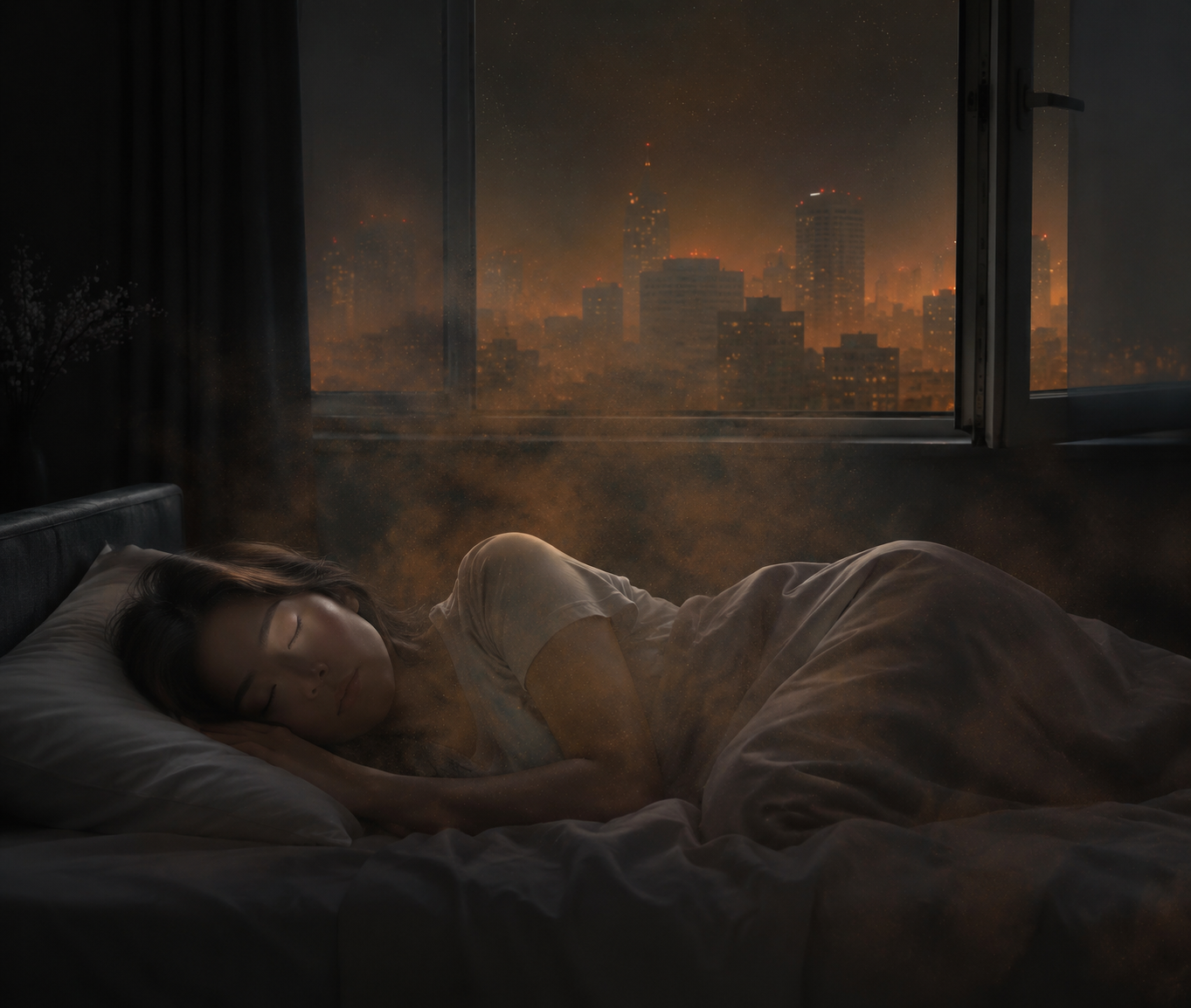
The causal estimate: about 12% more sleeplessness
The important feature of the 2019 sleeplessness study is not that it found another association between dirty air and bad nights. It used wind patterns as an instrumental variable, a design meant to separate pollution changes from many of the human behaviors and city conditions that usually muddy sleep research.[1]
The researchers used social media evidence from a panel of Chinese cities to identify expressions of sleeplessness, then examined how changes in pollution driven by wind related to those sleeplessness signals. In that design, a one-standard-deviation increase in AQI caused an 11.6% increase in sleeplessness. When they looked specifically at PM2.5, the estimated increase was 12.8%.[1]
This is the cleanest causal anchor in the evidence set, but it still does not mean that every person sleeps 11.6% worse every time the local AQI rises. The outcome was sleeplessness expressed in social media data, not a laboratory sleep recording. The estimate is a population effect, and the setting was Chinese cities. What it does support is narrower and still consequential: when air quality worsened for reasons plausibly outside people’s immediate control, sleeplessness increased.
Where the 41-minute figure comes from
The 41-minute number comes from a large study of 31,582 freshmen across five cohorts in Beijing. The researchers estimated that a one-standard-deviation increase in AQI, defined in the paper as 77.50 points, was associated with 0.68 fewer hours of sleep per night. Converted into ordinary clock time, that is about 41 minutes.[2]
That is a useful benchmark because sleep loss is often easier to understand in minutes than in regression coefficients. Forty-one minutes is the difference between a seven-hour night and something closer to six hours and twenty minutes. Across a week, if the association held night after night, it would be the kind of loss people might misattribute to stress, late caffeine, a bad mattress, or a vague “I just didn’t sleep well” phase.
The caution is equally important: this was an association in a specific student population, not proof that one polluted night removes exactly 41 minutes from one particular sleeper. Freshmen are not older adults with cardiopulmonary disease, shift workers, children, or people already dealing with insomnia. The number is best used as scale, not diagnosis.
The finding is not isolated
A 2020 systematic review covering 22 studies across 17 countries found that 21 of the 22 studies reported a positive association between air pollution and poor sleep quality.[3] That does not turn every study into a causal proof, but it does make the pattern harder to dismiss as one unusual dataset.
The review also helps explain why the evidence can feel uneven when translated into everyday terms. Many studies used self-reported sleep rather than polysomnography or actigraphy, which means recall and perception can enter the measurement. The geography is also uneven, with much of the large-scale evidence coming from China, the United States, and Europe.[3] The broad signal is consistent; the exact personal effect is not portable in a simple way.
One set of widely cited sleep-efficiency figures deserves a slower read. High NO2 exposure has been reported as raising the odds of low sleep efficiency by nearly 60%, and high PM2.5 by nearly 50%, but those figures trace to a 2017 American Thoracic Society conference presentation rather than a peer-reviewed journal article. They are strong enough to be interesting and too preliminary to carry the whole argument.
The air beside the bed also matters
Outdoor pollution is not the only air-quality question a sleeper actually lives with. A bedroom can become its own exposure chamber, especially when ventilation is low and CO2 accumulates overnight.
In a controlled dormitory experiment, improved ventilation lowered average bedroom CO2 from 2,395 ppm to 835 ppm. Under the improved conditions, sleep efficiency improved, and next-day cognitive test performance improved as well.[4] That result does not prove that opening a window is always the right move; on a smoky or high-pollen night, outdoor air can be the problem. It does show that “air quality” at bedtime is not only a citywide AQI number. It is also the air moving, or not moving, around the sleeping body.
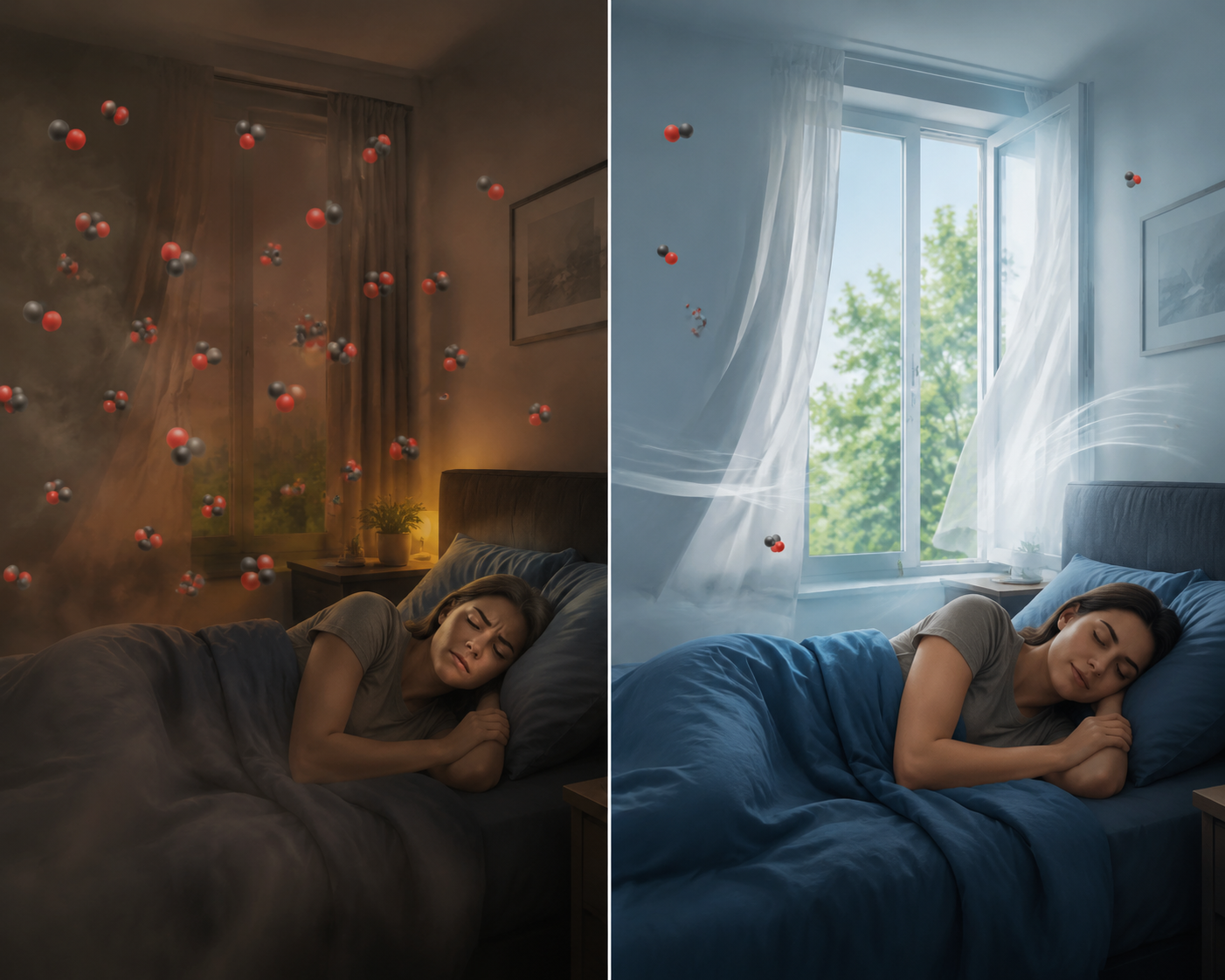
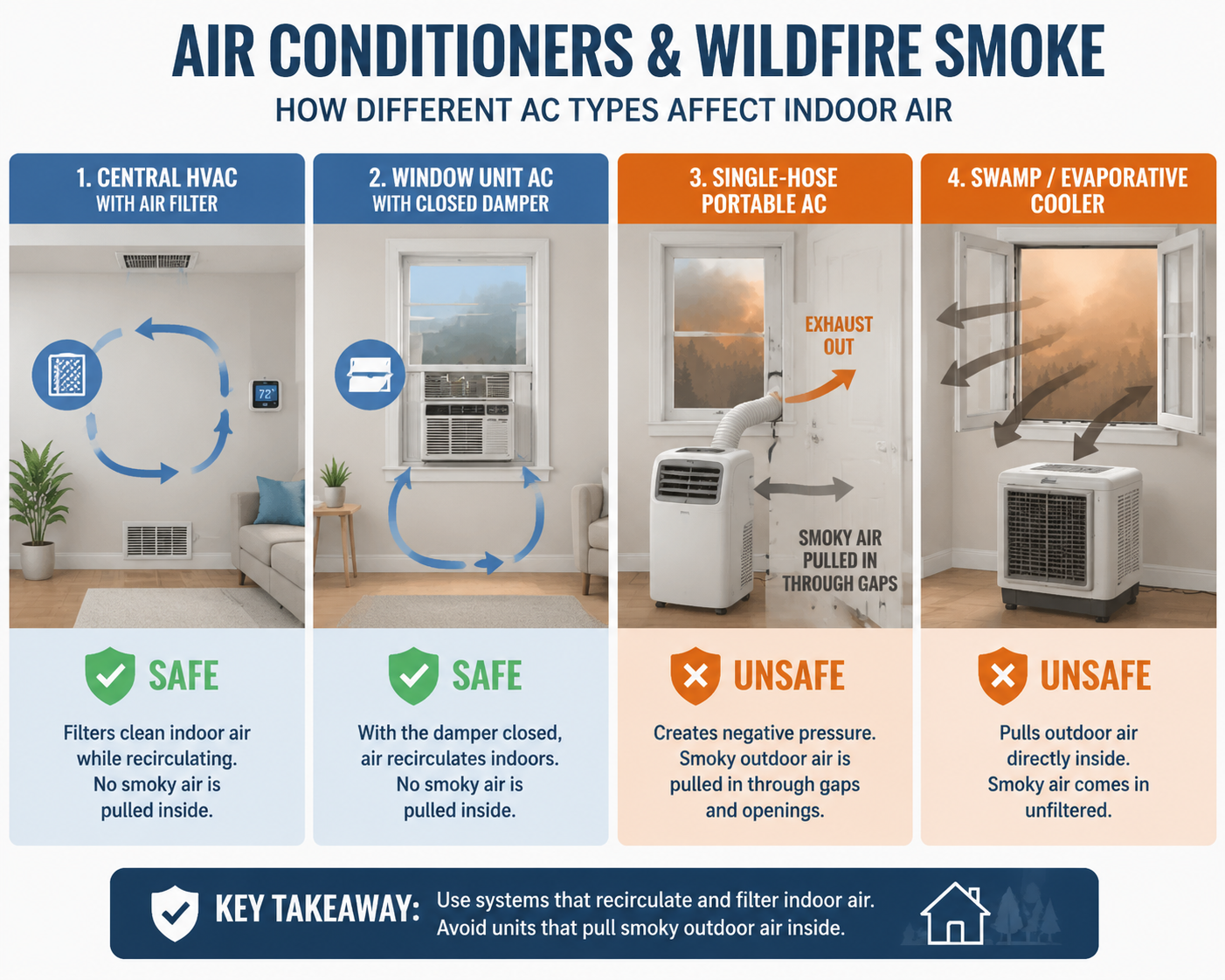
This is where practical interpretation has to stay modest. Ventilation, filtration, closed windows, open windows, and HVAC settings are not interchangeable; the right choice depends on what is outside, what is inside, and who is sleeping there. Readers looking for an evening protocol during alerts can use How Air Quality Alerts Disrupt Your Sleep, but the evidence here is enough to justify checking the bedroom environment before assuming the problem is only behavior.
What the global data add
A 2025 global metastudy reported in The Guardian drew on data from 1.2 million people across six countries and focused on middle-aged and older adults. Its estimate was blunt in a different way: cutting average PM2.5 from levels compared with a busy London road down toward World Health Organization guideline levels could reduce the likelihood of poor sleep by roughly one in ten among people aged 45 and older.[5]
That is not a nightly minute-loss estimate, and it should not be mixed casually with the Beijing student finding. It is a risk estimate for poor sleep in an older population. Its value is that it points in the same direction at a larger scale: lower particulate exposure is not merely a lung or heart concern. It may shift sleep risk for a large group of adults.
How to read your own bad-air nights
If sleep suddenly worsens during a polluted week, air quality belongs on the suspect list. It should not be the only suspect. Sleep timing, illness, heat, alcohol, medications, stress, noise, and existing sleep disorders can all produce the same morning complaint: unrefreshed sleep despite enough time in bed.
The evidence supports a calibrated interpretation. Poor air quality can measurably increase sleeplessness. A population-average estimate of about 41 fewer minutes per night gives a sense of possible magnitude. Stronger causal evidence supports an increase in sleeplessness of roughly 11% to 13% per standard-deviation rise in AQI or PM2.5.[1][2] None of those figures can tell one reader exactly how much sleep they lost last Tuesday.
Individual vulnerability is likely to vary by age, sex, socioeconomic context, baseline health, and pre-existing sleep or respiratory conditions. A healthy young adult in a filtered building may experience a polluted week differently from an older adult with asthma, cardiovascular disease, or fragmented sleep at baseline. Population averages are useful because they prevent hand-waving; they are limited because people do not sleep as averages.
Wildfire smoke is the version many people notice because it is visible, frightening, and often abrupt. The research base summarized here is stronger for chronic or cumulative pollution exposure than for single-event smoke spikes. For event-specific mechanisms and response planning, see How Wildfire Smoke Affects Your Sleep Quality; for a real-world extreme AQI case, see How Chicago's Air Quality Disrupts Sleep.
The cleanest answer is not that pollution explains every restless night. It is that air quality is a plausible, measurable contributor when sleep worsens without an obvious behavioral cause, and the size of the effect in the literature is large enough to take seriously before buying another supplement or blaming willpower.
References
- Air pollution as a cause of sleeplessness: Social media evidence from a panel of Chinese cities, Journal of Environmental Economics and Management, 2019.
- The Association between Air Pollution and Sleep Duration, International Journal of Environmental Research and Public Health, 2019.
- The effect of air pollution on sleep quality: a systematic review and meta-analysis, Environmental Science and Pollution Research, 2020.
- Using Indoor Air Quality Tactics to Sleep Better at Night, Perform Well the Next Day, ASHRAE Journal.
- Air pollution can affect how well we sleep, scientists discover, The Guardian, September 19, 2025.

Comments
Join the discussion with an anonymous comment.