
If your sleep study says mild obstructive sleep apnea, CPAP may still be the right treatment. But it is not the only serious treatment. For an adult with an AHI of 5–14.9, the better first question is usually not “What is the best CPAP alternative?” It is “Which alternative fits the reason my airway is closing, the way I actually sleep, and the amount of trouble this is causing me?”

Four details change the conversation quickly: whether your BMI is 30 or higher, whether your apnea is mostly worse on your back, whether your teeth and jaw can support a mandibular advancement device, and whether you are sleepy, foggy, or at higher cardiovascular risk versus minimally symptomatic. Those details do not replace a sleep clinician’s judgment, but they make a vague recommendation much easier to challenge or refine.
| If this describes you | The non-CPAP options most worth discussing first | What still needs checking |
|---|---|---|
| Good dental health and jaw tolerance | A custom mandibular advancement device | Number of teeth, periodontal status, TMJ history, bite changes, follow-up sleep testing |
| Supine-predominant OSA | Modern positional therapy | Whether your supine AHI is at least double your non-supine AHI, and whether you can tolerate side-sleeping |
| BMI ≥30 or weight appears to be a major driver | Structured weight loss treatment; GLP-1 medication discussion if severity and eligibility fit | OSA severity, medication eligibility, cardiometabolic profile, and realistic monitoring |
| Poor dental candidacy or strong preference against sleeping with a mouthpiece | EPAP devices, eXciteOSA, or myofunctional therapy | Evidence strength, nasal tolerance, time commitment, and whether symptoms justify a more reliable therapy |
When a Custom Oral Appliance Makes the Most Sense
For many people with mild sleep apnea, the most established CPAP alternative is not a shelf-bought snoring guard. It is a custom, titratable mandibular advancement device made and adjusted by a qualified dentist working with a sleep physician. The device holds the lower jaw forward enough to reduce airway collapse during sleep.
The American Academy of Sleep Medicine and American Academy of Dental Sleep Medicine guideline recognizes oral appliance therapy as an appropriate option for adults with obstructive sleep apnea who prefer it or cannot tolerate CPAP, with custom titratable appliances favored over non-custom devices.[1] That matters because mild OSA patients are often deciding between “treat this seriously” and “live with it,” not between two equally burdensome machines.
The expected result is meaningful improvement, not guaranteed cure. Reviews cited in clinical sleep medicine discussions report that roughly 68–69% of patients achieve at least a 50% reduction in AHI with oral appliance therapy, and more than one-third achieve normalization.[2][3] For a person whose mild OSA is paired with disruptive snoring, morning headaches, or bed-partner strain, that can be enough to change daily life.
Candidacy is the catch. About one-third of patients are poor dental candidates because of issues such as insufficient teeth, periodontal disease, or temporomandibular joint problems.[3] A patient with loose teeth, active gum disease, significant jaw pain, or complex dental work should not be handed a mouthpiece recommendation as if it were harmless. They need dental screening before the treatment plan is treated as realistic.
- Ask whether your clinician is recommending a custom titratable mandibular advancement device, not a generic boil-and-bite guard.
- Ask who will monitor bite changes, jaw discomfort, tooth movement, and gum health.
- Ask whether a follow-up sleep study or home sleep apnea test will confirm that the device is actually controlling your AHI.
- Ask what symptom improvement would count as success if your AHI improves but does not fully normalize.
If Your Apnea Happens Mostly on Your Back
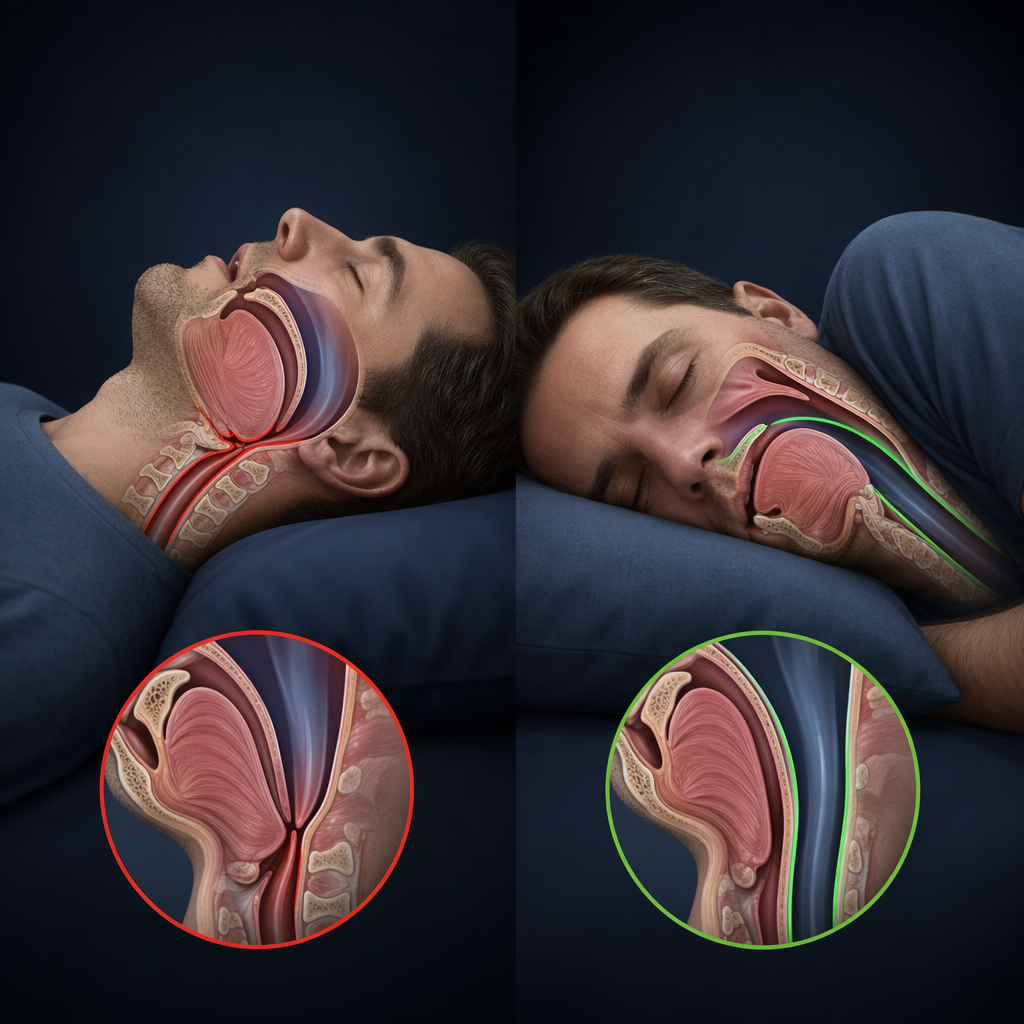
Supine-predominant OSA is one of the most useful findings in a sleep report. It means your breathing is substantially worse on your back than on your side, often defined in studies as a supine AHI at least double the non-supine AHI. Nearly half of people with OSA may fall into a positional pattern.[4]
This is where “sleep on your side” becomes either lazy advice or a legitimate treatment strategy, depending on how it is delivered. The old tennis-ball method had very poor staying power, with less than 10% long-term adherence at 30 months in the research summarized in a recent review.[4] Newer positional therapy devices are different: they usually use vibration feedback to discourage back-sleeping without fully waking the patient.
In a Cochrane comparison summarized in a 2025 review, positional therapy reduced AHI less than CPAP, producing 6.4 more events per hour than CPAP, but patients used positional therapy 2.5 hours longer per night.[4] That tradeoff is exactly why mild OSA deserves a profile-based conversation. A technically stronger therapy that stays in the drawer may not outperform a narrower therapy the patient actually uses.
A 2026 ATS conference-presented Pavlov study adds an intriguing possibility: positional therapy may train some patients into lasting side-sleeping rather than simply acting as a nightly prop. News-Medical reported that after six months of device use, more than two-thirds of participants maintained side-sleeping behavior and OSA control one year after stopping active treatment.[5] Because this was presented at a conference, it should not be treated as fully settled evidence until peer-reviewed publication confirms the details.
The practical discriminator is simple: look at your sleep study’s position breakdown. If your AHI is mild overall but much worse on your back, positional therapy belongs near the top of the discussion. If your breathing is disturbed in every position, positional therapy may still help comfort or snoring, but it is less likely to be enough as the main treatment.
For lower-risk self-care ideas that can sit alongside medical treatment, a separate severity-based home remedies guide is a better place to sort sleep-position habits, alcohol timing, and nasal congestion measures. Those steps can matter, but they should not be mistaken for verified control of OSA unless follow-up testing shows it.
When Weight Is Part of the Airway Problem
For a patient with BMI under 30, weight may or may not be central to mild OSA. For a patient with BMI 30 or higher, it deserves a direct conversation because weight can increase upper-airway collapsibility and reduce lung volume in ways that worsen obstruction. That does not mean weight loss is the only answer, and it certainly does not mean symptoms should be ignored while someone is told to “just lose weight.”
The evidence supports weight change as clinically relevant: a 10% weight loss has been associated with about a 26% decrease in AHI.[3] In mild OSA, that could be the difference between persistent disease and a much smaller residual breathing burden, but the only way to know is to retest after a meaningful change.
GLP-1 and related medication discussions need extra precision. In December 2024, the FDA approved Zepbound, the brand name for tirzepatide, as the first medication for obstructive sleep apnea, but the indication is for moderate-to-severe OSA in adults with obesity, not specifically for mild OSA.[6] The SURMOUNT-OSA trials studied adults with moderate-to-severe OSA and obesity, reporting AHI reductions of about 25–29 events per hour with tirzepatide versus about 5–6 events per hour with placebo at 52 weeks, along with 18–20% body weight loss.[7]
Those results are too large to ignore, but they do not turn tirzepatide into a mild-OSA-specific shortcut. For a mild OSA patient with obesity, the medication may be relevant through weight management, cardiometabolic risk, and the possibility of preventing worsening disease. For a mild OSA patient without obesity, it is not the same conversation. The American Academy of Sleep Medicine’s coverage of the approval also frames it around adults with obesity and moderate-to-severe OSA.[8]
If medication is on the table, eligibility, insurance requirements, adverse effects, and long-term planning matter as much as the AHI number. The more detailed weight-loss medication eligibility guide is the better next read for that narrow question.
Options When You Do Not Want a Nightly Mask or Mouthpiece
Some patients are poor dental candidates. Some can use an oral appliance but hate the idea. Others are minimally symptomatic and want to understand whether a less intrusive option is reasonable before committing to CPAP. This is where the evidence becomes more mixed, so expectations need to be more careful.
EPAP nasal devices
Expiratory positive airway pressure devices, such as Bongo Rx or ULTepap, sit at the nostrils and create resistance during exhalation. They are FDA-cleared for mild-to-moderate OSA. One randomized trial reported a median AHI reduction from 15.7 to 4.7 after one year, while another trial found no benefit in moderate-to-severe patients who had already discontinued CPAP.[3]
That split is useful. EPAP may be more plausible for selected mild-to-moderate patients who can breathe comfortably through the nose and are not trying to rescue a previously failed CPAP plan for more severe disease. Nasal obstruction, mouth breathing, and discomfort can make it a poor fit.
eXciteOSA
eXciteOSA is often described loosely as a “no-mask” option, which is true but incomplete. It is FDA-cleared through the 510(k) pathway, not FDA-approved, for snoring and mild OSA with AHI under 15.[9] The device is used during the day for tongue stimulation, typically 20 minutes per day for six weeks initially, followed by weekly maintenance.[9]
Clinical data cited by the AASM reported AHI reduction from 10.2 to 6.8 events per hour.[9] That is not the same kind of effect size as a well-fit oral appliance in a good candidate, and it may not satisfy a patient with substantial daytime sleepiness. But for a mild OSA patient who strongly prefers not to wear anything during sleep, it is a legitimate clinician discussion, provided the expectations are modest and follow-up testing is not skipped.
Myofunctional therapy
Myofunctional therapy uses repeated exercises for the tongue and oropharyngeal muscles. Systematic review evidence has reported about a 50% AHI reduction in adults, but evidence quality has been limited, and a European Respiratory Society task force did not recommend it as standard OSA treatment.[3]
That makes it easier to place: reasonable as an adjunct for motivated patients, especially if snoring, tongue posture, or oral muscle function are part of the picture; weaker as a stand-alone plan for someone who is sleepy, safety-sensitive at work, or already showing oxygen desaturation that worries the clinician.
What Not to Confuse With Treatment
Mild OSA sits in an awkward zone. It is serious enough to explain fatigue, snoring, morning headaches, or partner disruption, but it is also mild enough that the internet will offer shortcuts with great confidence. Mouth taping is the obvious example. It may be marketed as a way to force nasal breathing, but it is not an evidence-backed treatment for obstructive sleep apnea and can be risky for people with nasal blockage, reflux, or undiagnosed breathing problems. The mouth taping evidence review is a better place to sort that trend from actual therapy.
The same caution applies to symptom confusion. Midlife women, in particular, may be told they have insomnia, perimenopause-related sleep disruption, restless legs, or anxiety before anyone checks breathing. If you are still sorting out whether your symptoms point to apnea or another sleep disorder, the guide to perimenopause insomnia versus sleep apnea may help you prepare for a more specific evaluation.
How to Take This Back to Your Sleep Clinician
A good non-CPAP plan for mild sleep apnea should end with a way to verify that it worked. Symptom improvement is important, but snoring can improve while residual apnea remains. AHI can improve while sleepiness persists for another reason. The follow-up plan is not bureaucracy; it is how you avoid mistaking partial comfort for control.
- Sleep study pattern: Ask for your supine AHI, non-supine AHI, oxygen desaturation findings, REM-related worsening, and total time spent in each sleep position.
- Dental candidacy: Ask whether your teeth, gums, jaw joints, and bite make you a good candidate for a custom mandibular advancement device.
- Weight-related options: If your BMI is 30 or higher, ask whether weight treatment is part of your OSA plan and whether your severity meets criteria for medication discussions.
- Symptom burden: Be specific about sleepiness while driving, work errors, morning headaches, blood pressure concerns, mood changes, and bed-partner disruption.
- Treatment verification: Ask when to repeat a home sleep apnea test or lab study after starting an oral appliance, positional therapy, EPAP, eXciteOSA, weight intervention, or combined plan.
Mild sleep apnea does not have one best CPAP alternative. It has several credible paths. A custom oral appliance is often strongest when dental candidacy is good. Positional therapy moves up when the sleep study shows a strong back-sleeping pattern. Weight treatment matters most when obesity is part of the airway problem. EPAP, eXciteOSA, and myofunctional therapy may fit selected patients, but they deserve more guarded expectations.
The right choice is the one that matches your anatomy, sleep behavior, risk profile, symptoms, and treatment goal — and then proves itself on follow-up.
References
- AASM and AADSM issue new joint clinical practice guideline for oral appliance therapy — American Academy of Sleep Medicine
- Treatments for Obstructive Sleep Apnea: CPAP and Beyond — Cleveland Clinic
- Treatments for Obstructive Sleep Apnea: CPAP and Beyond — Missouri Medicine
- Comparative efficacy of sleep positional therapy, oral appliance therapy, and intensive lifestyle modification in patients with positional obstructive sleep apnea — Frontiers in Medicine
- Positional therapy trains sleep apnea patients for long-term recovery — News-Medical, May 20, 2026
- FDA Approves First Medication for Obstructive Sleep Apnea — U.S. Food and Drug Administration
- Tirzepatide for the Treatment of Obstructive Sleep Apnea and Obesity — New England Journal of Medicine
- Zepbound approved by FDA as first sleep apnea medication — American Academy of Sleep Medicine
- FDA authorizes eXciteOSA device for snoring and sleep apnea — American Academy of Sleep Medicine


Comments
Join the discussion with an anonymous comment.