
The first problem after a nighttime earthquake may not be the emergency kit in the closet. It may be the floor. A glass of water has fallen, a picture frame has broken, a lamp is down, the power is out, and the person getting out of bed is barefoot, half-awake, and possibly without glasses.
That is why sleep-specific earthquake supplies belong at the bed, not only in a garage bin or hallway go-bag. The American Red Cross specifically recommends a “Bed-Kit” attached to each bed for supplies needed if an earthquake happens while someone is sleeping.[1] Earthquake Country Alliance gives the same idea a more literal name: an “Under-Bed Bag,” with sturdy shoes, socks, glasses, a flashlight or headlamp, a dust mask, whistle, and work gloves.[2]
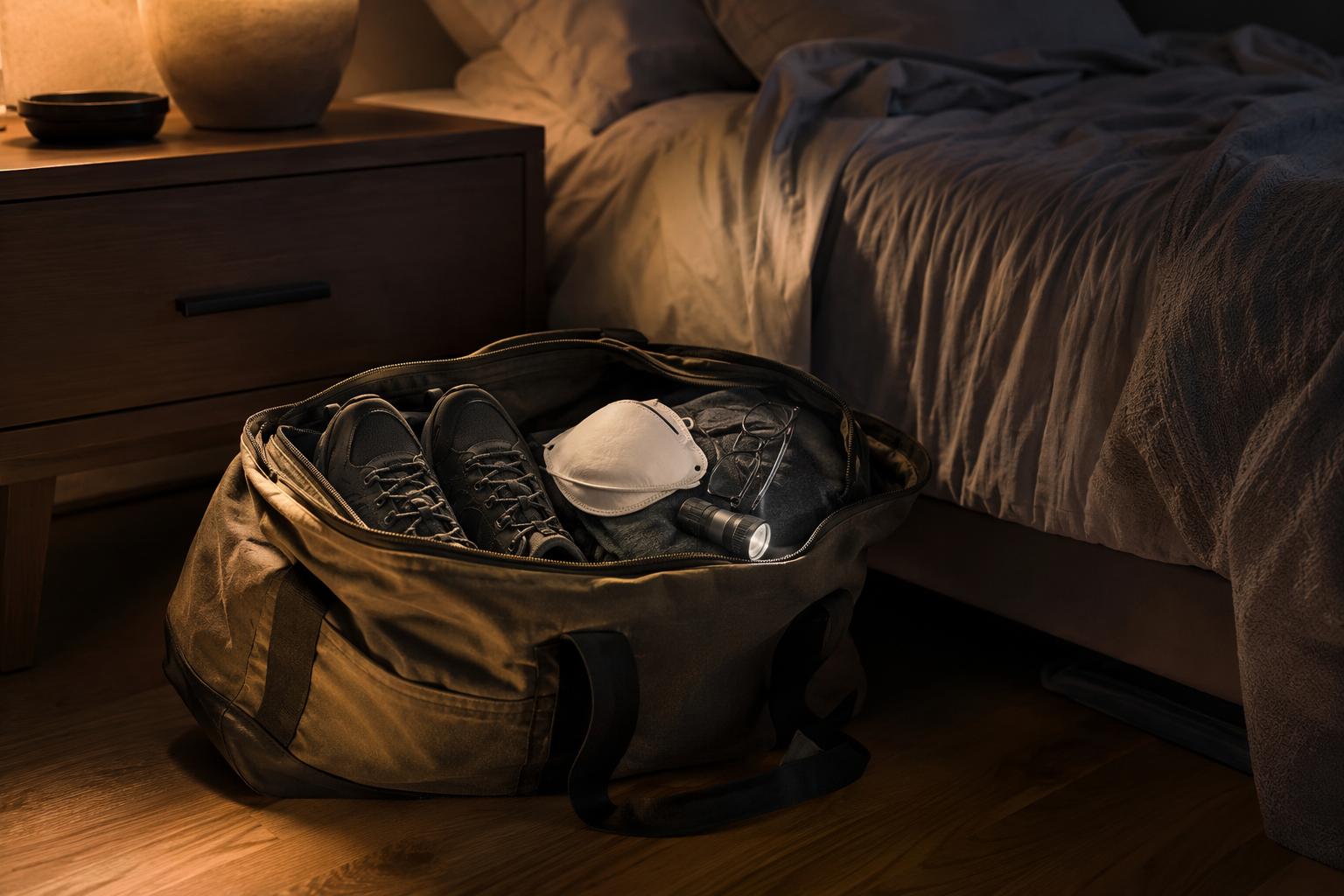
The point is not to build a second full disaster kit. The point is to keep the first minute after waking from becoming the injury. Shoes before food. Light before paperwork. A mask before stirring up dust. The larger home emergency supplies still matter, but they solve a different problem.
During shaking, the kit waits
A bedside kit is for after the shaking, not for a dash across the room during it. If you are already in bed and that is the safer place, CDC guidance says a safe spot may be under the covers with a pillow over your head.[3] Earthquake Country Alliance also notes that studies have shown people who moved from beds during shaking sustained more injuries than those who stayed put.[2]
That one detail changes the design of the kit. It should be reachable from bed, but it does not need to be opened while the room is still moving. You protect your head, stay away from windows if possible, wait until the shaking stops, then use the bag before standing or walking.
This also explains why a kit across the bedroom is not a bed-kit. If broken glass is already between you and the dresser, the useful supplies are on the wrong side of the problem.
Bedside kit, go-bag, and home kit are not the same thing
A general earthquake go-bag is usually built around evacuation: water, food, copies of documents, medications, phone chargers, cash, and other supplies for being away from home. A stay-at-home emergency kit is built around utility outages and delayed services. Both are useful. Neither is designed around a bare foot landing in debris beside the bed.
| Kit | Where it belongs | What it solves first |
|---|---|---|
| Bedside earthquake kit | Attached to or directly under each bed | Getting out of bed safely after nighttime shaking |
| Go-bag | Near an exit or other planned grab-and-go location | Leaving home with essential supplies |
| Home emergency supplies | Stored where the household can access them after the event | Managing hours or days without normal services |
The bed-kit should be smaller and more stubbornly practical than the other two. If adding bulky “just in case” items makes the shoes harder to grab or the flashlight harder to find by touch, the kit has started to fail at its actual job.
The same logic applies to the room itself. Anchoring furniture, moving heavy objects away from the bed, and reducing breakable items near sleep are part of the larger bedroom setup; those choices are covered in more detail in How to Prepare Your Bedroom for Earthquake Safety During Sleep. The bedside kit handles what remains: the first dark, awkward movements after waking.
Build the kit around the injuries it prevents
Earthquake Country Alliance’s under-bed list is short for a reason: sturdy shoes, heavy socks, glasses or contact supplies, flashlight or headlamp, N95 dust mask, whistle, and work gloves.[2] Each item earns its place because it solves a specific nighttime failure mode.
For broken glass: sturdy closed-toe shoes and heavy socks
Shoes are the center of the kit. The California Earthquake Authority notes that the most frequent earthquake injuries come from stepping on broken glass.[4] A pair of sturdy closed-toe shoes beside every bed is the simplest answer to that injury pattern.
Choose shoes that can be put on quickly without delicate laces, thin soles, or exposed toes. Old sneakers are usually better than sandals. Work shoes are fine if they are easy to put on while sitting on the edge of the bed. Heavy socks help if the shoes are stiff, cold, or shared with occasional guests in a guest room.
Do not store the shoes loose across the room. Put them in the bag or directly attached to it. A single shoe kicked under the bed is not a system; it is a scavenger hunt in the dark.
For poor vision: glasses or contact supplies
People who wear glasses often know exactly where they are at bedtime. That confidence can disappear when the nightstand shifts, drawers open, or a lamp falls. If you need vision correction to move safely, keep an older pair of glasses in the bedside kit if possible.
Contact lens wearers can keep a small case and needed supplies in the kit, but this should not slow the first step. After shaking, the first priority is still to protect feet and see enough to avoid immediate hazards. If glasses are an option, they are usually simpler under stress.
For darkness: flashlight or headlamp
A phone flashlight is useful only if the phone is charged, reachable, and not under the bed or across the room. A small flashlight or headlamp belongs in the kit because it can be found by touch and used before standing.
A headlamp has one advantage in this setting: both hands stay free. That matters when one hand is feeling for the bed frame and the other is pulling on shoes, holding glasses, or steadying a child. If you use a flashlight, choose one with a simple switch, not a sequence of tiny modes that require clear vision and patience.
For dust after shaking: N95 mask
An N95 dust mask is for the dusty minutes after shaking, not something to fumble with while the room is moving. Drywall dust, insulation, smoke-like debris, or particles from broken materials can make the air irritating just when someone needs to think clearly and move carefully.
Keep the mask flat or in a clean pouch so it is not crushed under heavier supplies. If there are children or multiple sleepers in the room, size and fit matter; one adult mask in a bag does not cover everyone.
For calling attention: whistle
A whistle is small, cheap, and easy to underestimate. It is not there because every earthquake traps people. It is there because shouting takes energy, voices get hoarse, and a person who cannot safely move may still need to be heard.
Attach it to the bag strap or place it in an outside pocket. If it sinks to the bottom under shoes and gloves, it becomes one more thing that requires light and calm hands.
For touching debris: work gloves
Work gloves protect against the second wave of small injuries: picking up broken glass, moving a fallen frame, touching splintered wood, or clearing a path to a door. They do not need to be specialized rescue gloves. They do need to be sturdy enough that a sharp edge does not go straight through them.
Put the gloves where they can be pulled on after shoes and light. In a two-person bed, each person should have their own pair or know exactly whose gloves are whose. Nighttime is not the moment to negotiate sizing.
Where to put the bag
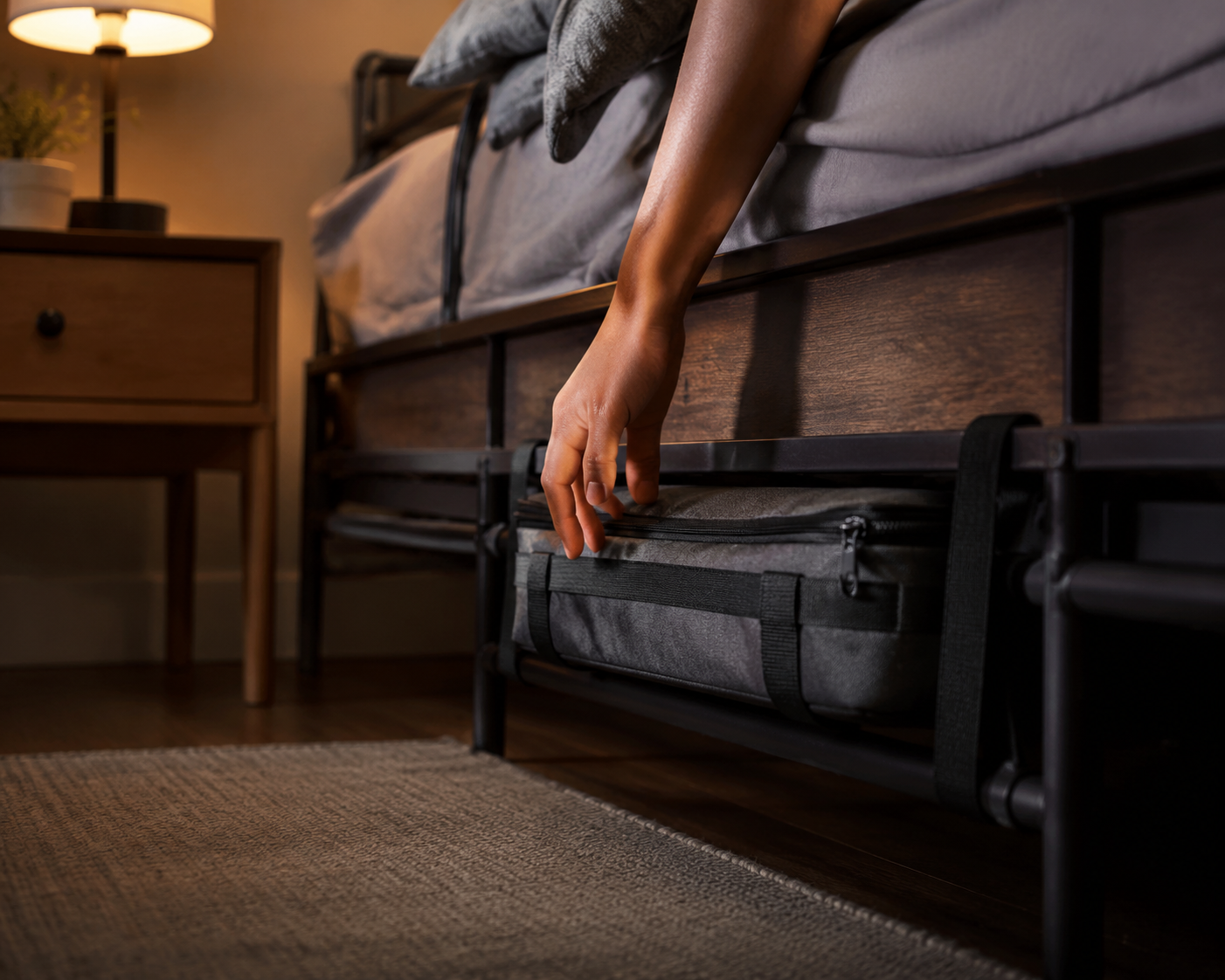
The Red Cross recommendation is specific: attach the bed-kit to each bed.[1] That matters because an unattached bag can slide, get kicked away, or be moved during cleaning and never returned. A small duffel, canvas tote, zip pouch, or drawstring bag can work if it stays in one predictable place.
- Tie or strap the bag to the bed frame, preferably on the side where the sleeper normally exits.
- Keep the opening oriented the same way every time, so the shoes and light are found by touch.
- Do not bury it behind storage bins, luggage, or seasonal bedding.
- Use one kit per bed, including guest beds if people sleep there regularly.
- Check batteries and fit of shoes, masks, and gloves when clocks change or during another recurring household habit.
The test is simple: from your normal sleeping position, can you reach the kit without standing up, without turning on the room lights, and without needing your glasses first? If not, move it.
Optional items belong behind the essentials
A few add-ons can be reasonable, but they should not crowd out the core items. The bedside kit is a first-minute tool, not a storage contest.
- Hard hat: Useful if the sleeping area has overhead hazards or if local guidance recommends one, but it should not replace the shoes, light, and mask.
- Crowbar: Potentially useful if doors jam, but heavy tools need a safe, consistent location and should not make the bag hard to handle.
- Small first-aid kit: Helpful for minor cuts, especially if it is compact. Larger medical supplies can stay with the household emergency kit.
- CPAP backup power: Important for some people with sleep apnea, but it is a separate power-planning need, not a reason to delay the basic bedside bag.
For CPAP users, the practical split is worth keeping clear. The mask, hose, and machine are already bedside; backup power planning should be handled according to the device and medical guidance. The earthquake bed-kit still needs the same low-tech items everyone else needs if the room is dark and the floor is unsafe.
The short setup
If the whole project has to happen tonight, do not start with the perfect bag. Start with the items that keep a sleepy person from getting hurt while leaving the bed.
- Put sturdy closed-toe shoes and heavy socks in a small bag.
- Add backup glasses or contact supplies if you need vision correction.
- Add a flashlight or headlamp with working batteries.
- Add an N95 dust mask, whistle, and work gloves.
- Attach the bag to the bed frame or place it directly under the bed where your hand naturally reaches.
After that, build the habit that goes with the supplies: know what you do during shaking, what you touch first after it stops, and when you leave the bed. That behavioral layer is covered in How to Build an Earthquake Safety Sleep Routine.
Preparedness should make sleep feel more settled, not turn bedtime into a hazard inventory. If earthquake planning is keeping you awake, How to Sleep When Earthquake Anxiety Keeps You Awake may be the more useful next read.
A bedside earthquake kit is not about surviving for days. It is about preventing the most avoidable injuries in the first dark minutes after waking. Put the shoes, light, mask, gloves, whistle, and vision needs in one bag, attach it to the bed, and keep the larger emergency kit somewhere else.
References
- Earthquake Safety, American Red Cross, https://www.redcross.org/get-help/how-to-prepare-for-emergencies/types-of-emergencies/earthquake.html
- Step 3: Organize Emergency Supplies, Earthquake Country Alliance, https://www.earthquakecountry.org/step3/
- Preparing for Earthquakes, CDC, https://www.cdc.gov/earthquakes/safety/index.html
- How to Make an Earthquake Emergency Kit, California Earthquake Authority, 2019, https://www.earthquakeauthority.com/blog/2019/how-to-make-an-earthquake-emergency-kit

Comments
Join the discussion with an anonymous comment.