
At 3:17 a.m., earthquake safety during sleep is not an abstract preparedness topic. It is a dark room, a half-awake body, a floor you cannot see, and objects around the bed deciding whether your first move is possible. That is why the bedroom deserves different attention from the rest of the house: you spend roughly one-third of your life in bed, and you are least able to see, judge, or move well when shaking starts there. [1]
The practical reason to start here is injury pattern, not fear. The CDC says most earthquake injuries come from falling or flying objects such as TVs, lamps, glass, and bookcases, rather than from building collapse. Earthquake Country Alliance gives the same basic warning: the things that move, break, tip, and slide during shaking are often what hurt people. [2][3]
That turns a vague instruction — “be ready” — into a bedroom audit. The question is not whether the room looks calm in daylight. It is whether anything near the sleeping person can fall onto the bed, shatter into the route out, block the door, or force a barefoot search across a dark floor.
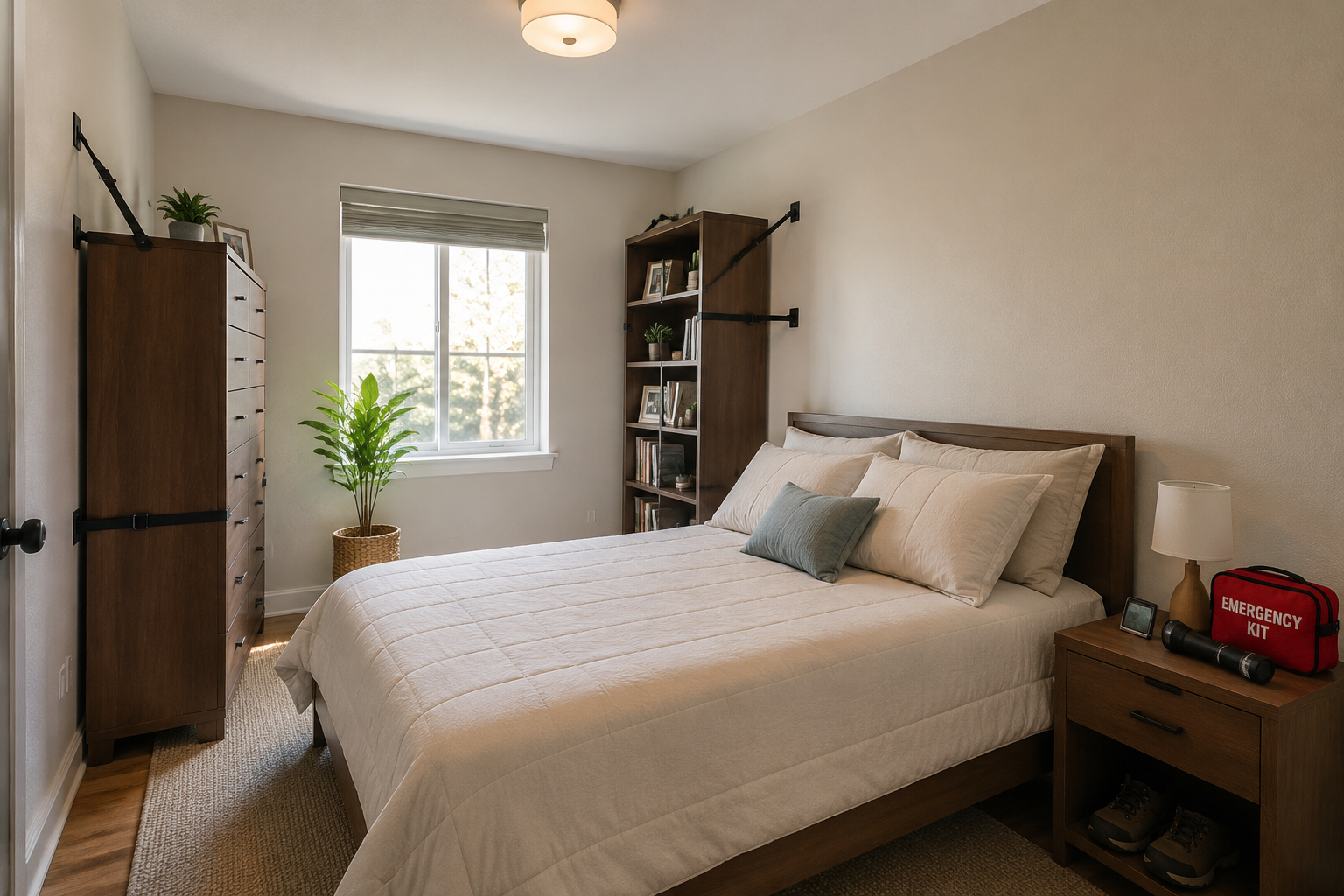
Start at the bed, because that is where the earthquake finds you
Stand at the foot of the bed and look at the room as if the lights have gone out and the floor is moving. The first pass is simple: what can hit the bed, what can drop glass onto the bed, and what can force you to stand before you are oriented?
The fastest zero-cost improvement is often bed placement. If the bed sits under a window, below a heavy framed print, beneath a shelf, near a tall bookcase, or directly under a ceiling fan or heavy light fixture, move it if the room allows. UC Berkeley’s residential earthquake guidance and bedroom-specific preparedness guides both emphasize keeping beds away from windows, unsecured shelves, and objects that can fall during shaking. [4][1]
An interior wall is usually the better target than a window wall. That does not make the bed earthquake-proof. It just removes a common injury path: glass, frames, mirrors, books, lamps, or decorative objects reaching the pillow before the person in the bed has made a decision.
| Bedroom zone | What to look for | Preferred fix |
|---|---|---|
| Above the pillow | Heavy art, mirrors, shelves, plants, wall-mounted speakers | Remove them or relocate them away from the bed |
| Beside the bed | Windows, glass lamps, tall furniture, unstable nightstands | Move the bed or restrain the object |
| Foot of the bed | Bookcases, dressers, TVs, leaning mirrors | Anchor tall items and clear the route out |
| Floor within first steps | Slippers, cords, glass-prone objects, clutter | Keep sturdy shoes and a flashlight reachable from the bed |
Remove overhead hazards before buying gear
A bedroom emergency kit is useful, but it should not be asked to solve a preventable impact problem. First take down what does not need to be above the bed at all: glass-fronted pictures, mirrors, heavy shelves, wall-mounted decor, hanging plants in ceramic pots, or anything decorative that would be unacceptable if it landed on a sleeping person’s face or chest.
Lightweight art is not automatically safe if it is held by a weak hook over a pillow. If something must remain on the wall, it should be secured with hardware appropriate to its weight and wall type. For renters, this may mean moving the bed instead of modifying the wall. The point is the same either way: do not leave the sleeping area inside the fall zone of objects that serve no safety purpose.
Ceiling fans and overhead fixtures deserve the same plain treatment. If the bed is directly below a heavy fixture and the room layout gives you another reasonable option, move the bed. If relocation is impossible, inspect the fixture, repair looseness, and avoid adding anything hanging or decorative above the sleeping area. This is not because every fan will fail; it is because the bed should not be positioned under avoidable overhead mass.
Anchor the things that can become blockers, strikers, or traps
Tall bedroom furniture is not just storage during an earthquake. A dresser, bookcase, armoire, wardrobe, or TV stand can tip, slide, shed contents, strike the bed, block a door, or trap someone before they are fully awake. Ready.gov tells households to secure heavy items such as bookcases, refrigerators, water heaters, televisions, and objects that hang on walls; bedroom guidance from UC Berkeley and other preparedness resources points to the same work at room scale. [5][4][1]
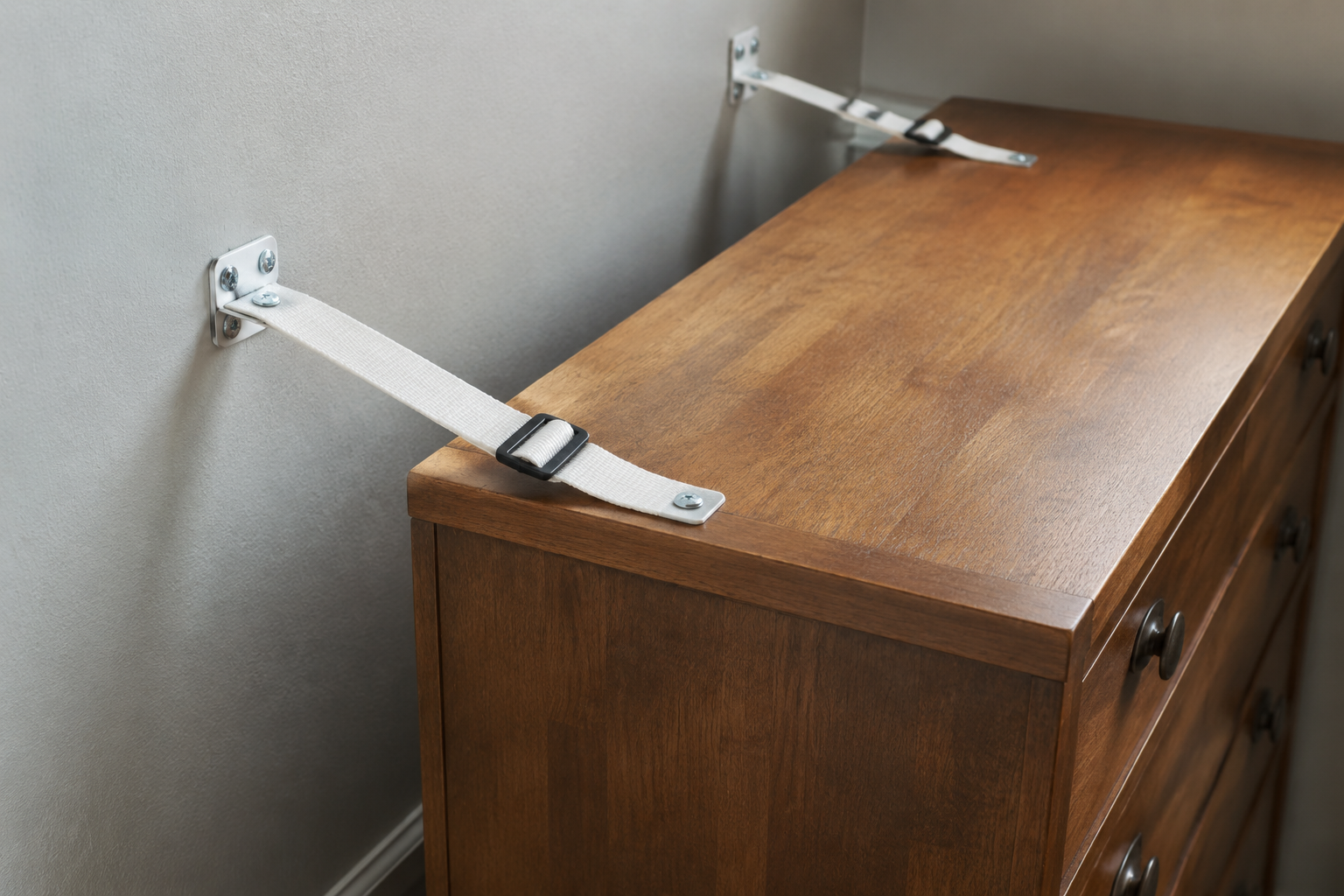
Use furniture straps, anti-tip kits, or L-brackets that are rated for the object and fastened into studs when the wall type allows. Drywall alone is not the same as a stud. The hardware has to connect the furniture to the structure strongly enough that the top of the object cannot swing forward freely during shaking.
Start with the objects that could reach the bed or the path from bed to door. A tall dresser across the room may still matter if it can fall into the exit route. A bookcase beside the bed matters more if its upper shelves hold books, framed photos, speakers, or ceramic objects that can launch outward. A wall-mounted TV matters because the mount and the object both need to stay attached, not because the screen is expensive.
- Anchor dressers, wardrobes, bookcases, freestanding shelves, and tall storage units.
- Secure TVs to the wall or furniture, and secure the furniture itself if the TV sits on top.
- Move heavy objects to lower shelves so the top of the furniture is not loaded with falling weight.
- Latch cabinet doors if they can throw contents onto the bed or into the walking path.
- Check that wall-mounted mirrors, shelves, and art are attached with hardware appropriate for their weight.
The mechanism matters because it keeps the task honest. Anchoring is not a ritual. It reduces the chance that a tall object becomes the first emergency in the room: the thing that lands on you, pins you, or turns the route to the door into an obstacle course.
Treat glass as a nighttime floor hazard
Broken glass is different at night. In daylight, you can avoid it. In a dark bedroom after abrupt waking, it becomes an invisible layer between the bed and everything else. That is why windows, glass lamps, mirrors, picture frames, and glass-front cabinets deserve attention even if they are not directly above the pillow.
Move glass lamps off narrow nightstands if they can fall into the first step zone. Replace them with lower, sturdier lighting if possible. Keep framed glass away from the wall above or beside the bed. If a mirror leans against the wall, either mount it properly or move it out of the bedroom impact zone. A leaning mirror is not stored; it is waiting for the floor to move.
Build the Bed-Kit after the room stops throwing things at you
Once the bed is out of the most obvious impact zones and the tall furniture is restrained, put the small emergency items where a half-awake person can reach them without standing. The American Red Cross recommends keeping sturdy shoes and a flashlight near the bed, and it specifically points to items such as glasses, a dust mask, and a whistle for earthquake safety. [6]
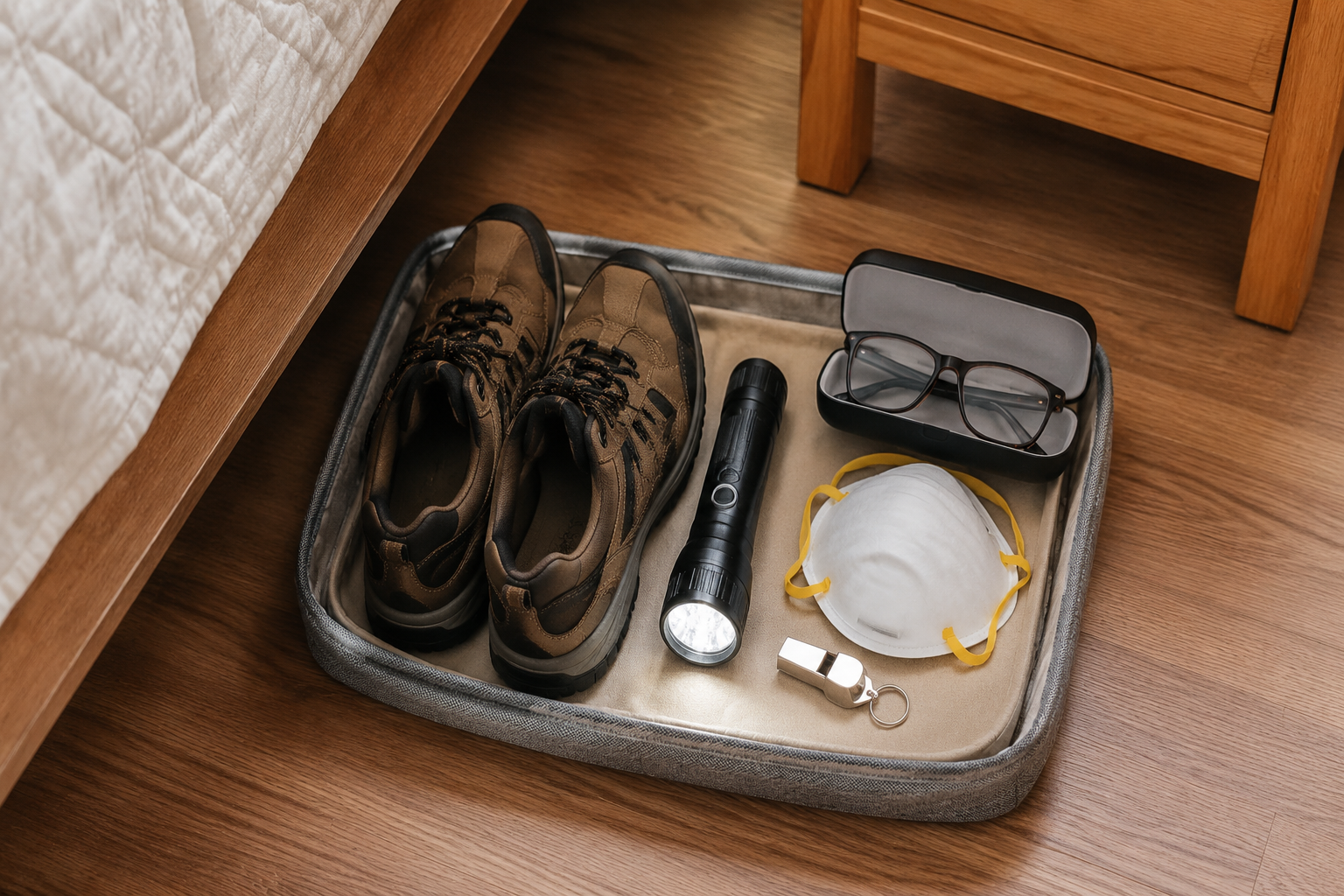
The kit should be attached to the bed frame, tied to a bed leg, or kept in a fixed pouch beside the bed. A drawer is less reliable if the nightstand moves. A flashlight across the room is not a bedside flashlight. Slippers are not the same as sturdy shoes if the floor may hold broken glass.
- Sturdy closed-toe shoes that can handle glass and debris.
- A flashlight or headlamp with working batteries.
- Prescription glasses in a hard case, if you need them to navigate safely.
- A dust mask for dust, insulation, or debris after shaking.
- A whistle in case you need to signal without shouting.
- A small card with emergency contacts, medications, and household shutoff notes if those details are easy to forget under stress.
Ready.gov’s broader emergency kit guidance adds items such as water, food, radio, batteries, first aid supplies, sanitation supplies, and phone charging options. Those belong in the household plan, but they should not bury the bedside purpose: protect feet, restore light, restore vision, reduce dust exposure, and make signaling possible before you leave the bed area. [7]
Keep alerts useful, not central
Earthquake alerts can help, but they are not a substitute for the room doing less harm when shaking arrives. ShakeAlert-supported warnings and the MyShake app are available in California, Oregon, and Washington; Wireless Emergency Alerts and Android Earthquake Alerts have broader reach but different thresholds and behavior. Turn on the alerts you can receive and keep your phone charged close enough to hear, but treat them as a possible seconds-ahead advantage, not as the foundation of bedroom safety.
The stronger work is physical and local: the bed is moved, the furniture is anchored, the glass exposure is reduced, and the flashlight is within reach. Those changes do not require a signal, a charged phone, or a clear first thought.
Maintain the bedroom system
Some earthquake safety tasks are one-time or infrequent investments. Moving a bed away from a window, taking heavy art off the wall above the pillow, and anchoring a dresser usually do not need weekly attention. They do need to be revisited when furniture moves, a new TV is installed, a shelf is added, or a child’s room changes layout.
Other tasks are maintenance. Batteries die. Flashlights migrate. Shoes get borrowed. Anchor straps can loosen after furniture is moved for cleaning. A practical schedule is to check the Bed-Kit and visible straps when clocks change, when smoke alarm batteries are checked, or at the start of local earthquake preparedness reminders. The exact date matters less than giving the room a recurring inspection.
| Task | How often to revisit |
|---|---|
| Move bed away from windows and overhead hazards | When the room layout changes |
| Anchor tall furniture and wall-mounted items | After installation, moving, or remodeling |
| Check strap tightness and hardware | Periodically and after furniture is shifted |
| Test flashlight and replace batteries | Periodically |
| Confirm shoes, glasses, mask, and whistle are still bedside | Periodically and after travel or cleaning |
What the prepared room supports during shaking
The room is prepared so the response can stay simple. Earthquake Country Alliance advises that if you are in bed when shaking starts, you should stay there, turn face down, cover your head and neck with a pillow, and hold on until shaking stops. It also warns against running outside or moving to another location during shaking. [3]
That instruction is easier to trust when the bed is not under glass, shelves, or heavy frames. It is also easier when the first necessary tools are already bedside. The preparation does not depend on waking up calm; it reduces how much the half-awake person has to solve.
For the response sequence itself, see what to do during an earthquake and tsunami if you’re in bed. For the nightly habit side — where the phone goes, how shoes and glasses are staged, and how to avoid turning preparation into bedtime anxiety — use the companion earthquake safety sleep routine. If the physical room is already secured but worry is keeping you awake, the next problem is different; earthquake anxiety aftershocks and sleep belongs in that lane.
A realistic weekend threshold
There is no controlled trial that proves one bedroom layout eliminates earthquake injury risk, and there is no honest way to promise that a room is earthquake-proof. The useful standard is narrower: remove or restrain the known hazards that do the most predictable harm when a sleeping person has the least capacity to respond.
By the end of a weekend, the bed can be out of the impact zone of windows and heavy overhead objects. Tall furniture can be anchored. Heavy items can be off the wall above the bed. Glass hazards can be reduced. Sturdy shoes, a flashlight, glasses, a dust mask, and a whistle can be reachable without standing. That is not the whole earthquake plan, but it is a high-leverage bedroom safety system for the hour when clear thinking is least available.
References
- How to Prepare Your Bedroom for an Earthquake, Amerisleep
- Stay Safe During an Earthquake, CDC
- Drop, Cover, and Hold On, Earthquake Country Alliance
- Earthquake Safety, UC Berkeley Residential Life
- Earthquakes, Ready.gov
- Earthquake Safety, American Red Cross
- Build A Kit, Ready.gov




Comments
Join the discussion with an anonymous comment.