
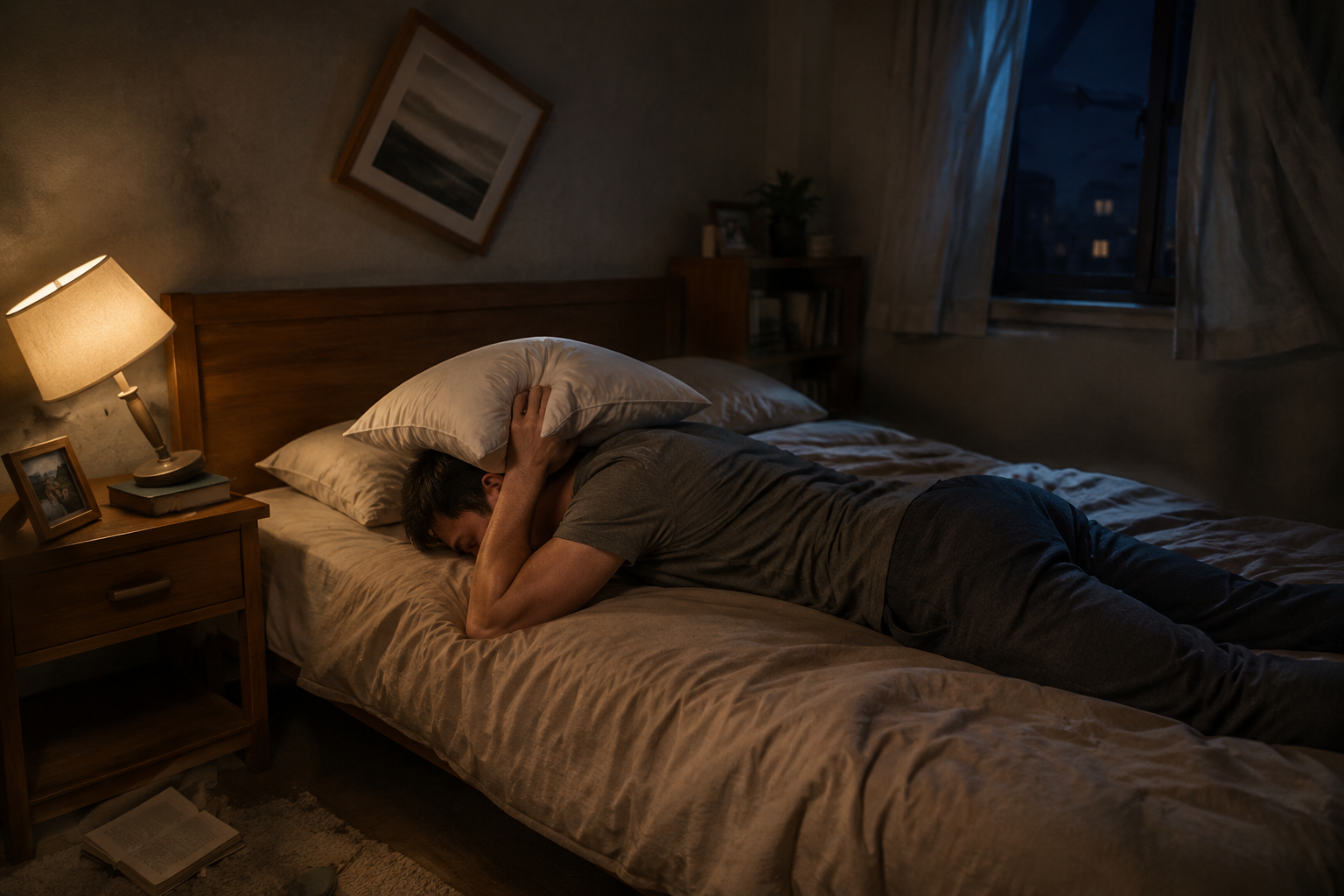
If shaking starts while you are already in bed, do not get up. Stay in bed, lie face down, cover your head and neck with a pillow, and hold on until the shaking stops. That is the in-bed version of Drop, Cover, and Hold On recommended by Earthquake Country Alliance, and it is the first instruction worth memorizing because it has to work before you are fully awake.[1]
The part that feels wrong is the part that matters: staying put. In a dark room, during shaking, getting out of bed can put bare feet into broken glass, send you into furniture, or move you under falling objects. The safest path is not across the room. It is down into the mattress, face protected, neck covered, body still.
The In-Bed Earthquake Script
Practice the sequence as a body instruction, not as a paragraph you hope to remember at 2:17 a.m.
- Stay in bed.
- Roll or turn face down if you can.
- Pull a pillow over the back of your head and neck.
- Hold on to the pillow, mattress, or bed frame.
- Wait until the shaking stops before you move.
The American Red Cross also tells people who are in bed during an earthquake to stay there and protect the head and neck with a pillow.[2] The CDC and Ready.gov reinforce the same larger pattern: protect yourself where you are, avoid running during shaking, and use Drop, Cover, and Hold On rather than trying to move through the room.[3][4]
This advice is not a general instruction to dive into bed from across the room. If you are awake, standing, or walking when shaking starts, use standard Drop, Cover, and Hold On where you are. Get low, cover under sturdy furniture if possible, and hold on. The bed protocol is for the person who is already under the covers when the room starts moving.
Why Getting Up Is the Wrong First Move
A bedroom is full of small, ordinary hazards that become sharp or mobile during shaking: framed glass, lamps, books, water glasses, mirrors, dressers, loose chargers, and the hard corner of a nightstand. The risk is worse at night because you may not have glasses on, may not know where your phone landed, and may be moving before your balance catches up.
That is why the first instruction is so plain. Do not go looking for shoes while the floor is moving. Do not run to a doorway. Do not try to reach a child’s room during active shaking unless there is a separate immediate danger where you are. The first few seconds are for protecting your skull, neck, and body from what is falling or sliding nearby.
A doorway is not the dependable refuge many people were taught to imagine. Modern emergency guidance emphasizes Drop, Cover, and Hold On instead of moving to a doorway, because moving during shaking is itself a hazard and many doorways do not provide special protection.[4]
Make the Bed Area Safer Before the Shaking
The in-bed protocol works best when the bed is not placed under a preventable hazard. The point is not to turn the bedroom into a bunker. It is to remove the objects most likely to punish you for doing the correct thing and staying where you are.
Start with the space directly above and beside the pillow. Do not hang framed glass, heavy art, mirrors, shelves, plants, or decorative objects above the bed. Move tall bookcases, unsecured dressers, and heavy furniture away from the path where they could fall toward the mattress. If a lamp or nightstand object could hit your head, relocate it or secure it.
The CDC recommends fastening items above four feet high with L-brackets or eyebolts into wall studs, and specifically calls out objects that can fall, break, or block exits during an earthquake.[3] In the bedroom, that guidance becomes a simple audit: what can fall toward the bed, what can shatter beside bare feet, and what can block the way out after shaking stops?
| Bedroom item | Safer choice |
|---|---|
| Framed glass or mirror over the bed | Move it to another wall or replace it with something soft and light |
| Tall dresser, bookcase, or wardrobe | Anchor it into wall studs and keep it from falling toward the bed |
| Heavy objects on high shelves | Move them low or secure the shelf and contents |
| Glass of water, ceramic lamp, loose decor on nightstand | Use a shatter-resistant bottle and keep hard objects away from the pillow edge |
| Shoes across the room | Store sturdy shoes in a bed-kit attached to the bed |
The Bed-Kit Is Not Extra Gear
The Red Cross recommends keeping sturdy shoes, a flashlight, glasses, a whistle, a dust mask, and a phone charger in a bag attached to the bed.[2] Attached is the important word. A kit on a closet shelf is a household emergency kit. A kit tied to the bed is for the half-asleep person who has just done the right thing by not crossing broken glass during shaking.
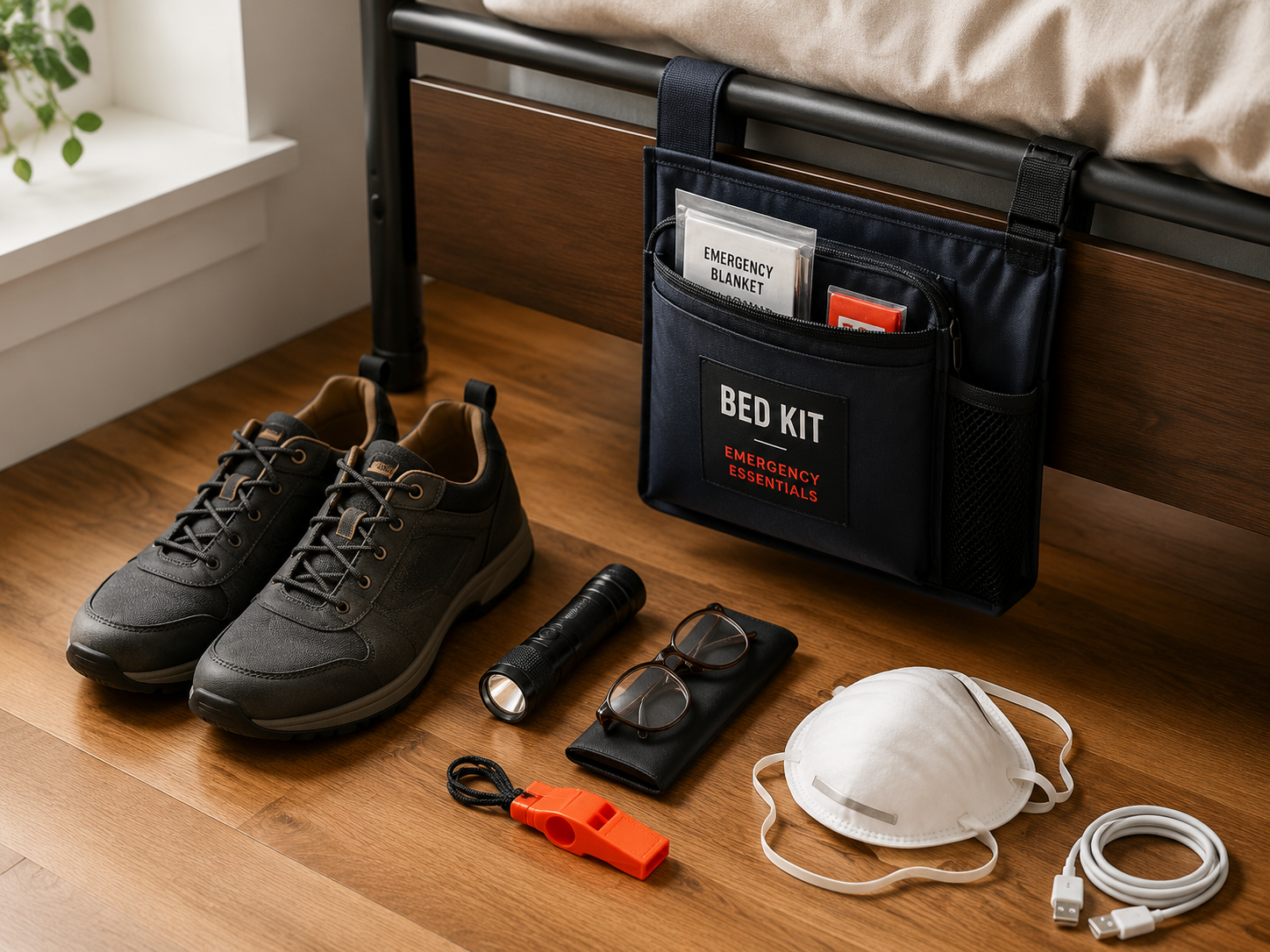
Pack it so your hand can find the same items in the same order every night. If you wear glasses, they should not wander between the bathroom, nightstand, and book stack. Put a backup pair in the kit if you have one, or make one consistent place for your primary pair before sleep. If the room is dark, dusty, or full of debris after shaking, vision and shoes become safety equipment.
- Sturdy shoes: protect your feet from glass, splinters, and fallen objects after the shaking stops.
- Flashlight or headlamp: lets you check the floor and exits without relying on room lights.
- Glasses: keep them in the same reachable place, preferably inside or clipped to the bed-kit.
- Whistle: helps you call for help if you are trapped or cannot safely move.
- Dust mask: useful if dust, insulation, or debris is in the air after damage.
- Phone charging cable or power bank: keeps communication possible after the immediate danger.
Tie the bag to the bed frame, not to a nightstand that can slide away. Use a pouch that closes. Shoes can sit beside it or be clipped together by their laces. The goal is not neatness; it is making the first safe post-shaking move obvious: sit up, put on shoes, get light, then decide what the building and location require.
If You Are in a Tsunami Zone, the Rule Changes After Shaking Stops
During shaking, do not run. After shaking stops, if you are in a coastal tsunami-inundation zone and the earthquake is strong or long, evacuate on foot to high ground immediately. Do not wait for an official warning.[2]
That distinction is easy to blur, especially at night. The earthquake instruction is about surviving the moving room. The tsunami instruction is about leaving the hazard area once the ground stops moving. Ready.gov warns that tsunami waves can move at 20 to 30 mph, reach 10 to 100 feet high, and arrive within minutes after a nearby earthquake.[5]
If you live, work, or sleep in a mapped tsunami-inundation zone, keep the evacuation route as familiar as the bed protocol. Shoes and a flashlight belong in the bed-kit partly because coastal readers may need to leave in darkness, without power, and without time to search. Ready.gov’s tsunami guidance is also blunt about transportation: walk to high ground; do not drive unless officials direct you to.[5]
If you are not in a coastal tsunami zone, do not add a tsunami evacuation step to your earthquake plan. Stay protected during shaking, check yourself and the room afterward, avoid damaged areas, and follow local emergency information. A rushed evacuation away from a non-tsunami hazard can create its own problems.
A Nightly Routine That Takes Less Than a Minute
Preparedness helps sleep when it removes decisions from the dark. It does not make earthquakes predictable, and it does not promise that fear will disappear. It does give your half-awake body fewer choices to sort through while furniture is moving.
- Place glasses in the same spot or inside the bed-kit.
- Keep shoes reachable from the mattress, not across the room.
- Confirm the flashlight is in the kit and works.
- Keep the phone charging cable where it can be found by touch.
- Look once at the wall above the pillow: nothing heavy, sharp, or glass.
- If you are in a tsunami zone, know which direction you walk after shaking stops.
Ready.gov encourages practicing earthquake drills, including Drop, Cover, and Hold On, through efforts such as the Great ShakeOut.[4] For a bedroom plan, practice does not need to be dramatic. Lie down, reach for the pillow, cover the head and neck, hold on, then reach for shoes and the flashlight. That is enough to make the motion less novel if it ever matters.
When Fear Keeps Showing Up at Bedtime
Earthquakes and displacement can disturb sleep, especially after severe disasters. In a 2025 study of adolescent earthquake survivors, 74.4% reported that relocations and household disruption negatively affected sleep.[6] That finding should not be stretched into a forecast for every person who feels one moderate tremor, but it does make one thing clear: sleep can be affected by the aftermath, not only by the shaking itself.
If the bedroom is prepared and the in-bed response is rehearsed, but you still cannot settle after an earthquake, shift to a sleep-anxiety plan rather than adding more gear. For the immediate night, use How to Sleep With Earthquake Anxiety Tonight. If insomnia persists, Can’t sleep after an earthquake? How CBT-I breaks the anxiety cycle is the better next step.
For the physical plan, stop at the essentials: stay in bed during shaking, cover your head and neck, keep hazards away from the pillow, attach the bed-kit to the bed, and if you are in a tsunami-inundation zone, walk to high ground as soon as the shaking stops.
References
- Step 5: Drop, Cover, and Hold On — Earthquake Country Alliance. https://www.earthquakecountry.org/step5/
- Earthquake Safety — American Red Cross. https://www.redcross.org/get-help/how-to-prepare-for-emergencies/types-of-emergencies/earthquake.html
- Preparing for Earthquakes — CDC. https://www.cdc.gov/earthquakes/safety/index.html
- Earthquakes — Ready.gov. https://www.ready.gov/earthquakes
- Tsunamis — Ready.gov. https://www.ready.gov/tsunamis
- Kahraman & Çubukcu 2025 — Nature Scientific Reports. PMC12267622





Comments
Join the discussion with an anonymous comment.