
Sleep does not begin with the brain simply deciding to switch off. One of the quieter requirements is thermal: core body temperature has to fall by roughly 0.5–1°C, and the body has to move heat outward through the skin so that sleep can take hold.[1] That is why hot weather sleep disruption can feel so stubborn. The problem is not only that the room is unpleasant. The heat is pushing against one of the body’s own entry routes into sleep.
In ordinary sleep onset, the center of the body cools while the hands and feet often become warmer. That distal warming is not a contradiction; it is part of the mechanism. Blood vessels in the extremities widen, heat moves toward the surface, and the core can shed enough warmth for NREM sleep to begin. A 2019 review in Frontiers in Neuroscience describes this skin-temperature shift as tightly linked to sleep initiation, with distal vasodilation acting as one of the strongest physiological predictors of falling asleep.[1]
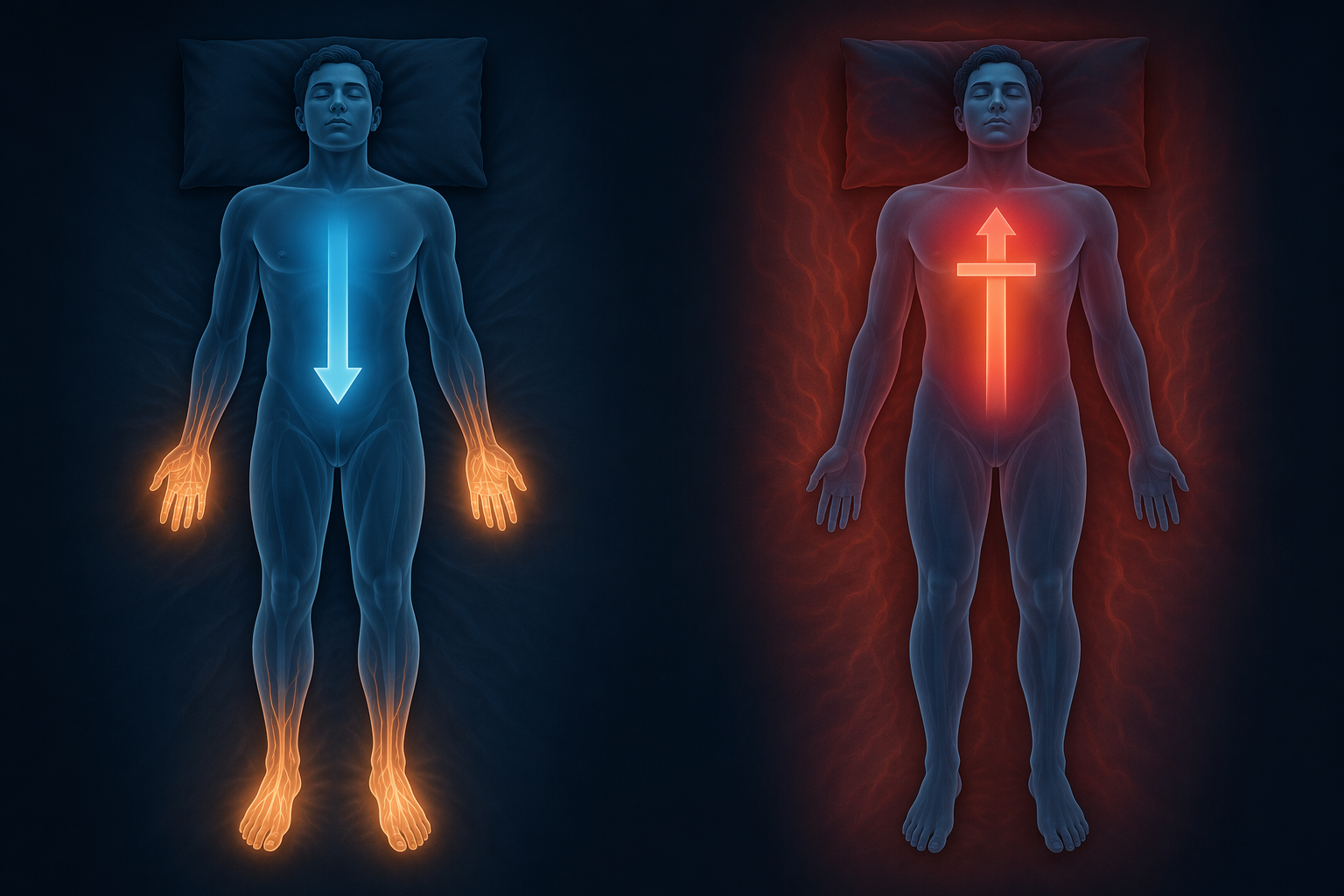
This is the part that gets flattened when summer sleep advice stops at “keep the room cool.” A cooler room matters because it protects the temperature gradient the body is trying to create. If the air around the sleeper is too warm, heat loss through the skin becomes harder. The body may still be tired, the clock may still say bedtime, and the person may still be lying still in the dark, but the thermoregulatory handoff that usually helps open the gate to sleep is being obstructed.
Sleep Onset Depends on Losing Heat, Not Just Feeling Comfortable
The daily rhythm of core body temperature is tied to the sleep-wake cycle. Core temperature typically declines in the evening and reaches its lowest point during the sleep period. That decline is not a decorative background process; it is part of the physiology that helps sleep arrive. When the body cannot unload heat efficiently, sleep onset can be delayed even if the person has done the obvious behavioral things correctly.
The skin is where much of this negotiation happens. The Frontiers review highlights the distal-to-proximal skin temperature gradient: the difference between temperatures at the extremities and more central skin sites. When the hands and feet warm relative to the trunk, the body is often better positioned to shed core heat. In neonates, a distal-to-proximal skin gradient above 2.5°C was associated with a tripled likelihood of falling asleep within 30 minutes, a striking example of how closely distal warming and sleep onset can move together.[1]
That neonatal finding should not be treated as a one-to-one rule for adults. It is still useful because it shows the direction of the mechanism: sleep onset is not helped by simply being warm everywhere. It is helped when heat can be redistributed outward. Warm hands and feet can be a sign that the body is opening a pathway for core cooling. A hot room can erase the usefulness of that pathway by making heat dissipation less effective.
The same review also points to work identifying neurons in the preoptic hypothalamus that connect skin warmth with NREM sleep initiation.[1] That matters because it keeps the explanation from drifting into folk wisdom about fresh air or personal preference. The body is reading thermal information and using it in the machinery that helps generate sleep. Heat is not merely competing with comfort; it is competing with a control system.
Why a Hot Room Can Leave You Tired but Still Awake
A person can be sleep deprived and still unable to fall asleep quickly in heat because sleep pressure and thermal readiness are not identical. Sleep pressure builds with time awake. Thermal readiness depends on whether the body can lower core temperature and redistribute heat. On a hot night, those two signals can point in different directions: the brain needs sleep, while the body is still struggling to create the temperature conditions that make sleep easier to initiate.
This distinction helps explain why heat-related sleep trouble often feels different from ordinary restlessness. The person is not necessarily alert, anxious, or under-stimulated. They may be exhausted, heavy-limbed, and mentally done with the day. But if the skin cannot lose heat efficiently, the normal evening core-temperature decline is blunted. The body is stuck trying to begin a state that depends on a thermal transition it has not completed.
The practical implication is narrow but important. Cooling strategies are useful when they restore the body’s ability to dump heat, not because they create a generic feeling of freshness. A fan, open window, cool shower, breathable bedding, or air conditioning can each help or fail depending on whether it changes the heat exchange that matters. For a more practical comparison of non-AC approaches, see cooling a bedroom without AC. The physiology is the filter for judging the advice.
Once Sleep Starts, Heat Can Still Reshape the Night
Falling asleep is only the first failure point. Heat can also change what happens after sleep begins. The 2019 temperature-dependence review describes higher ambient temperatures as disruptive to sleep architecture, including reductions in slow-wave sleep, suppression of REM sleep, and increases in wakefulness after sleep onset.[1] A 2024 systematic review of ambient heat and sleep in a warming climate reached a similar broad conclusion: higher ambient heat is associated with poorer sleep, including shorter duration and altered sleep structure, while evidence for rapid adaptation remains limited.[2]
That architecture point deserves more attention than it usually gets. “I slept badly” can mean several different things. It can mean taking longer to fall asleep. It can mean waking repeatedly. It can mean losing the deeper NREM sleep that normally clusters earlier in the night. It can mean less REM sleep, which tends to become more prominent later. Heat can touch more than one of these processes, so the complaint is not always solved by asking whether the person technically slept at all.
| Part of the night | What heat can interfere with | Why it feels different |
|---|---|---|
| Sleep onset | Core temperature decline and distal vasodilation | Tired but unable to cross into sleep |
| Early sleep | Slow-wave sleep stability | Sleep feels shallow or physically unrecovering |
| Across the night | Wakefulness after sleep onset | Repeated awakenings or long restless stretches |
| Later sleep | REM continuity | Sleep feels fragmented, shortened, or mentally unsatisfying |
Slow-wave sleep is especially relevant because it is not just “being asleep more deeply” in a vague way. It is a distinct NREM state with its own physiology. If heat reduces it, the consequence is not the same as losing a few minutes at the edge of bedtime. The night can become lighter and more breakable. A person may wake with the sense that sleep happened, but not the kind that restored much.
REM suppression belongs in the same discussion for a different reason. REM sleep is physiologically unusual: thermoregulation is reduced compared with waking and NREM sleep. That makes hot conditions especially poorly timed when the sleeper needs the night to move through its normal cycling. If the environment keeps pushing heat stress into the sleep period, the body is not just uncomfortable inside sleep; it is trying to preserve sleep stages under thermal conditions that work against them.

The Threshold Is Not Extreme Heat
The bedroom does not have to feel like a heat emergency before sleep physiology notices. European Insomnia Network guidance describes a bedroom temperature around 19°C, or 66°F, as optimal and temperatures above 25°C, or 77°F, as disruptive.[3] That threshold is useful because it matches what many people experience: the night can be only mildly hot by daytime standards and still be warm enough to disturb sleep.
This is where “just adapt” becomes too easy an answer. People do adapt to seasonal conditions in some ways, and housing, bedding, humidity, airflow, hydration, medications, age, and health status all shape the actual burden of a hot night. But the 2024 systematic review specifically notes limited evidence of fast sleep adaptation to heat.[2] It is safer to say that some people and places cope better than others than to imply the sleep system simply learns its way around the thermal problem.
A hot room also does not act alone. Humidity can make sweat less effective. Still air can reduce convective heat loss. Bedding can trap warmth close to the body. Urban housing can retain heat after sunset. These factors matter because they alter the same basic exchange: whether heat can leave the body fast enough for sleep to start and remain stable.
Population Studies Show the Same Pattern at Scale
Mechanism explains why the night feels wrong; population data show that the effect is measurable outside the lab. A 2025 USC-led analysis using All of Us Research Program data examined 14,232 U.S. adults across more than 12 million nights and found that a 10°C increase in nighttime temperature was associated with 2.63 fewer minutes of sleep per night.[4] That number is small at the level of one night, but it is not trivial when repeated across hot periods and large populations.
The same USC report found regional differences: West Coast residents lost nearly three times as much sleep as residents in other U.S. regions under comparable nighttime temperature increases.[4] That does not prove a single cause for the regional pattern. Housing stock, air-conditioning access, acclimatization, local climate, and behavior may all contribute. What it does show is that hot-night sleep loss is not distributed evenly, and the reason is unlikely to be willpower.
Older CDC-linked analysis, described in Psychology Today, used data from 2002–2011 and about 750,000 respondents. It reported that a 1°C deviation above the monthly average nighttime temperature was associated with three additional nights of insufficient sleep per 100 people, estimated as about 9 million additional poor-sleep nights per month in the United States.[5] Because those data come from an earlier period, they should not be treated as a current prevalence estimate for 2026. They are still useful as evidence that nighttime temperature shifts have shown up in self-reported sleep at national scale.
The population findings do not replace the physiology. They make it harder to dismiss the physiology as a private complaint. When enough people lose sleep as nighttime temperature rises, the individual story of lying awake in a hot room starts to look like the predictable output of a system being stressed in the same direction.
Some Bodies Pay More for the Same Hot Night
The least useful version of summer sleep advice assumes the sleeper is a healthy adult with control over the room. That is not always the person in the bed. The CDC-linked analysis described stronger warm-night sleep disruption among older adults, with effects reported as twice as large in elderly populations and ten times as large in elderly low-income individuals.[5] The numbers matter because they identify a difference in exposure and resilience, not a difference in attitude.
Older adults may already have lighter, more fragmented sleep, altered thermoregulation, medical conditions, medications that affect heat handling, or housing constraints that make nighttime cooling less reliable. Low income can add another layer: less access to air conditioning, less control over building conditions, and greater risk of living in spaces that retain heat. The same outdoor temperature can therefore become a very different sleep stressor depending on who has to sleep through it.
The European Insomnia Network review also notes that evidence on heatwaves and sleep remains scarce, especially for vulnerable groups.[3] That uncertainty should not be used to soften the problem into vagueness. It means the evidence base is still catching up with the people most likely to be affected. For an older person in a poorly cooled apartment, the question is not whether the bedroom feels ideally pleasant. It is whether the body can safely and repeatedly perform the heat loss that sleep requires.
When It Looks Like Insomnia, Context Matters
Heat-related sleep disruption can resemble insomnia from the inside: long sleep latency, repeated awakenings, frustration, and dread of another bad night. The difference is that the trigger may be environmental and thermoregulatory rather than a persistent insomnia disorder. That distinction is not always obvious during a run of hot nights, especially once sleep loss itself starts increasing stress.
A useful triage question is whether the pattern tracks the heat. If sleep worsens mainly when the bedroom stays warm, improves when the room is cooled, and does not persist under more favorable conditions, the body may be reacting normally to a hostile sleep environment. If the problem continues across cooler nights, expands beyond the heat event, or comes with significant daytime impairment, it may need a different frame. For that distinction, this sleeping problem vs. insomnia triage framework is the more relevant next step.
This does not mean a hot night is harmless just because it has an obvious cause. A clear trigger can still produce real sleep loss. It only means the first explanation should respect the trigger instead of immediately treating the sleeper as mysteriously broken.
Cooling Matters Because It Restores the Sequence
The best reason to cool a bedroom is not that sleep advice has always said so. It is that cooling helps restore the sequence the body is trying to run: distal blood vessels open, heat leaves through the skin, core temperature falls, NREM sleep becomes easier to initiate, and the night has a better chance of moving through deeper NREM and REM without repeated thermal interruptions.
That sequence also explains why some familiar fixes disappoint. A fan may help if it increases heat loss from the skin; it may do less in very hot, stagnant, or humid conditions. A cold shower may feel dramatic but can be mistimed if it triggers rebound warmth or leaves the body fighting to stabilize. Heavy bedding can undo a cooler room by trapping a warm microclimate around the sleeper. The useful question is not whether an intervention sounds cooling, but whether it helps the body shed heat at the time sleep is supposed to begin and continue.
There is no need to turn that into a shopping list here. The physiological point is enough: hot weather disrupts sleep because it blocks the normal core-temperature decline, interferes with distal vasodilation, and then reshapes sleep architecture after sleep begins. If the night is hot, the problem is not merely that sleeping feels worse. The sleep system is being prevented from entering and sustaining the state it is built to enter.
References
- The Temperature Dependence of Sleep, Frontiers in Neuroscience, 2019.
- A systematic review of ambient heat and sleep in a warming climate, Sleep Medicine Reviews, 2024.
- European Insomnia Network recommendations to deal with sleep problems during heatwaves, Journal of Sleep Research, 2023.
- Study links rising temperatures to reduced sleep in U.S. adults, Keck School of Medicine of USC, 2025.
- Hot Nights Can Disrupt Your Sleep, Psychology Today, 2017.

Comments
Join the discussion with an anonymous comment.