
If you mention weeks of bad sleep at a primary care visit and get handed the PHQ-9 or GAD-7, the pivot can feel jarring. You came in because you cannot fall asleep, stay asleep, or function the next day. Now the form is asking whether you feel down, hopeless, nervous, or unable to stop worrying.
The useful answer is also the narrow one: mental health screening does not improve sleep quality by itself. A questionnaire is not treatment. What it can do is flag depression, anxiety, stress, or sleep disturbance patterns that may be shaping the sleep problem, so the clinician has a reason to ask better follow-up questions and route care toward something more specific than “try to relax.”
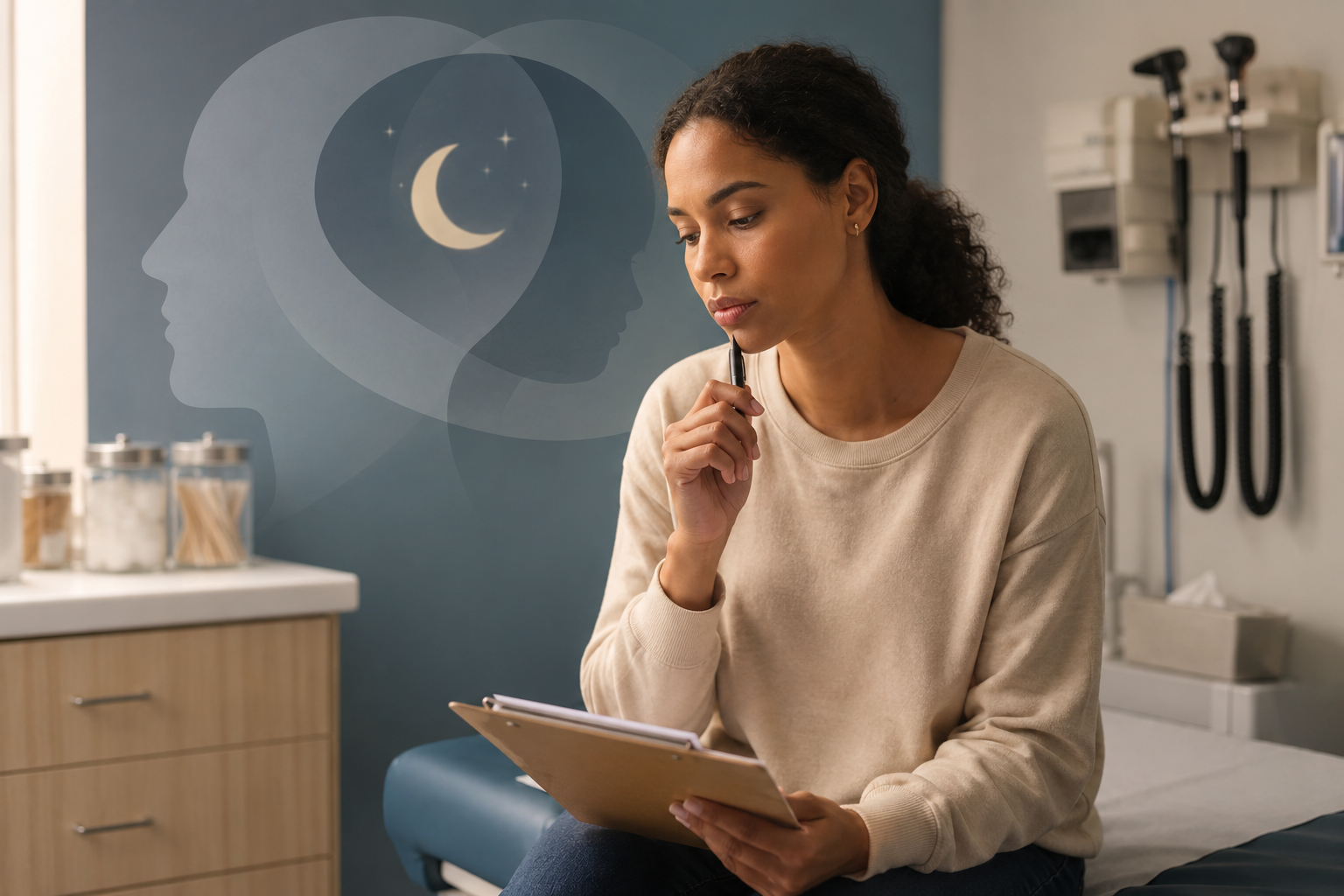
That distinction matters. Screening is the doorway. The measurable sleep improvement, when it happens, comes later: from assessment, diagnosis when appropriate, and treatment that addresses insomnia, depression, anxiety, or some combination of them.
Why a Depression Screener Asks About Sleep
The PHQ-9 is best known as a depression screening tool, but one of its questions is directly about sleep. Item 3 asks about “trouble falling or staying asleep, or sleeping too much.” That single item is one reason a mental health form may be relevant during a sleep visit rather than a paperwork detour.
In a primary care study evaluating PHQ-9 item 3 as a sleep disturbance screen, the item correlated strongly with the Insomnia Severity Index, with r=0.75. At a cut score of 1 or higher, it detected insomnia with 82.5% sensitivity.[1]
Those numbers do not mean one PHQ-9 answer can diagnose insomnia. They mean the sleep item is not random filler. A strong correlation with the Insomnia Severity Index suggests it is tracking something close to what a dedicated insomnia measure is designed to capture. The sensitivity figure suggests that a low threshold catches many people with insomnia, which is useful for a first-pass screen in a busy visit.
The caveat is important: the validation study was conducted in a male VA population.[1] That does not make the finding useless for broader primary care, but it should keep anyone from treating the item as a universal stand-alone test. A younger adult, a postpartum patient, a shift worker, or someone with a medical sleep disorder may need a different follow-up path even if the questionnaire starts the conversation.
The Pathway Is Screening, Then Follow-Up, Then Treatment
A helpful screening process has a sequence. First, the questionnaire identifies symptoms worth discussing. Then the clinician checks what those symptoms mean in context: how long sleep has been poor, whether mood or anxiety symptoms are present, whether medication, pain, alcohol, breathing problems, restless legs, caregiving, work schedules, or other factors are involved. Only after that does treatment planning begin.
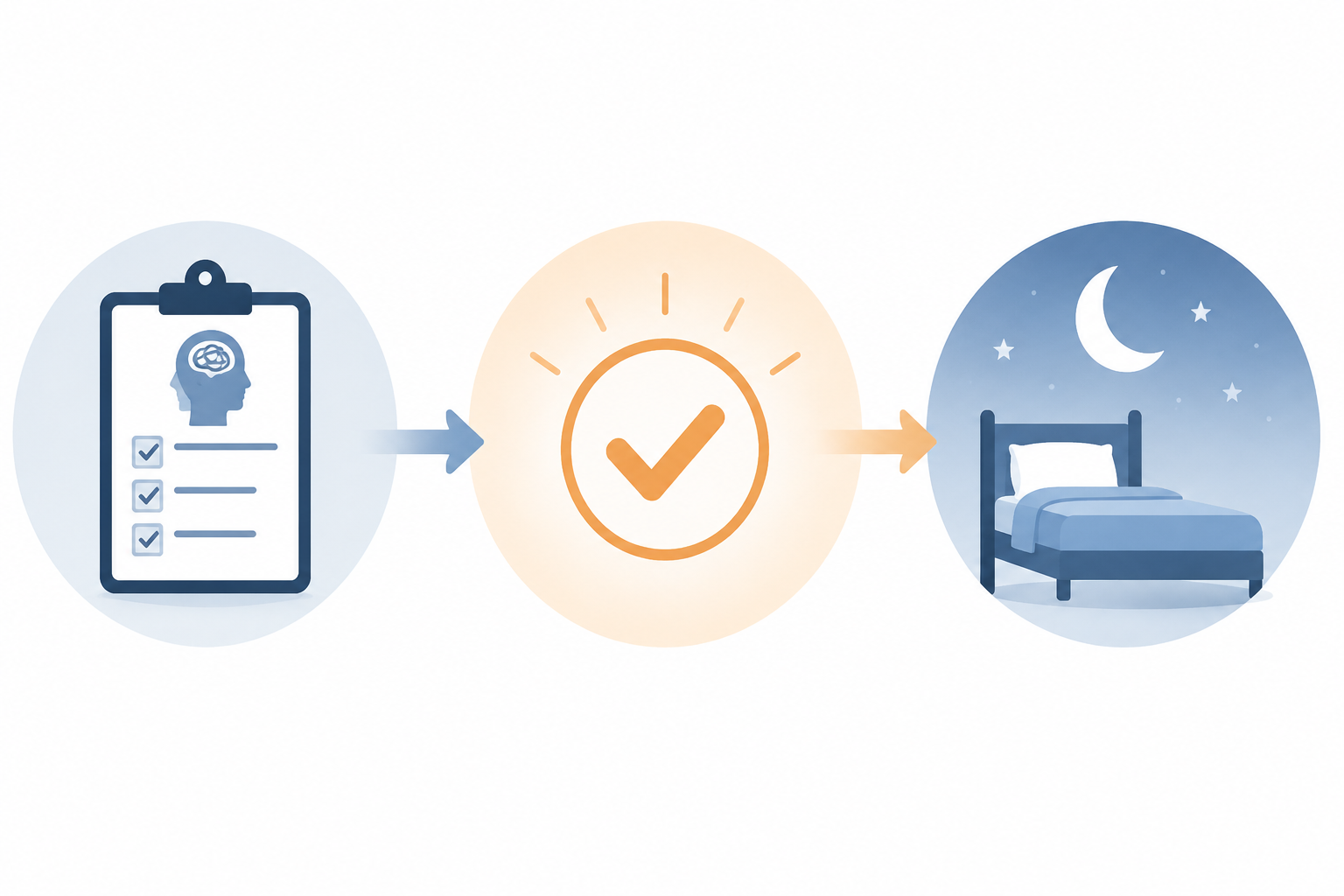
The evidence for improved sleep is strongest when the conversation moves from screening into treatment. A 2021 meta-analysis of 65 randomized controlled trials found that interventions improving sleep quality were associated with medium-to-large reductions in depression, anxiety, and stress. The reported effects were g+=-0.63 for depression, g+=-0.51 for anxiety, and g+=-0.42 for stress.[2]
That same analysis found a significant dose-response relationship: larger improvements in sleep quality were linked with larger improvements in mental health outcomes.[2] This is where the screening form becomes clinically meaningful. It can help identify the person whose sleep complaint is not isolated from mood, anxiety, or stress, and whose care plan may need to treat sleep and mental health together.
| Stage | What It Can Do | What It Cannot Do |
|---|---|---|
| PHQ-9, GAD-7, or similar screening | Flag symptoms of depression, anxiety, stress, or sleep disturbance | Diagnose the cause of insomnia or improve sleep by itself |
| Clinical follow-up | Put symptoms in context and decide whether more evaluation is needed | Guarantee that a positive screen reflects a mental health disorder |
| Sleep-focused or mental health treatment | Produce measurable changes in sleep quality and related symptoms | Work equally well for every person or be equally easy to access |
CBT-I Is a Good Example, Not a Magic Shortcut
Cognitive behavioral therapy for insomnia, or CBT-I, is often the treatment pathway people hope screening will open. In the 2021 meta-analysis, face-to-face CBT-I showed a larger effect than self-administered CBT-I, with g+=-0.63 compared with g+=-0.34.[2] That does not make self-guided care worthless. It does mean the format and support around treatment can affect how much benefit people get.
There is a real-world catch: being identified as someone who might benefit from CBT-I is not the same as being able to find it, afford it, or schedule it. For more on that gap, see why cognitive behavioral therapy for insomnia is so hard to get. A screening result can justify a referral or a treatment discussion, but the health system still has to provide somewhere for the patient to go.
Why Stress, Anxiety, and Depression Belong in the Sleep Conversation
For many people, sleep is where mental strain becomes visible. The American Academy of Sleep Medicine reported in 2024 that 74% of Americans said stress disrupted their sleep, 68% said anxiety disrupted their sleep, and 55% said depression disrupted their sleep.[3] Those figures are prevalence context, not treatment proof. They explain why clinicians ask mental health questions when the stated complaint is sleep.
The relationship can run in both directions. Poor sleep can worsen emotional regulation, concentration, and resilience; depression and anxiety can also make sleep harder to initiate or maintain. Reviews of depression and sleep disturbance describe this as a bidirectional relationship, which is why separating “the sleep problem” from “the mental health problem” is not always clinically realistic.[4]
That does not mean every sleep problem is caused by depression or anxiety. Sleep apnea, circadian rhythm disruption, chronic pain, medications, substance use, menopause symptoms, caregiving, and work schedules can all disturb sleep. A decent follow-up visit should keep those possibilities open, especially when a person’s screening answers do not match the rest of the story.
Readers interested in the timing side of this relationship may also want to read Does Your Bedtime Affect Your Mental Health? The screening question is only one part of a larger pattern: when sleep happens, how stable it is, and how well it restores the next day can all shape the clinical picture.
A Positive Screen Is Not a Diagnosis
This is the part that protects patients from overinterpretation. A positive mental health screen means the answers crossed a threshold for follow-up. It does not prove major depression, generalized anxiety disorder, or any specific diagnosis. It also does not prove that depression or anxiety is the sole reason for poor sleep.
Harvard Medical School has highlighted concerns about mental health screening in primary care, including an approximately 50% false-positive rate and limited trial evidence that screening programs themselves improve outcomes.[5] That critique should not be waved away. False positives can create worry, extra appointments, and labels that may not fit.
But false positives are not an argument for ignoring sleep-linked depression or anxiety symptoms. They are an argument for doing the second step properly. A clinician should ask what the score reflects, whether symptoms are persistent, whether functioning is impaired, whether there is safety risk, and whether a sleep-specific evaluation is needed.
What to Do With the Result
If your sleep complaint leads to a PHQ-9, GAD-7, or similar form, the practical question is not whether the form knows what is wrong. It does not. The question is whether the result leads to a more complete conversation than you would have had otherwise.
- Ask what your score means and whether it is being treated as a screen or a diagnosis.
- Describe the sleep problem concretely: onset, awakenings, early waking, oversleeping, daytime impairment, and how long it has been happening.
- Mention mood, anxiety, stress, panic symptoms, grief, trauma, pain, medications, alcohol, caffeine, and schedule changes if they apply.
- Ask whether treatment should focus on insomnia, depression, anxiety, another sleep disorder, or more than one problem at once.
- If CBT-I is recommended, ask what options are actually available: in-person, telehealth, group, digital, or self-guided support.
Mental health screening affects sleep quality only when it is connected to follow-through. If poor sleep is happening alongside low mood, persistent worry, stress, or daytime impairment, screening can be a legitimate first step. The next step is the one that matters most: a clinician using the result to decide what kind of care your sleep actually needs.
References
- Evaluation of the PHQ-9 Item 3 as a Screen for Sleep Disturbance in Primary Care — PMC, 2011
- Improving sleep quality leads to better mental health: A meta-analysis of RCTs — PMC, 2021
- Stress, anxiety, depression and sleep: New AASM survey results — American Academy of Sleep Medicine, 2024
- Depression in sleep disturbance: A review on a bidirectional relationship, mechanisms and treatment — PMC
- Reassessing Mental Health Screening in Primary Care — Harvard Medical School, 2025
Comments
Join the discussion with an anonymous comment.