
If you work nights, standard sleep hygiene can feel oddly accusatory. Keep a consistent bedtime. Get morning light. Avoid naps. Stop caffeine after lunch. Wind down in the evening. The advice is tidy, and for people who sleep at night it is often useful. But for a nurse leaving the hospital after sunrise, a warehouse worker driving home through morning glare, or a hotel worker trying to sleep while the rest of the building wakes up, the rules are aimed at someone else’s day.
The 2023 Delphi consensus on healthy sleep practices for shift workers says the quiet part plainly: standard sleep hygiene guidelines “as currently written may be impractical for shift workers.” It does not stop at sympathy. It replaces the usual bedtime checklist with shift-specific practices: plan transitions to days off, use strategic naps, manage light before and after the shift, time caffeine and melatonin around intended sleep, and protect an anchor sleep window instead of pretending every day can have the same bedtime. [1]

That matters because this is not a niche complaint from people who have failed to be disciplined. In NIOSH NHANES data, 61.8% of night shift workers reported short sleep of 6 hours or less, compared with 35.9% of day workers. Among night shift workers, 30.7% reported poor sleep quality, and 18.5% met insomnia criteria, compared with 8.4% of day workers. [2] Cleveland Clinic, citing American Academy of Sleep Medicine data, notes that shift workers sleep about 1 to 4 fewer hours per day than non-shift workers. [3]
Those numbers should change the tone of the conversation. When the gap is that large, “try harder to relax” is not an adequate explanation.
The problem is not the bedroom alone
A dark, cool, quiet room helps. Blackout curtains help. Earplugs, a sleep mask, a phone on silent, and a family agreement not to knock at noon all help. But daytime sleep is not just nighttime sleep with better curtains.
The mismatch becomes clearer through the two-process model of sleep regulation. Sleep is shaped by homeostatic sleep drive, the pressure that builds the longer you are awake, and the circadian rhythm, the internal timing system that promotes alertness and sleepiness across the day. For a night shift worker coming home exhausted in the morning, those two systems can be pulling in opposite directions: sleep pressure says “lie down,” while the circadian system, reinforced by daylight and daytime activity around you, says “be awake.” [4]

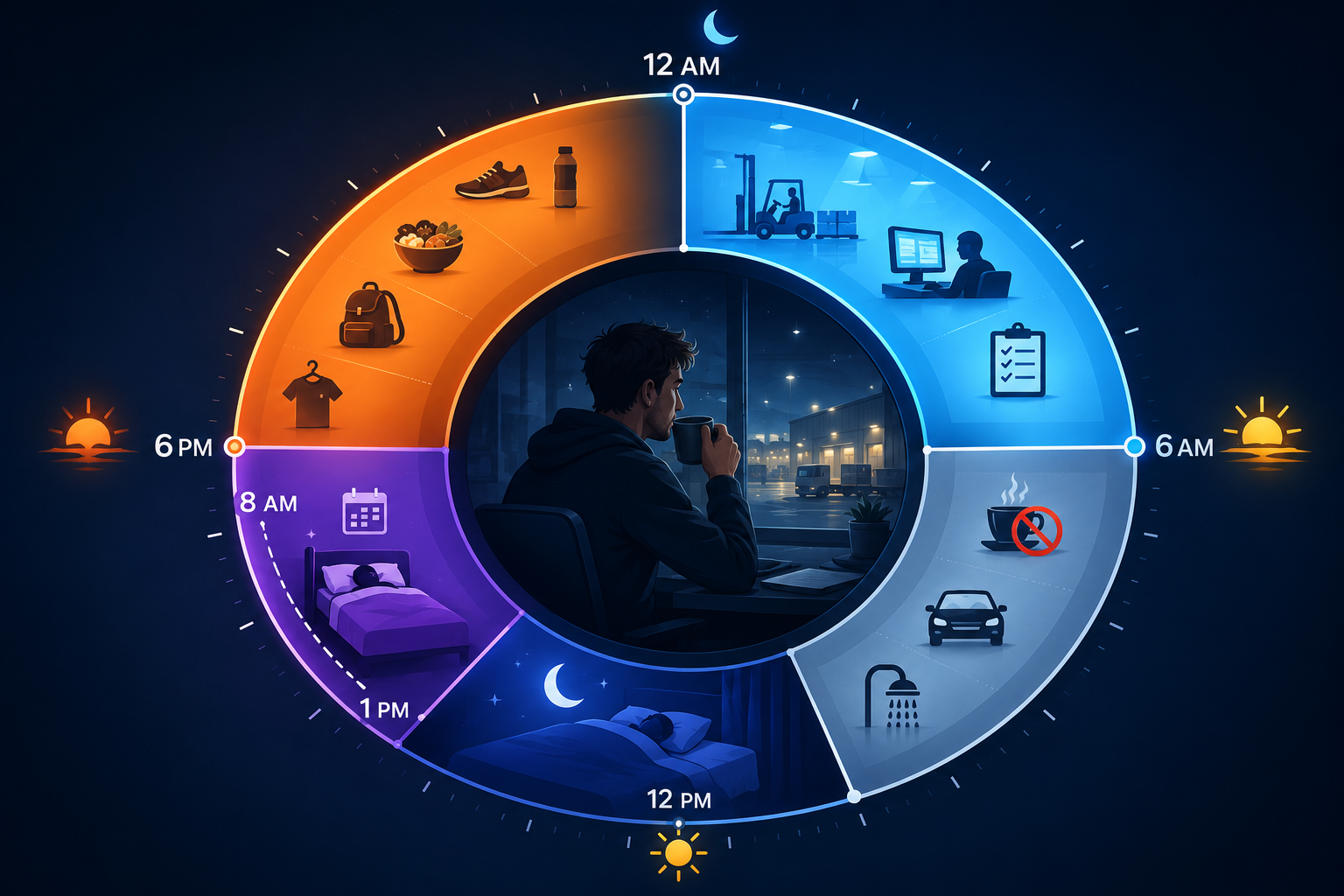
That is why ordinary bedtime advice can fail even when the worker follows it. The issue is not only what happens in the last 30 minutes before sleep. It is the whole transition: the light during the shift, the light on the commute, the timing of caffeine, whether a nap was planned before alertness collapsed, whether food was pushed into the biological night, and whether days off were handled as a total reset or a controlled adjustment.
For the conventional framework that most people have seen, it is still worth knowing the basics of evidence-based sleep hygiene. But for night work, those basics need to be reorganized around circadian misalignment rather than simply repeated with more urgency.
Where standard sleep hygiene reverses for night shift workers
| Conventional rule | Shift-worker replacement |
|---|---|
| Keep the same bedtime every night. | Use an anchor sleep window and shift it deliberately across work blocks and days off. |
| Get bright morning light. | Use bright light when it supports alertness at work, then reduce or block light on the way home. |
| Avoid naps. | Use planned 15–20 minute naps or full 90 minute sleep-cycle naps when they fit the schedule. |
| Avoid caffeine after lunch. | Stop caffeine at least 6 hours before intended sleep, regardless of clock time. |
| Take melatonin at bedtime. | If appropriate, time melatonin before the desired sleep window rather than using the clock’s bedtime. |
| Eat regular daytime meals. | Keep heavier meals out of the biological night when possible, especially during the overnight window. |
The word “replacement” is doing real work here. Night workers do not need a slightly more heroic version of a daytime routine. They need rules that accept the fact that the work period, commute, meals, social life, and sleep opportunity have been rearranged.
Light has to be managed as a sequence, not a bedtime mood
Standard sleep hygiene often treats light as an evening issue: dim the lights before bed, put the phone away, avoid bright screens. For a night shift worker, light management starts much earlier and continues after the shift ends.
During the first part of a night shift, bright light can support alertness when the body expects darkness. After the shift, the job changes. Morning light on the commute can push the circadian system in the wrong direction just as the worker is trying to create a daytime sleep opportunity. The Delphi consensus includes using sunglasses on the commute home, and University of Utah Health gives the same practical advice for night shift workers trying to reduce light exposure after work. [1][5]
That may sound like a small detail until you picture the actual sequence: fluorescent light at work, sunrise through the windshield, a bright kitchen, then a bedroom where the worker is expected to fall asleep by willpower. The bedroom matters, but by then the circadian message may already have been delivered.
- Use light to stay alert earlier in the shift when alertness is required.
- Reduce bright and blue-enriched light near the end of the shift when possible.
- Wear sunglasses on the commute home if daylight exposure would interfere with sleep.
- Keep the daytime bedroom dark enough that sleep is not being fought minute by minute.
This is not about making the room prettier. It is about controlling the signal your brain is using to decide whether it is day.
Naps are not indulgences when the schedule is compressed
For standard nighttime sleepers, naps are often treated cautiously because they can reduce sleep pressure before the main sleep period. That warning gets repeated so often that some night shift workers hear “no naps” even when their schedule gives them too little protected sleep.
The shift-worker consensus treats naps as tools. It specifically includes strategic 15–20 minute naps or 90 minute naps, depending on the situation. [1] Emergency Medicine Cases gives the same practical distinction: a short nap can improve alertness while limiting sleep inertia, while a roughly 90 minute nap aims to complete a full sleep cycle. [4]
The choice is not moral. It is operational. A short nap before a shift may be enough to blunt the worst dip in alertness. A longer nap may make sense when there is a real sleep opportunity and enough time to wake fully before driving or performing safety-sensitive work. An unplanned collapse on the couch with an alarm set too close to departure is a different thing entirely.
Caffeine timing should count backward from sleep
“No caffeine after lunch” is useless advice for someone whose lunch break may happen after midnight. The better rule is to count backward from the intended sleep period.
Emergency Medicine Cases recommends a caffeine cutoff at least 6 hours before planned sleep. [4] For a worker trying to sleep at 8:30 a.m., that means caffeine needs to stop around the early morning hours, not after a conventional lunch. For a worker sleeping in the afternoon before a night shift, the cutoff moves again.
This is where shift work punishes vague rules. “Use caffeine wisely” is too soft. The useful question is: What time are you trying to sleep, and what is the last caffeine time that gives your body a chance to do it?
Melatonin is a timing tool, not a generic bedtime ritual
Melatonin advice also gets flattened in ordinary sleep content. People are often told to take it “at bedtime,” as though bedtime is the same biological event for everyone. For night shift workers, the point is not the wall clock. It is the desired sleep window.
Emergency Medicine Cases discusses melatonin for shift workers at doses of 0.3–5 mg and describes timing it 3–4 hours before the desired sleep period. [4] That is a different instruction from casually taking a pill when you climb into bed. It treats melatonin as a circadian signal, not just a sedative.
This is also a place for caution. Individual responses vary, supplement quality is not regulated like prescription medication, and recurring use across shift blocks raises different questions than occasional use after a bad night. Readers who want the broader safety discussion can start with melatonin as a sleep aid for adults and long-term melatonin safety.
Meals can either support the transition or keep the body on duty
Meal timing is another area where ordinary advice assumes an ordinary day. The shift-worker consensus includes avoiding eating during night shifts when possible. [1] NIOSH training for nurses advises avoiding eating between 12 a.m. and 6 a.m. when possible and using planned meals and snacks to cope with night and evening shifts. [6]
That does not mean every worker can simply skip food overnight. Some shifts are physically demanding. Some breaks are unpredictable. Some workers need food to take medication safely. The practical move is narrower: avoid turning the middle of the night into the heaviest meal of the day when your next task is to get home and sleep.
Anchor sleep is more realistic than a perfect fixed bedtime
A fixed bedtime is one of the most repeated sleep hygiene rules. It is also one of the least realistic rules for rotating shifts, split obligations, childcare, overtime, and days off.
The shift-worker alternative is an anchor sleep window: a protected block of sleep that stays as consistent as possible across workdays and off-days, even if the full schedule moves around it. The Delphi consensus includes structuring anchor sleep windows and planning transitions to days off rather than letting each schedule change become an accidental all-nighter. [1]
For example, a hypothetical worker on several consecutive night shifts might protect a late-morning sleep block after each shift, then keep part of that block on the first day off instead of flipping immediately to an early bedtime. The exact hours depend on the shift, commute, family responsibilities, and whether the person is rotating back to days. The principle is to preserve a reliable core of sleep rather than chase a perfect schedule that the job will break.
For readers who want this translated into a sample schedule, a practical night shift sleep routine can be useful. The larger point here is why the routine has to be built differently in the first place.
A better framework for sleep hygiene for night shift workers
The replacement framework is not complicated, but it is less sentimental than most sleep advice. It starts with the schedule the worker actually has.
- Name the intended sleep window first. Caffeine, melatonin, meals, light exposure, naps, and household boundaries should be timed around that window.
- Manage light across the whole work-to-sleep transition. Bright light may belong early in the shift; light blocking may belong on the commute home.
- Plan naps before the worst fatigue arrives. Choose short naps for alertness or longer sleep-cycle naps only when there is enough time to wake safely.
- Protect an anchor sleep block. Do not let days off erase every bit of circadian stability if another night block is coming.
- Treat food and stimulants as biological signals. The clock time matters less than where they fall relative to work, sleep, and the body’s night.
This is still sleep hygiene. It is just sleep hygiene that has stopped pretending the reader gets to sleep when society is quiet.
When the problem may need medical evaluation
Shift-specific habits can reduce the mismatch, but they do not make every schedule safe or sustainable. Persistent insomnia, excessive sleepiness, near-misses while driving, repeated inability to function on duty, or symptoms that continue despite protected sleep opportunities deserve medical evaluation. Cleveland Clinic describes shift work sleep disorder as a circadian rhythm sleep disorder related to working nontraditional hours. [3]
That distinction matters. A worker can have a brutal schedule without meeting criteria for a disorder. A worker can also be blamed for “bad habits” when the real issue is a circadian disorder, an unsafe schedule, another sleep condition, medication effects, or a medical problem. Sleep hygiene should not be used as a way to avoid that assessment.
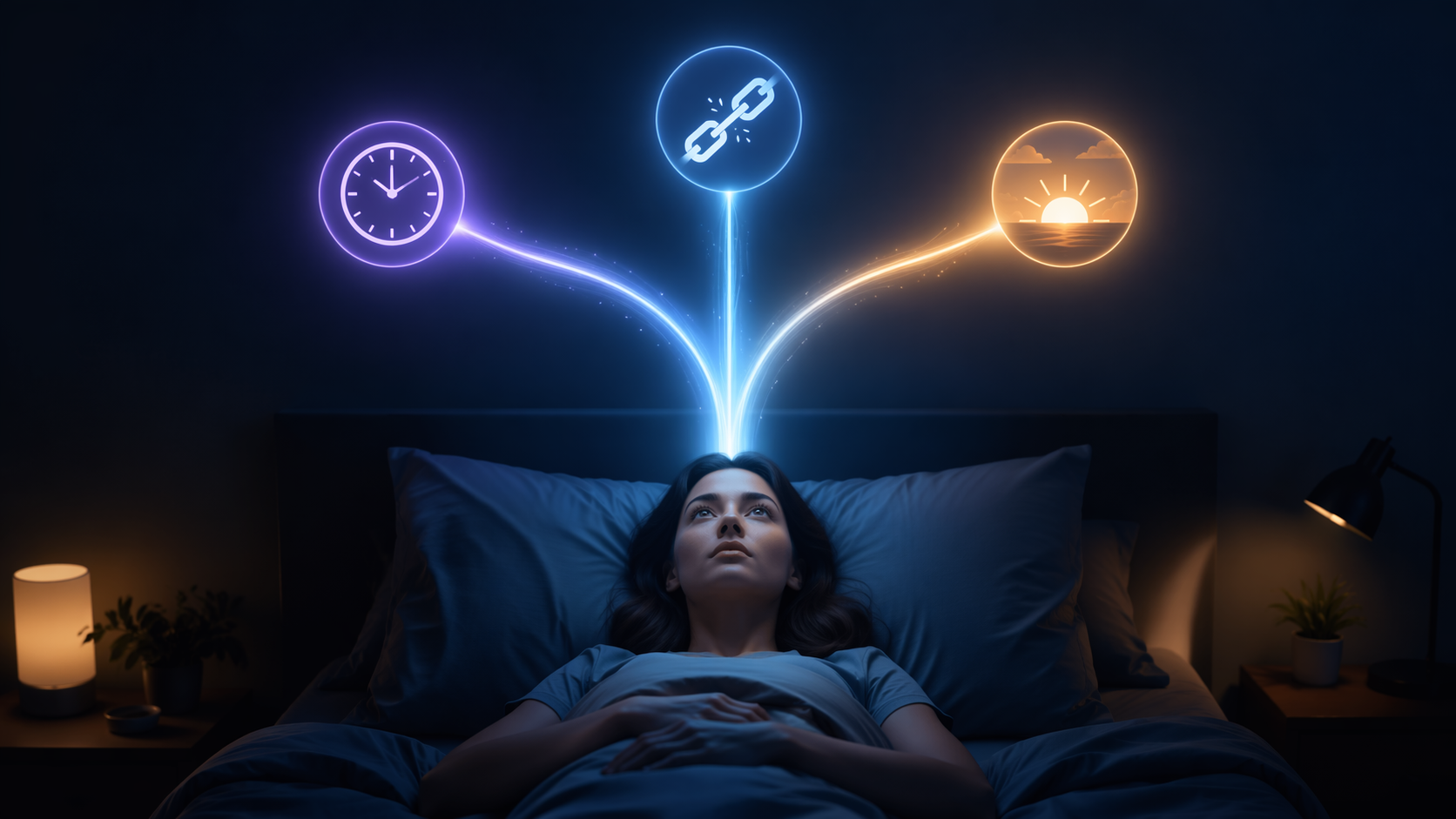
Night shift workers do not need a more disciplined version of daytime sleep hygiene. They need rules designed for circadian misalignment: light managed in both directions, naps used deliberately, caffeine counted backward from sleep, melatonin timed to the desired sleep window when appropriate, meals placed with the biological night in mind, and anchor sleep protected across work blocks and days off.
References
- Healthy Sleep Practices for Shift Workers — Sleep Health Foundation / CQ University, 2023
- Shift Work and Sleep — NIOSH Science Bulletin, 2016
- Shift Work Sleep Disorder (SWSD): Symptoms & Treatment — Cleveland Clinic
- Sleep Strategies for Shift Work — Emergency Medicine Cases
- Sleep Tips for Night Shift Workers — University of Utah Health, 2023
- Module 9. Coping with the Night and Evening Shifts, Sleep — CDC NIOSH



Comments
Join the discussion with an anonymous comment.