
The frustrating part of subway flooding sleep disruption is that it does not always feel like a noise problem. Some nights the train is the obvious culprit: metal-on-metal sound, braking, a low roll through the floor, a burst of vibration under the bed frame. Other nights, especially during heavy rain, the bedroom may be nearly quiet and the trains may be delayed or stopped, yet sleep still becomes shallow. You lie there listening for evidence: water in the street, a service alert, the next rumble, the absence of the next rumble.
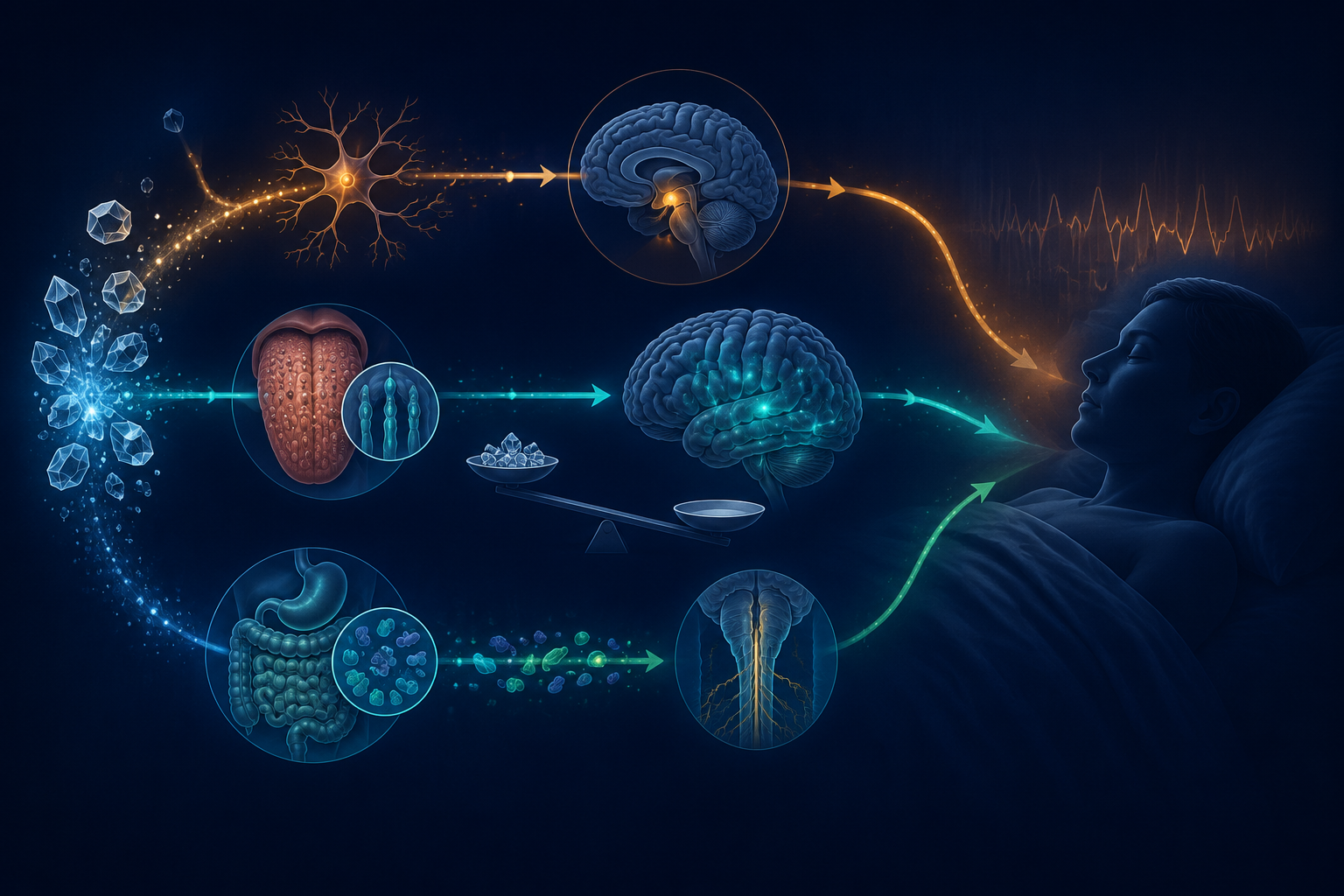
That inconsistency makes more sense if the problem is split into two pathways. One pathway is physical: railway noise and vibration can trigger arousals even when you do not fully wake up. The other is predictive: after flooding or repeated transit disruption, rain itself can become a threat cue, keeping the brain on watch before anything reaches the bedroom. No single study proves this exact chain for subway flooding and sleep. The evidence comes from neighboring literatures: railway sleep experiments, vibration research, and flood mental-health studies. But the fit is strong enough to explain why earplugs, closed windows, or a fan can help one piece and leave the rest untouched.
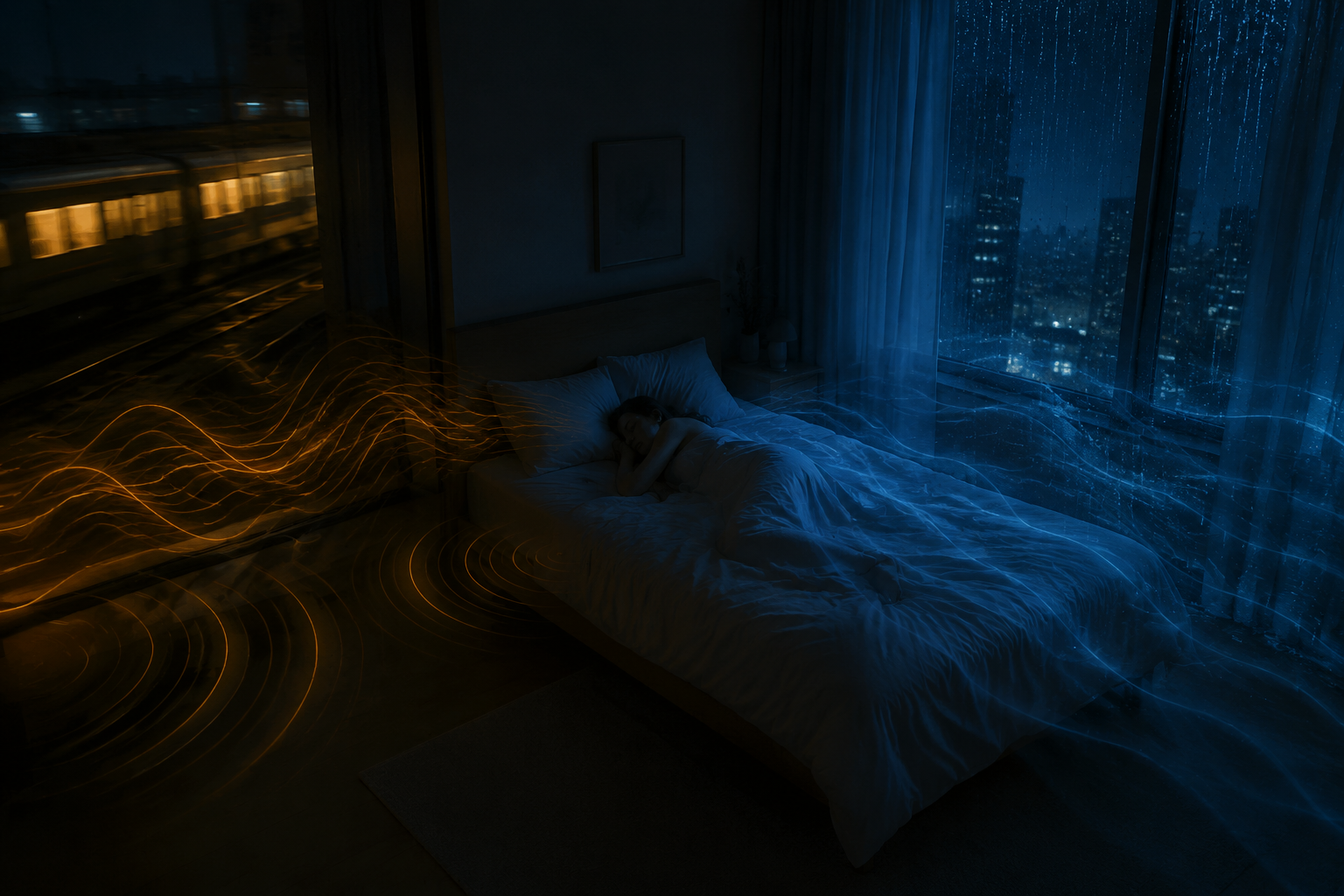
The first pathway: trains disturb sleep through more than sound
Railway noise has a specific sleep profile. In a pooled laboratory analysis of 237 subjects exposed to 109,836 traffic-noise events, railway noise produced a higher probability of awakening than road or aircraft noise at comparable levels. At 70 dB, railway noise was more than 7% more likely to cause awakenings than aircraft noise at the same level. [1]
That finding matters because it moves the discussion away from the loose category of “urban noise.” A train passing at night is not simply a loud event. It has a rise, a peak, a decay, and often a low-frequency component that arrives through more than one route. The ear hears part of it. The building carries part of it. The sleeping body may respond to both.
The laboratory conditions in that pooled work also deserve careful reading. The studies used controlled exposures, not every messy condition found next to an elevated line, a shallow tunnel, or a station throat. So the result should not be inflated into a precise prediction for any one apartment. Its value is narrower and more useful: railway noise is not interchangeable with generic traffic noise when researchers measure sleep arousal.
Why the body can react after the train seems to have passed
A second study helps explain a common bedroom experience: the pulse spike that arrives after the obvious sound cue. In a BMJ Open experiment on train noise and vibration during sleep, researchers found a biphasic heart-rate response. Noise was associated with an immediate acceleration around 10 to 15 seconds after train onset. Vibration was associated with a later acceleration, about 17 to 48 seconds after onset. [2]
That delay is not a small technical detail. If you are awake enough to notice only the train’s audible arrival, the later physiological response can feel mysterious: the room is quieter now, but your body is not. The study authors interpreted the delayed acceleration as consistent with a heightened threat response to vibration. [2]
This is where ordinary masking advice starts to fray. A fan or white-noise machine can make the sharp edge of a train less noticeable. It can also make the bedroom feel less acoustically exposed. But it cannot stop the floor, wall, bed frame, or radiator from transmitting mechanical energy. For a broader discussion of why masking can be useful without being a complete answer, see Sleeping with a Fan On: What the Evidence Actually Says About White Noise.
Vibration does not need to be consciously heard to matter
The clearest reason to separate sound from vibration comes from research that tested them apart. Smith and colleagues found that railway vibration alone, without accompanying noise, increased the probability of cortical awakening during sleep. When vibration and noise were combined, vibration had an additive effect on physiological arousal. [3]
That finding is irritating in the best possible way. It explains why someone can do the supposedly sensible things—close the window, wear earplugs, run a fan—and still wake as a train moves through the structure. The intervention may have reduced airborne sound while leaving the structural channel open.
It also explains why the person in the room may not have a clean story to tell. “I heard the train” is easy to say. “I felt the train, partly woke, and then my heart rate changed half a minute later” is harder to notice, much less explain. Some low-frequency environmental exposures create sleep effects that are not neatly captured by conscious hearing; a similar problem appears in How Data Center Noise Disrupts Your Sleep Without You Hearing It.
Field data point in the same direction, though not from U.S. subway systems specifically. The Dutch National Institute for Public Health and the Environment reported in 2023 that 13% of residents within 300 metres of railway tracks reported severe sleep disturbance from train vibration, with freight trains identified as the dominant source. [4]
That does not mean a subway apartment in Queens, Brooklyn, Chicago, Boston, or Philadelphia behaves like a Dutch home beside freight rail. Train type, track depth, tunnel construction, soil, building age, and foundation design all change transmission. But the Dutch data make one point difficult to dismiss: residents are not merely complaining about a sound they could mask. Vibration itself is a sleep-relevant exposure.
The second pathway: rain can become a warning signal
Flooding changes the meaning of rain. Before a major disruption, rain may be background weather: inconvenient, loud against the window, maybe sleep-disrupting during thunder. After water has filled a station, stopped a line, stranded people underground, or made a commute feel unsafe, rain can become information. The brain starts treating it as a predictor.

Flood mental-health research gives this anticipatory state a more concrete shape. A University of York study reported by The Guardian found that flood victims were nine times more likely to develop long-term mental-health problems, and the reporting described “sleepless nights during rain” years after flooding. [5]
That does not prove every subway-adjacent resident who sleeps badly during storms has trauma, PTSD, or a flood-related disorder. It does show that rain-triggered wakefulness after flooding is not an eccentric response. It is a plausible conditioned reaction: a neutral or tolerable cue becomes linked to threat, loss of control, delay, danger, or the need to monitor.
The same reporting cited Public Health England data showing anxiety and PTSD rates six to seven times higher among flooded residents. [5] Again, the careful conclusion is not that subway flooding automatically produces those outcomes. The useful conclusion is that flooding can leave a durable psychological trace, and one common expression of that trace is sleep becoming sensitive to rain.
This pathway has a different rhythm from the train pathway. It does not require a decibel spike. It does not require a train to pass under the building. It can begin with weather radar, a push alert, a harder rainfall sound, or the memory of a previous night when service failed. The person in bed is not only trying to sleep through weather. They are waiting to find out whether weather will become infrastructure trouble.
Storms can disrupt sleep through acoustic startle and physiological arousal even without a transit system in the story; that broader storm physiology is covered in Why Thunderstorms Disrupt Sleep Quality. Flooding adds a more specific association: rain is no longer only a weather event. It is a possible first step in a sequence the sleeper has learned to track.
Why the two pathways feel tangled in real bedrooms
In a lab, researchers can separate noise from vibration. In a bedroom, they arrive mixed with memory, forecasts, building sounds, and service uncertainty. A person may fall asleep expecting a normal train pattern. Rain intensifies. Trains slow, stop, reroute, or run irregularly. The usual rhythm changes, and the absence of sound can become as noticeable as sound itself.
This is why habituation is not a complete explanation. Many city residents do adapt subjectively to recurring sounds. They stop labeling every pass-by as a disturbance. But subjective familiarity does not guarantee that the sleeping body has stopped responding to train events, and it says even less about vibration that reaches the bed through the structure.
The same split explains why one night’s solution fails on the next. If the main problem is airborne sound, masking may help. If the main problem is vibration, masking may leave the arousal pathway almost untouched. If the main problem is rain-conditioned vigilance, even a perfectly quiet room can still feel unsafe because the brain is tracking what the rain might mean.
| What wakes or keeps you up | Likely pathway | Why ordinary noise advice may miss it |
|---|---|---|
| A train pass-by that is clearly audible | Airborne railway noise | Masking can reduce the sound edge, but not necessarily the full arousal response |
| A bed, floor, or wall tremor with little obvious noise | Structural vibration | Earplugs and fans do not stop vibration moving through the building |
| A racing pulse after the train seems quieter | Delayed autonomic response | The body may respond after the sound cue has already passed |
| Wakefulness during heavy rain even when trains are stopped | Conditioned threat and hypervigilance | The trigger is prediction and monitoring, not just bedroom sound |
The practical mistake is treating all four experiences as “noise.” That word is too blunt. It encourages one-channel fixes for a two-channel or three-channel night. It also makes the person in the room sound overly sensitive when the more accurate description is that different arousal systems are being activated.
What this changes about interpreting your own sleep
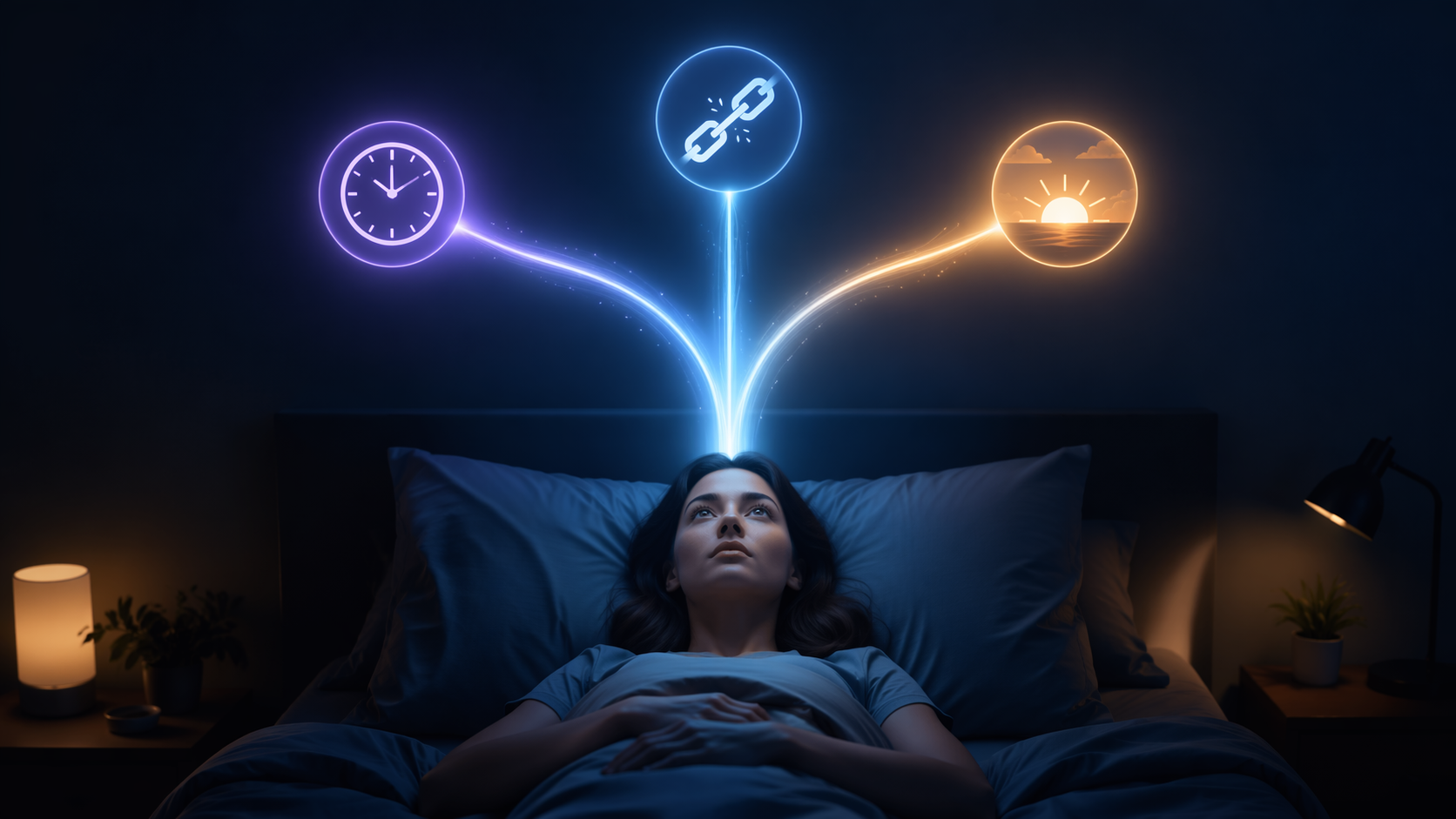
The first useful distinction is between hearing, feeling, and anticipating. Hearing points toward airborne sound. Feeling points toward vibration and building transmission. Anticipating points toward conditioned threat: the state where rain, alerts, or irregular train patterns keep the nervous system from standing down.
Those distinctions do not solve the infrastructure problem. They do prevent a bad interpretation of the sleep problem. If earplugs help only a little, that does not mean the disturbance is imagined. If the train is not running and you still cannot sleep during rain, that does not mean the transit system is irrelevant. It may mean the trigger has moved upstream, from the train event to the weather cue that predicts disruption.
It also keeps storm-sleep advice in its proper lane. Guidance on reducing nighttime monitoring, preparing before severe weather, or calming anticipatory arousal can be useful; How to Sleep Through a Thunderstorm: A Science-Based Breakdown is a better fit for those tactics. But storm advice alone will not explain a bed that vibrates with rail movement, and rail-noise advice alone will not explain why a weather forecast can keep someone awake before the first train changes.
The cleanest reading of the evidence is not that subway flooding disrupts sleep through one mysterious mechanism. It is that flooding can sit on top of an existing rail exposure and add a second arousal system. Railway noise and vibration can fragment sleep through sensory and physiological pathways. Flood experience can teach the brain that rain deserves surveillance. Subway flooding sleep disruption has to be separated into sound, vibration, and conditioned threat; otherwise “make the room quieter” is not wrong, but incomplete.
References
- Comparing the Effects of Road, Railway, and Aircraft Noise on Sleep — 2019.
- Effects of train noise and vibration on human heart rate during sleep — BMJ Open, 2013.
- Physiological effects of railway vibration and noise on sleep — 2017.
- Annoyance and sleep disturbance caused by vibrations from trains — RIVM, 2023.
- 'We don't sleep when it's raining': the mental health impact of flooding — The Guardian, 2020.

Comments
Join the discussion with an anonymous comment.