
The room is quiet enough that every sound starts to mean something. A truck passes and the window gives a small tremor. The building settles. Your body is tired, but your attention keeps checking the ceiling, the doorway, the bridge you drove over earlier, the image you saw on the news. The problem is not that you forgot how to relax. The problem is that sleep has started to feel like the one moment when you would not be able to respond.
Earthquake and bridge collapse fear can hijack sleep because they aim at the same vulnerable state: being unconscious, horizontal, and less able to protect yourself. After a frightening quake, a collapse video, a commute over an elevated structure, or a lived disaster, the bed can become less like a place of recovery and more like a monitoring station. That shift is the clinical center of the problem.
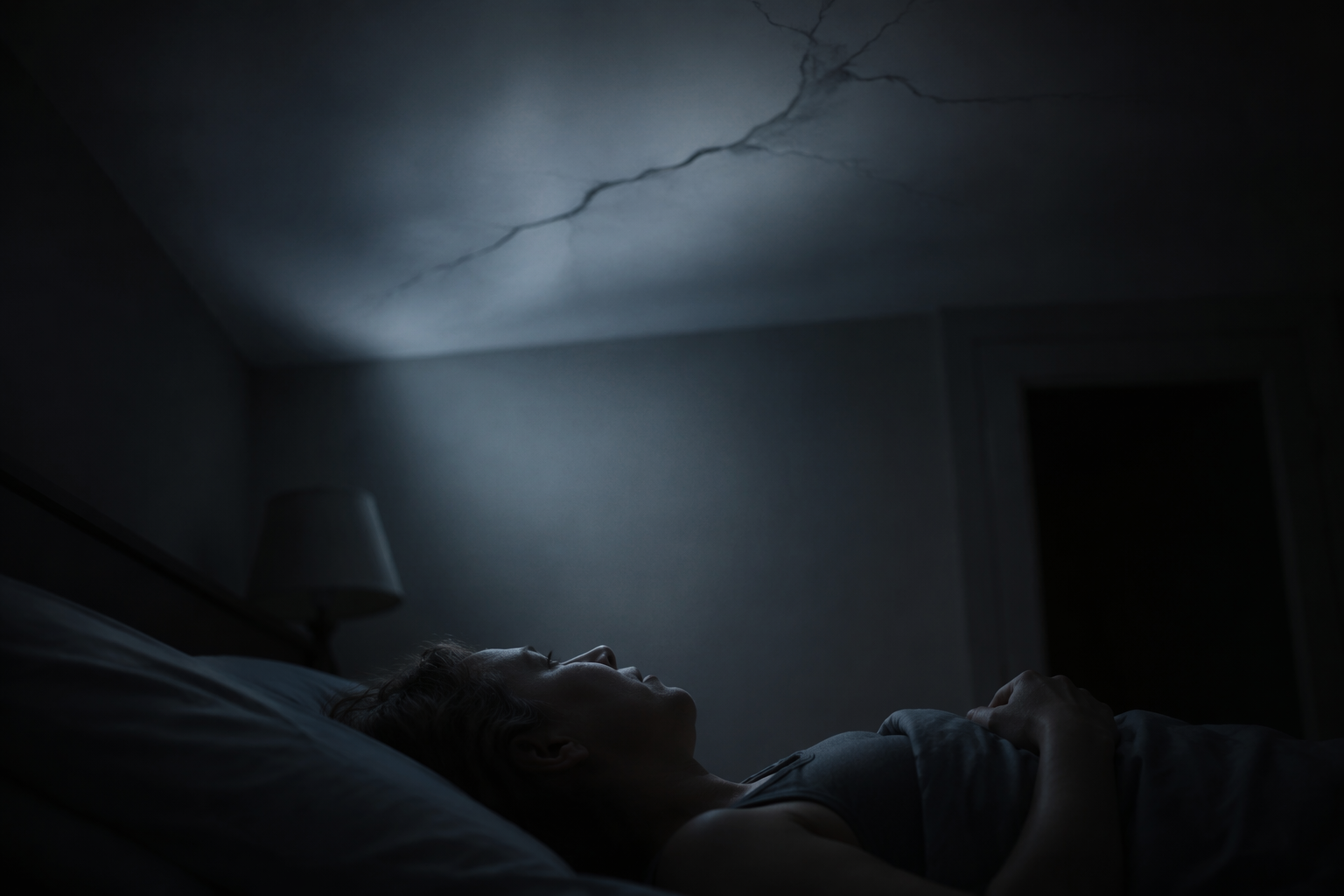
Why disaster fear gets louder at bedtime
Daytime fear usually has outlets. You can read an emergency plan, choose a different route, check a local alert, talk to someone, or stay busy. At night, those options narrow. The nervous system notices that you are about to give up control, and if it has learned that collapse, shaking, or entrapment are possible, it may treat drowsiness itself as a risk.
That is why disaster-related insomnia often feels different from ordinary bedtime worry. The fear is not only “what if an earthquake happens?” It is “what if it happens while I am asleep?” Fricke-Oerkermann and colleagues identified fear of being caught or trapped during sleep as a key driver of post-earthquake sleep disruption, which explains why the sleep state itself can become threatening after an earthquake experience.[1]
Once that association forms, the bed starts carrying the meaning of danger. You may scan for vibration, listen for cracking sounds, imagine exits, replay structural failures, or delay sleep because staying awake feels like staying available. The body responds as if vigilance is useful: heart rate rises, muscles hold tension, and attention keeps returning to threat cues. Unfortunately, those same responses make sleep onset harder.
The evidence is strongest for earthquake anxiety, but the pattern is broader
The clearest quantitative anchor comes from a 2025 cross-sectional study of 402 adolescent survivors, ages 12 to 18, assessed 9 to 12 months after the 2023 earthquakes in Türkiye. In that sample, 89.4% of adolescents in the high earthquake-anxiety group had poor sleep quality, and high earthquake anxiety was associated with 5.721 times higher odds of poor sleep quality than mild anxiety.[2]
That finding should be taken seriously, but not stretched beyond what it shows. The study involved adolescent earthquake survivors in Türkiye, not a general adult U.S. sample, and its cross-sectional design cannot prove that earthquake anxiety caused poor sleep. It does show that, in a disaster-exposed group, high earthquake anxiety and poor sleep were tightly linked long after the immediate event.[2]
Other earthquake-fear research also recognizes sleep as part of the symptom picture. The Fear of Earthquake Scale includes the item “I cannot sleep because I’m worrying about getting an earthquake,” showing that insomnia is not an accidental add-on to earthquake fear; it is one of the ways the fear can present.[3] That scale item is not a dedicated sleep-outcomes study, so it should not be read as prevalence data. It is still clinically meaningful: sleep is where the fear often declares itself.
Bridge collapse fear enters through a related route. The March 2024 collapse of Baltimore’s Francis Scott Key Bridge gave many people vivid footage of structural failure, water, vehicles, and sudden helplessness. Media interviews after the collapse described gephyrophobia, or fear of bridges, as a real clinical concern for some drivers, though the available material here is mostly expert commentary rather than large epidemiological research.[4][5]
For people in earthquake regions, bridge imagery can combine two fears. The 1989 Loma Prieta earthquake caused the Cypress Street Viaduct collapse, a case that remains part of public memory in Northern California. When the mind links shaking ground, elevated roads, trapped vehicles, and nighttime vulnerability, it does not need a new disaster to occur before sleep becomes difficult. A remembered image can be enough to restart the monitoring loop.
How the loop maintains itself
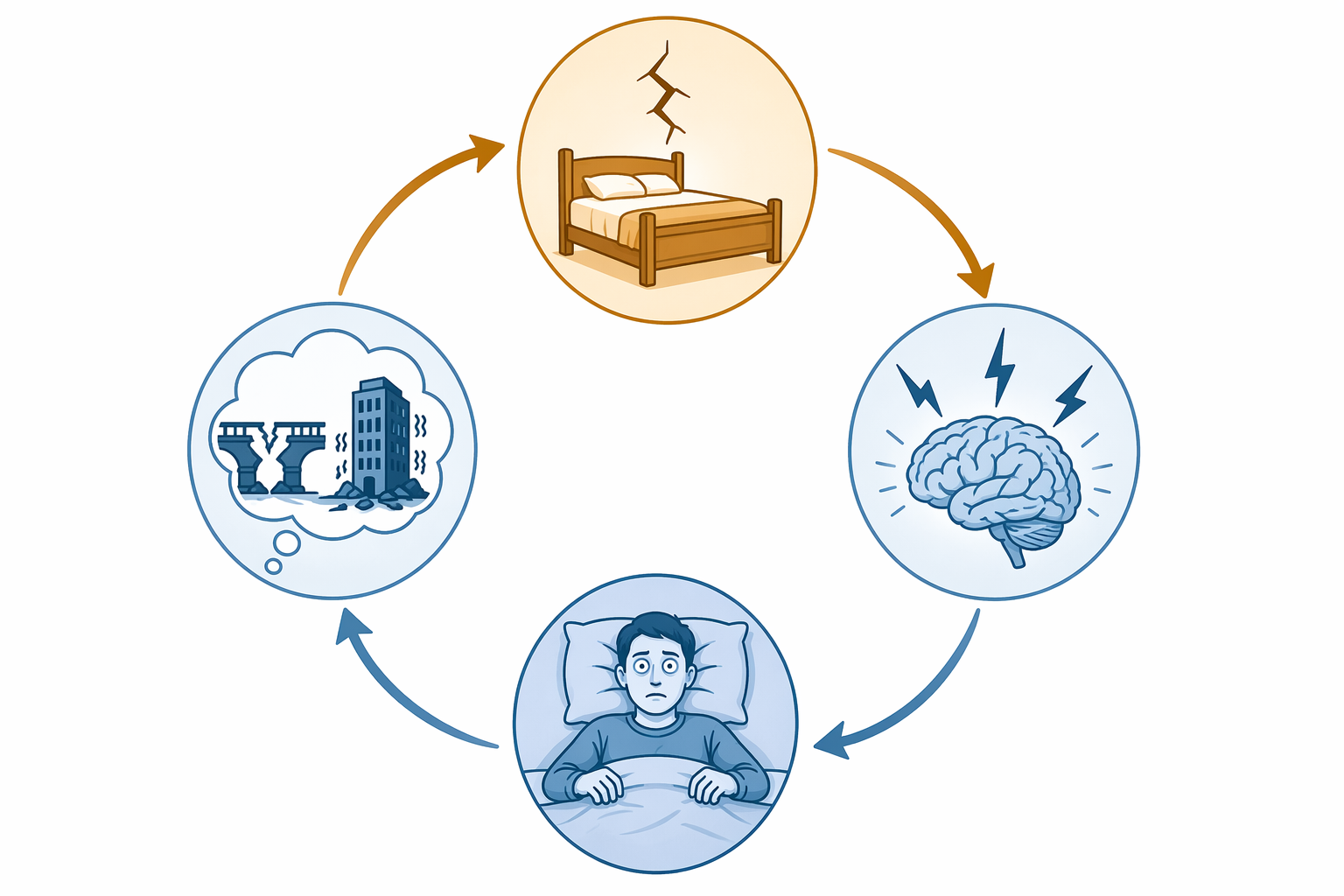
The loop usually has four parts. First, a trigger appears: a small tremor, a news clip, a bridge commute, a building noise, an anniversary, or a forecast. Second, the mind produces disaster imagery. Third, the body moves into hyperarousal. Fourth, sleep is delayed, fragmented, or avoided. The next day, fatigue lowers emotional bandwidth, making the same fear easier to trigger again.
That last part matters. Disaster-exposed adolescents in a 2018 Sleep Medicine study showed prospective associations between sleep problems and anxiety subtypes, supporting a bidirectional pattern: sleep problems and anxiety can feed each other over time.[6] This is not a character flaw. It is a reinforcement problem. The more nights the bed is paired with danger rehearsal, the more quickly the body prepares for threat when bedtime returns.
This also explains why being exhausted does not reliably solve it. Sleep drive can be high while threat detection is higher. A person can feel heavy, foggy, and desperate for rest, yet still jolt awake when the mind imagines a bridge giving way or a building shifting. If that mismatch is familiar, it may help to read more about the broader sleep anxiety and insomnia cycle, because disaster fear is one specific version of that larger pattern.
Why sleep hygiene helps only at the edges
A regular wake time, less caffeine, lower evening light, and a cooler room can all support sleep. They are not useless. But they do not directly teach the nervous system that lying in bed is safe enough to stop monitoring. If the main association is “bed equals reduced survival control,” then a darker room can simply become a darker place to scan.
This is where many people start blaming themselves. They followed the sleep hygiene list and still lay awake imagining collapse. That result does not mean they failed the advice. It means the advice was built for circadian and habit problems, while their insomnia is being maintained by conditioned threat. The distinction matters; our guide to the limits of sleep hygiene goes deeper into that mismatch.
The treatment target is the bed-danger association
Cognitive behavioral therapy for insomnia, or CBT-I, is widely recommended as a first-line treatment for chronic insomnia.[7] For earthquake and bridge collapse fear, CBT-I often needs to be adapted rather than applied as a generic sleep program. The work is not only to increase sleep efficiency. It is to uncouple the bed from danger rehearsal.
Stimulus control is a good example. In standard CBT-I, a person who cannot sleep gets out of bed after a period of wakefulness and returns when sleepy. In disaster-fear insomnia, the same technique has an added purpose: it prevents the bed from becoming the place where you spend long stretches scanning for structural clues, replaying collapse footage, or negotiating with fear. The instruction is not punishment. It is association repair.
A practical version looks like this: if you are in bed and the fear loop has clearly taken over, leave the bed briefly and do something quiet, dim, and non-rewarding. Do not turn the departure into another checking mission. No repeated window inspection, no searching for bridge failure videos, no refreshing earthquake feeds unless there is a real alert or immediate safety reason. Return when sleepiness is stronger than monitoring.
Cognitive restructuring is the second piece. It does not ask you to pretend disasters never happen. It asks you to identify the prediction that is keeping the body awake. The prediction may be “if I sleep, I will be trapped,” “if I stop listening, I will miss the first sign,” or “if I drove over that bridge today, something bad is more likely tonight.” Those thoughts can feel protective, but at bedtime they often become untestable commands.
| Bedtime prediction | More useful response |
|---|---|
| If I fall asleep, I will not be able to protect myself. | I have taken reasonable preparation steps while awake; staying awake all night is not the same as being safer. |
| Every sound could be the building failing. | I can notice a sound without assigning it the worst possible meaning. |
| I need to check one more time before I can sleep. | One planned check is preparedness; repeated checks are reassurance that resets the fear cycle. |
| The bridge collapse video means my route is unsafe. | A vivid image can raise fear without proving that my current route has changed. |
The wording matters less than the function. A useful response should be believable, specific, and calm enough to repeat when the body is activated. It should not become a debate that lasts an hour. At some point, the treatment move is behavioral: stop feeding the rehearsal and let the bed become boring again.
Exposure therapy is about retraining, not forcing yourself to be fearless
Specific fears usually shrink when the brain has repeated, structured experiences of approaching the feared cue without the expected catastrophe. The Sleep Foundation’s review of somniphobia notes that exposure therapy resolves specific phobias in more than 90% of people who try it.[8] That figure is encouraging, but it should not be heard as instant or guaranteed. Exposure works best when it is planned, gradual, and matched to the actual fear.
For earthquake fear, exposure might begin with reading neutral preparedness information during the day, then sitting with mild earthquake-related words or images, then tolerating normal building sounds without checking. For bridge fear, it might involve looking at bridge photos, watching non-disaster bridge-driving footage, driving near a bridge, crossing a small bridge with support, and later crossing a more feared bridge. For sleep-specific fear, exposure may include lying in bed with the lights off for a short planned period while practicing a non-checking response.
The order should be boringly manageable. Flooding yourself with collapse footage at midnight is not treatment; it is more likely to strengthen the association between night, imagery, and threat. The goal is to teach the nervous system that a cue can be present without requiring escape, checking, or all-night vigilance.
Preparedness helps when it has an endpoint
Disaster preparedness is not reassurance-seeking by default. A stocked emergency kit, shoes near the bed in earthquake regions, a family communication plan, and knowing the safest spots in your home can restore appropriate control. The trouble starts when preparedness loses its endpoint and becomes a ritual that must be repeated until anxiety drops.
- Choose one daytime preparedness window rather than solving disaster safety in bed.
- Write the completed steps down so the night brain does not get to restart the checklist.
- Set a rule for legitimate checking, such as responding to an official alert or an obvious immediate hazard.
- Treat repeated “just one more” checks as part of the insomnia loop, not as new information.
This distinction is especially important for people who do live with real seismic risk. The answer is not to abandon preparedness. It is to move preparedness into waking life, give it boundaries, and stop letting fear use bedtime as an emergency-planning meeting.
When to get more help
Consider professional support if the fear lasts for weeks, causes significant sleep loss, changes your driving or work life, leads to repeated checking, follows a traumatic event, or comes with panic symptoms. A clinician can help separate phobia-driven sleep anxiety from post-traumatic stress symptoms, generalized anxiety, nocturnal panic, or another sleep disorder.
That distinction matters because the treatment emphasis may change. Waking in terror from sleep with intense physical symptoms can look different from lying awake in anticipatory fear of a quake or collapse. If that is part of your pattern, the comparison in nocturnal panic attacks vs. sleep anxiety may help you decide what to bring to a clinician.
Medication may be appropriate for some people, especially when anxiety, panic, depression, or trauma symptoms are severe. But for many people with earthquake and bridge collapse fears disrupting sleep, the durable work is behavioral: reduce the checking, reduce the rehearsal, approach avoided cues gradually, and rebuild the bed as a place where the body no longer has to stay on duty.
No one can honestly promise that the ground will never shake or that every structure will always hold. The more useful goal is different: teach your nervous system where reasonable preparedness ends and sleep can begin again. That progress may show up quietly at first: one fewer check, a shorter stretch of listening, a clearer response when the image appears, and eventually a bed that stops functioning as a disaster-monitoring station.
References
- Fricke-Oerkermann et al. on fear of being caught or trapped during sleep after earthquakes. 2007.
- Earthquake anxiety and sleep quality among adolescent survivors 9–12 months after the great earthquakes in Türkiye. Scientific Reports.
- The development of the fear of earthquake scale.
- Baltimore bridge collapse: Fear of bridges, gephyrophobia, explained. USA Today, 2024.
- Bridge phobia: How to manage your fears after Francis Scott Key Bridge collapse. ABC7 News, 2024.
- Prospective associations between sleep problems and subtypes of anxiety symptoms among disaster-exposed adolescents. Sleep Medicine, 2018.
- Cognitive Behavioral Therapy for Insomnia (CBT-I): A Primer.
- Somniphobia: Understanding the Fear of Sleep. Sleep Foundation.


Comments
Join the discussion with an anonymous comment.