
A bedroom can look almost embarrassingly optimized and still work against you. The curtains are doing their job. The thermostat is reasonable. The phone is out of reach. You log 7 or 8 hours, then wake up with the flat, sandbagged feeling that makes sleep advice sound like it was written for someone else.
One overlooked air-quality influence on sleep is not dust, scent, or a vague sense of “freshness.” It is the carbon dioxide you exhale all night into a room that may have been carefully sealed for quiet, warmth, security, or darkness. Outdoor CO₂ is typically around 400–500 ppm, but closed bedrooms can climb into the 2,500–3,000+ ppm range by morning. At that point, the room is no longer just cozy. It is chemically different from the room you fell asleep in.
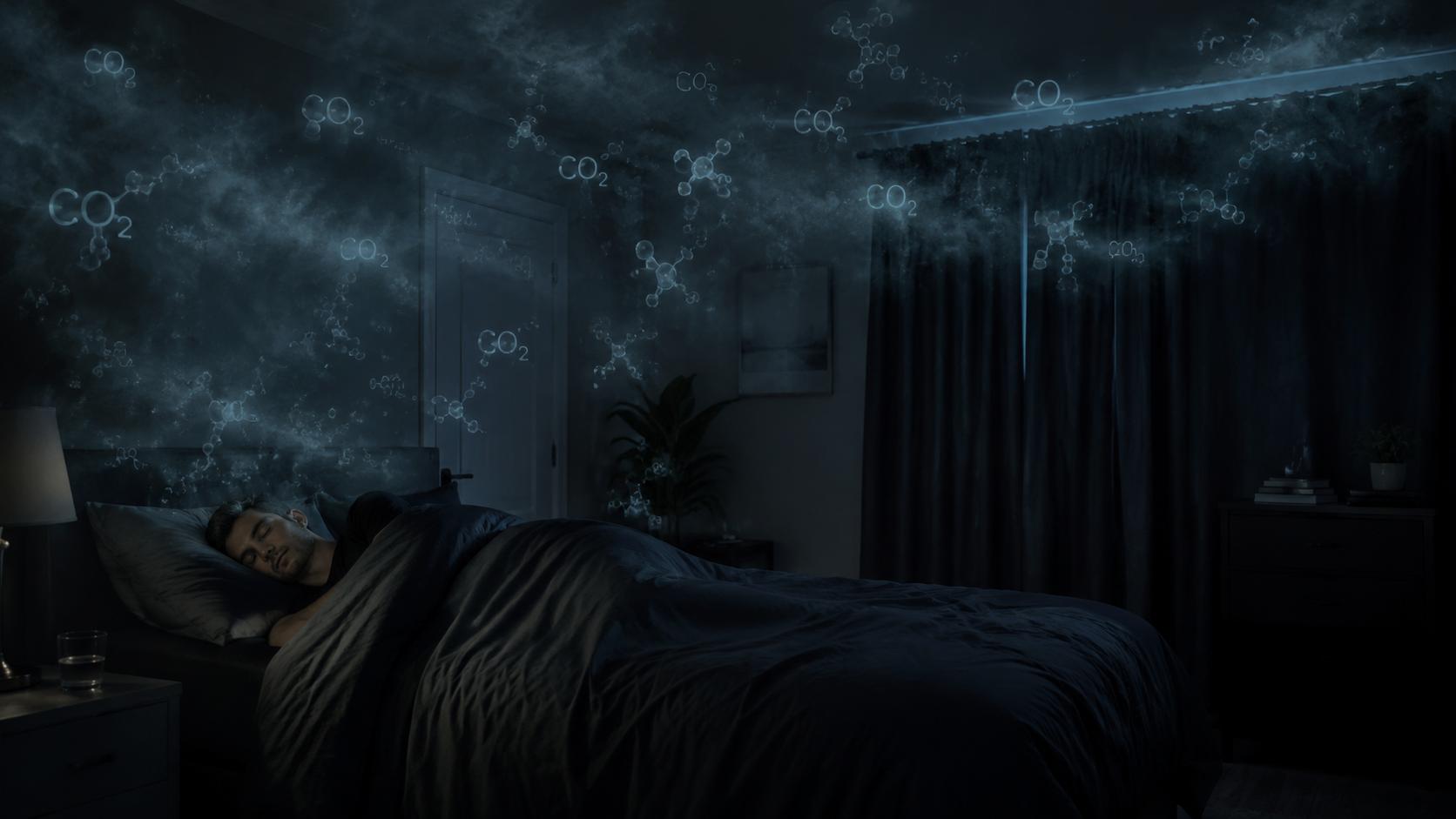
That buildup matters because sleep is not only about time spent unconscious. The question is whether the room lets your brain stay in the deeper stages long enough, and whether you wake with the next-day attention and speed you expected from a full night.
The closed-bedroom experiment that makes the problem hard to dismiss
The most useful evidence here is not a general indoor-air-quality warning. It is a dormitory experiment from Technical University of Denmark researchers that changed bedroom ventilation and measured what happened next. When average bedroom CO₂ was reduced from 2,395 ppm to 835 ppm through increased ventilation, actigraphy-measured sleep quality improved, and next-day cognitive performance improved as well.[1]
That pairing is important. A person may tolerate a stuffy bedroom and still believe nothing happened because they did not fully wake up. The DTU study followed the chain further: lower overnight CO₂, better sleep-quality measures, better performance the next day. It does not prove that every tired morning is a ventilation problem, but it does make a sealed bedroom a reasonable suspect when the usual sleep-hygiene list has already been handled.
| Bedroom condition | Average CO₂ level | Measured outcome |
|---|---|---|
| Lower ventilation | 2,395 ppm | Worse actigraphy-measured sleep quality and next-day cognitive performance |
| Increased ventilation | 835 ppm | Improved sleep quality and next-day cognitive performance |
This is also why a bedroom air problem can hide in plain sight. Unlike light or noise, CO₂ does not announce itself sharply. It accumulates. The first hour may feel fine. By the final third of the night, when sleep architecture is still cycling and the brain is preparing for waking performance, the exposure can be very different.
What higher CO₂ appears to do to sleep architecture
The more specific sleep question is not whether CO₂ is “bad” in the abstract. It is whether normal bedroom concentrations can change the structure of sleep. A 2020 controlled study monitored 12 subjects across 54 polysomnography-recorded nights and found a linear negative correlation between CO₂ concentration and slow-wave sleep. At 3,000 ppm, the comprehensive sleep quality score fell to 80.8% of the 800-ppm baseline.[2]
Polysomnography matters because it does not ask sleepers how rested they think they feel. It tracks sleep stages. The finding points toward N3 slow-wave sleep, the deep sleep stage people often mean when they say they want “quality” sleep. For a broader discussion of why slow-wave sleep is treated differently from simple time in bed, see this related guide to sleep architecture and recovery.
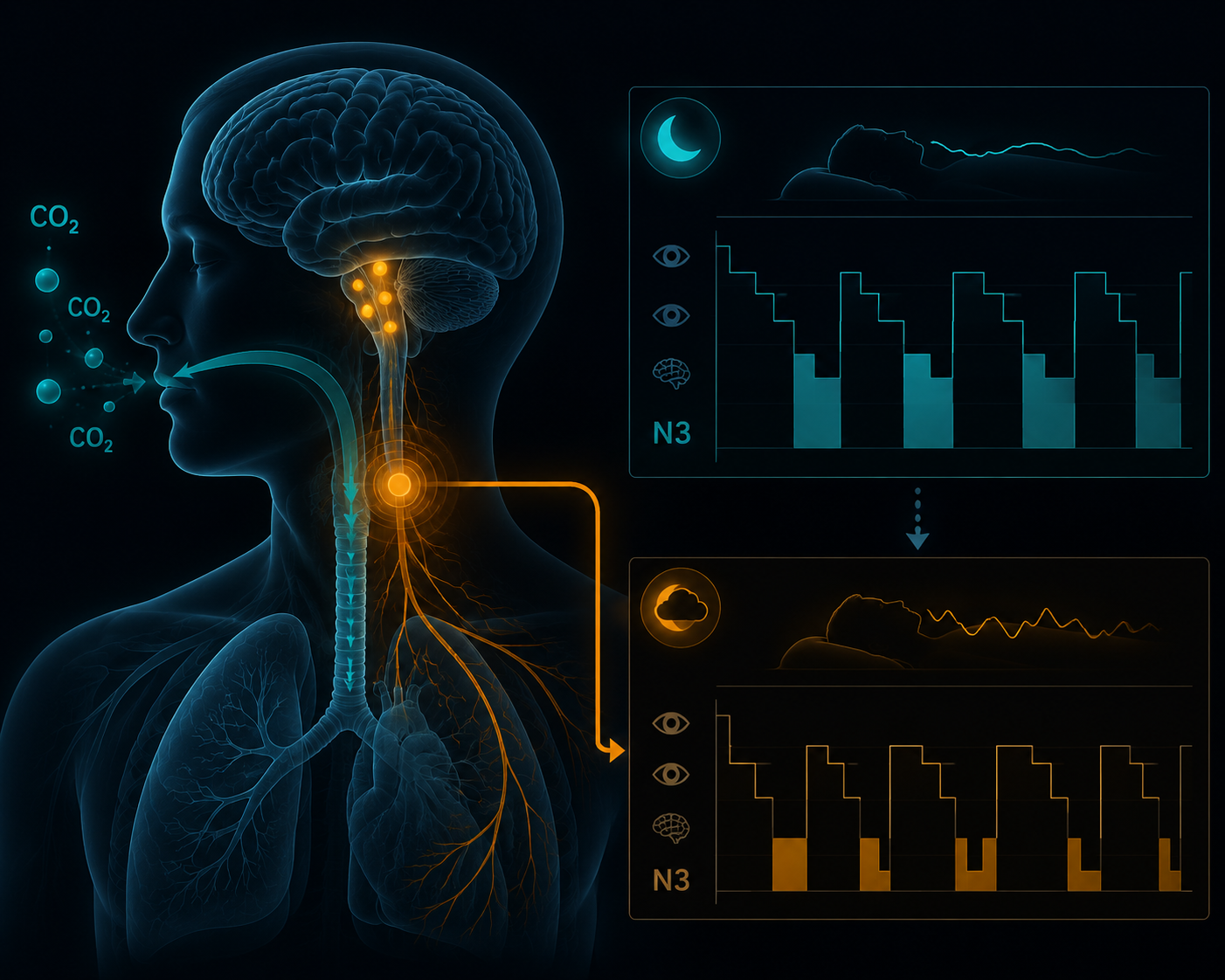
The likely pathway is physical enough to be worth spelling out. Chemoreceptors detect rising CO₂. Breathing effort increases. Sympathetic activation rises. Sleep becomes easier to lighten or fragment, and N3 slow-wave sleep can shrink. Elevated cortisol may also be part of this response pathway, but the strongest practical point is simpler: the sleeping body is still monitoring blood gases, even when the room feels calm.
This helps explain why the problem can feel so unfair. You can remove blue light, keep the room dark, and avoid late caffeine, yet still ask your body to spend the night compensating for stale air. That does not cancel standard sleep hygiene; it adds a missing variable.
Why 800 ppm keeps showing up
The 800 ppm number is not magic, and it should not be treated as a diagnostic line between healthy and unhealthy sleep. It is useful because several lines of evidence cluster around it. In the DTU experiment, the improved ventilation condition averaged 835 ppm.[1] In the 2020 polysomnography study, 800 ppm served as the baseline against which 3,000 ppm produced worse sleep-quality scoring.[2]
A 2025 international review from Waseda University and ASHRAE also recommended bedroom ventilation sufficient to maintain CO₂ at or below 800 ppm, a level described as roughly double the minimum ventilation required by many current residential building codes.[3]
That target is more sleep-specific than the familiar 1,000 ppm general indoor-air benchmark often used as a broad ventilation boundary. The distinction matters: an office or classroom threshold is not automatically a sleep-architecture threshold. A sleeper is in the same small air volume for hours, with closed doors and windows often chosen deliberately.
Real bedrooms are messier than lab rooms
Controlled studies carry the cleanest causal evidence, but they cannot reproduce every apartment compromise: street noise, wildfire smoke alerts, winter cold, summer humidity, roommates, pets, security concerns, or a partner who sleeps cold. Field evidence is useful because it shows whether CO₂ remains relevant after those complications enter the room.
A 2023 Shanghai field study of 168 participants found that bedroom CO₂ concentration had a stronger impact on sleep quality than temperature or humidity in real bedrooms.[4] That does not mean temperature is irrelevant; heat can still disrupt sleep, and the interaction deserves its own treatment in a guide to how heat affects sleep quality. The Shanghai finding does mean CO₂ should not be treated as a secondary comfort detail after the room “feels” cool enough.
The evidence is still not enormous. Intervention studies in this area often involve small samples, including the 12-subject polysomnography study.[2] Observational bedroom studies can show strong associations without proving every causal step. That is a reason to be measured, not dismissive. The same small evidence base repeatedly points in a physically plausible direction: high overnight CO₂ is associated with lighter, poorer sleep, and lowering it can improve both sleep measures and next-day function.
What to change before buying anything complicated
The least glamorous intervention is still the first one to test: exchange air before and during sleep. An air purifier may help with particles, depending on the device and pollutant, but a standard purifier does not remove the CO₂ you exhale. For the broader distinction between CO₂, PM2.5, and other indoor pollutants, see the overview on how indoor air quality affects sleep quality.
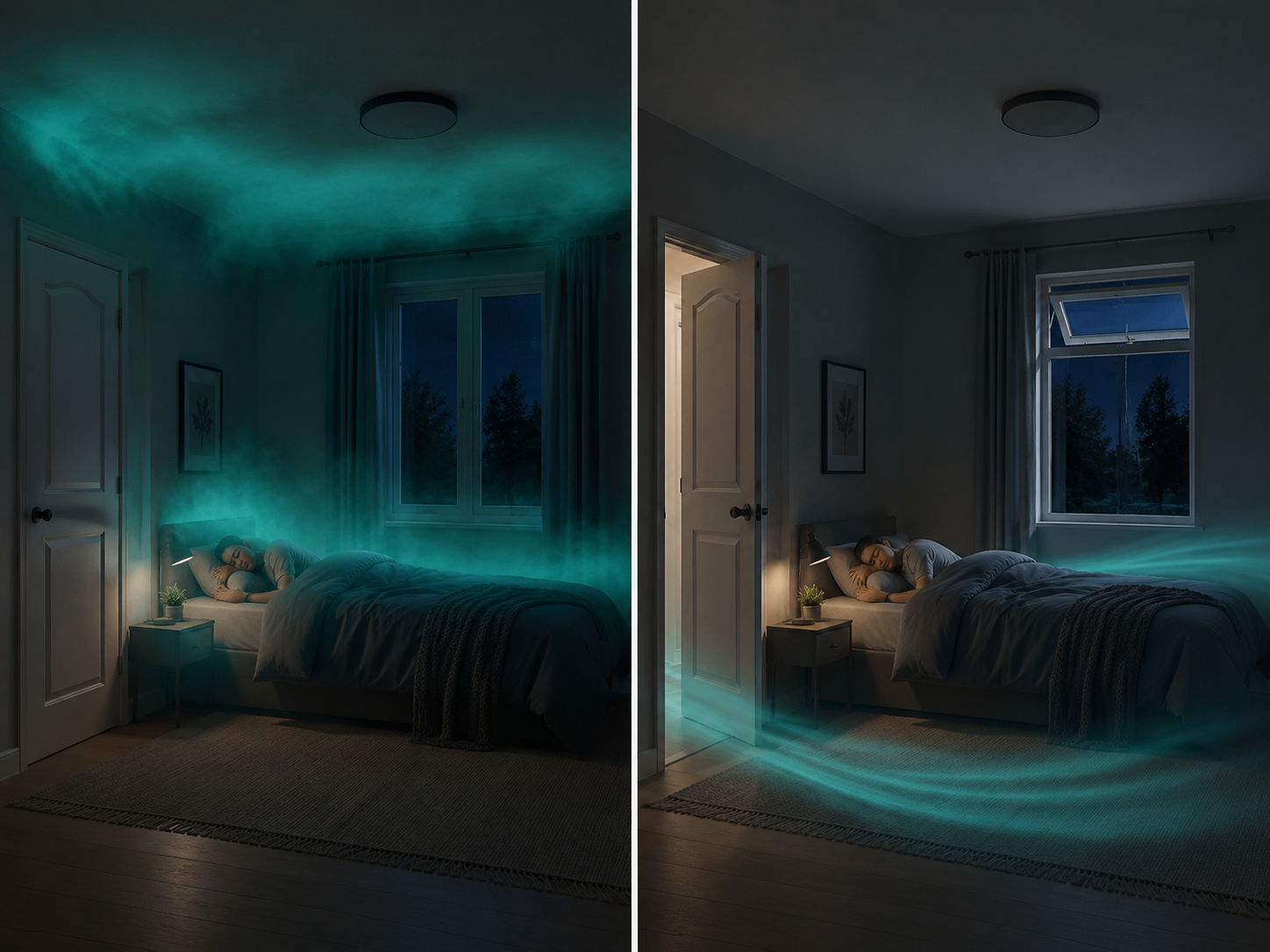
Start with changes that fit the actual constraints of the room:
- Air out the bedroom for 15–20 minutes before bed if outdoor conditions are acceptable, then close the window if noise, safety, temperature, or outdoor pollution makes overnight opening unrealistic.
- Leave the bedroom door ajar when privacy and household noise allow it; a slightly larger connected air volume can slow overnight CO₂ buildup.
- Use cross-ventilation when possible, even briefly, because a single cracked window may exchange air slowly in a still apartment.
- If outdoor air is the problem, separate that decision from the CO₂ decision; air-quality alerts and particle exposure may require different timing or filtration choices.
- Use a CO₂ monitor for a week before assuming the room is fine. The useful reading is not the bedtime number but the overnight peak and morning level.
The monitor is not there to create another anxiety dashboard. It answers a concrete question: does this bedroom climb toward 2,500–3,000+ ppm by morning, or does ventilation keep it closer to the 800 ppm range? Without measurement, a sealed room and a ventilated room can feel deceptively similar at lights-out.
For people in cities, the choice is not always “open the window” versus “ignore the science.” On poor outdoor-air nights, it may make more sense to air out earlier, ventilate through a less exposed side of the home, use filtration for particles, or choose a door-open strategy instead of a window-open strategy. The indoor-versus-outdoor tradeoff is real; this related piece on air quality alerts and sleep problems covers that tension more directly.
A simple self-experiment
Treat bedroom CO₂ like a testable condition, not a personality flaw in your sleep routine. For several nights, sleep normally and record morning CO₂, perceived alertness, number of remembered awakenings, and any unusual disruptions. Then change only ventilation as much as the room allows: pre-bed airing, door ajar, cracked window, or a combination. Keep bedtime, caffeine, alcohol, and room temperature as steady as practical.
Sleep trackers can help if you use them cautiously. Their stage labels are not clinical proof, but trends in awakenings, movement, resting heart rate, or sleep continuity may be useful when paired with CO₂ readings. Readers deciding how much confidence to place in wearable data can compare consumer devices with more formal testing in this guide to sleep tracker accuracy.
If ventilation lowers the morning CO₂ reading and your alertness improves over repeated nights, that is useful evidence for your room, even if it is not a clinical diagnosis. If the room already stays near 800 ppm and mornings are still rough, CO₂ is less likely to be the main explanation, and it is worth looking elsewhere.
Ventilation is not a miracle cure. It will not fix sleep apnea, chronic insomnia, circadian misalignment, pain, medication effects, or a newborn in the next room. But if a sealed bedroom is reaching 2,500–3,000+ ppm by morning, the evidence supports taking that seriously. A room can be dark, quiet, cool, and still ask your sleeping brain to work harder than it should.
References
- The effects of bedroom air quality on sleep and next-day performance, Indoor Air.
- Effects of Carbon Dioxide Concentration on Sleep Quality, PubMed.
- Using Indoor Air Quality Tactics to Sleep Better at Night, Perform Well the Next Day, ASHRAE.
- Effects of bedroom environmental quality on sleep quality in Shanghai dwellings, Building and Environment.


Comments
Join the discussion with an anonymous comment.