
The best sleep tracking device is not the one with the most polished sleep score. It is the one that answers the question you actually have, in a form you can tolerate every night, at a cost you will not resent six months later.
Before comparing rings, watches, bands, mats, and smart beds, narrow the purchase to three filters: your priority metric, your wearability tolerance, and your total cost tolerance. If those are unclear, a device ranking mostly tells you which company has the stronger product story.
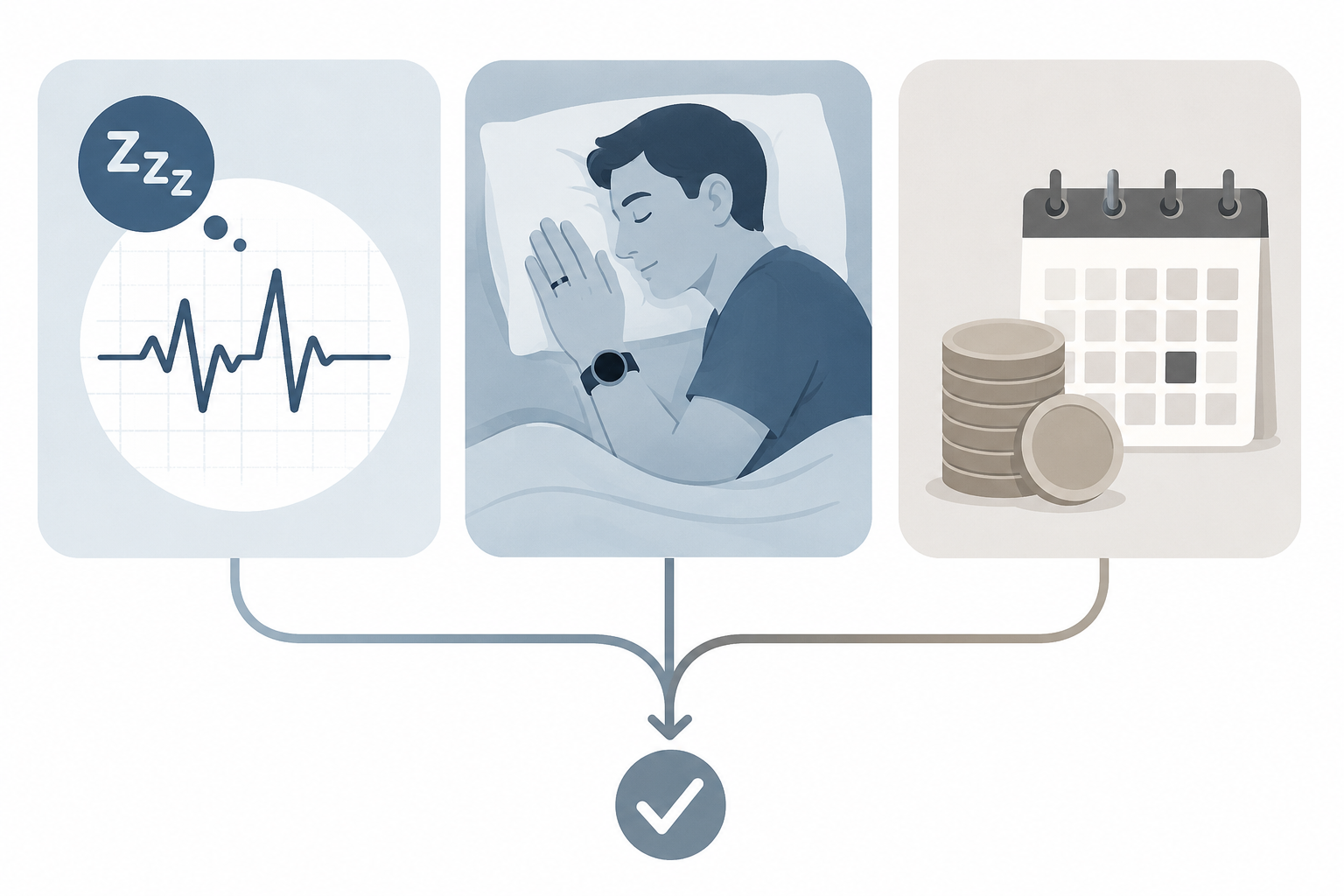
| Decision filter | What to decide before shopping | Why it changes the device choice |
|---|---|---|
| Priority metric | Sleep/wake timing, HR/HRV trends, apnea screening context, bedroom environment, or full-bed temperature control | Consumer trackers are more useful for some signals than others; sleep stages are the weakest place to start. |
| Wearability tolerance | Ring, watch, band, under-mattress sensor, bedside system, or no nightly device at all | The most accurate sensor you stop wearing after a week is not your best tracker. |
| Total cost tolerance | Upfront device price plus required subscriptions over the period you expect to use it | Several popular options become meaningfully more expensive after memberships, app access, or smart-bed plans are included. |
Start With The Metric, Not The Device
Most buyers say they want “better sleep tracking,” but that can mean very different things. One person wants to know whether a late workout pushes bedtime later. Another wants a comfortable HRV trend without wearing a bulky watch. Another has a partner noticing snoring and wants to understand whether an apnea-screening feature is worth attention. Those are not the same purchase.
Use this first cut:
- For sleep schedule and consistency: prioritize reliable sleep/wake trends, battery life, and low-friction nightly use.
- For recovery-style signals: prioritize overnight heart rate and HRV comfort, then check how the app explains uncertainty.
- For apnea-screening context: distinguish FDA-authorized or medically regulated notification features from wellness-only snore or oxygen charts.
- For people who dislike wearables: consider under-mattress or bedside options, accepting that they may be less useful outside sleep.
- For bed temperature and environment: treat the device as a sleep system purchase, not a small tracker purchase.
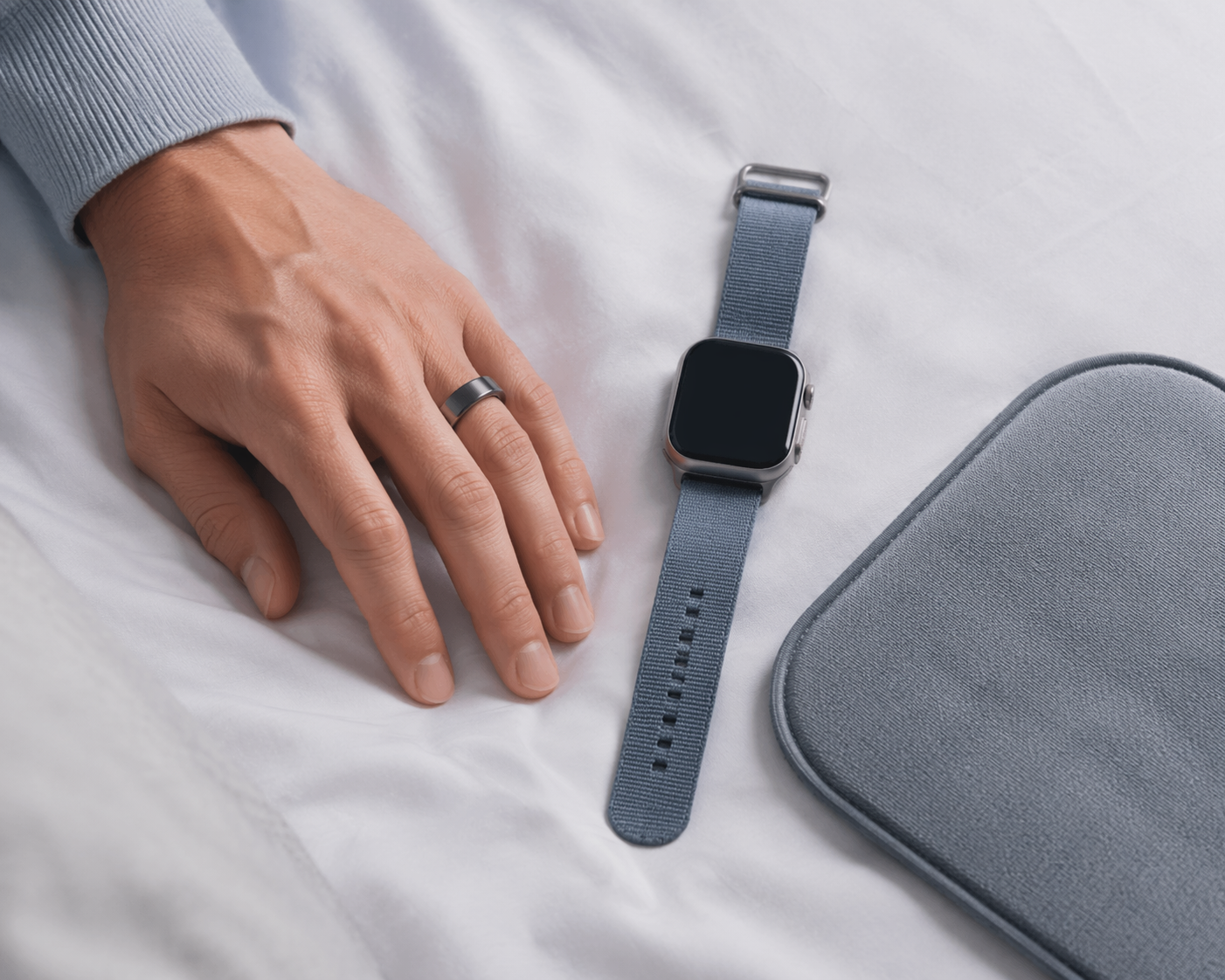
If you still need the mechanics of rings versus watches versus mattress pads, the broader form-factor comparison is the better place to linger. Here, the important point is sharper: the device category should follow the job.
What Accuracy Studies Actually Support
The strongest reason to avoid a universal winner is accuracy. In a multicenter validation study of 75 participants comparing 11 consumer sleep trackers against in-lab polysomnography, Lee et al. reported macro F1 scores for sleep staging ranging from 0.26 for the Pillow app to 0.69 for the SleepRoutine app; leading wearables such as Google Pixel Watch, Fitbit Sense 2, and Galaxy Watch 5 were around 0.57 to 0.58.[1]
That does not mean consumer trackers are useless. It means the useful part is narrower than the marketing often implies. A 2024 scoping review in npj Digital Medicine covering 35 articles and 62 wearable setups found average sleep/wake accuracy of 87.2%, while four-stage sleep staging accuracy dropped to 65.2%.[2] In plain terms: these devices are better at estimating whether you were probably asleep or awake than at telling you exactly how much light, deep, REM, and wake time you had in a particular night.
The most buyer-relevant error is not exotic. Lee et al. found that all devices overestimated sleep by misclassifying quiet wake as light sleep.[1] That matters for the person lying still at 3:40 a.m., trying not to wake a partner, then seeing the app congratulate them on a better night than they experienced. The dashboard may look calm precisely when the user was not.
Polysomnography is still the clinical reference point, not a casual benchmark for consumer devices to outrun. Even among sleep specialists scoring PSG, reported inter-scorer agreement for sleep staging is 78.9% to 82.6%, which remains above consumer-device performance in the evidence summarized here.[1] A sleep tracker can be useful without pretending to be a home sleep lab.
There are also limits to the evidence itself. The Lee et al. study was conducted in South Korea with a predominantly Korean population, which the authors noted limits generalizability to other ethnic groups.[1] Several devices in published studies are also older than the 2026 models now on shelves. Newer algorithms may be better, but “newer” is not the same as independently validated.
For a deeper validation-by-device discussion, see the PSG-focused comparison of which fitness tracker is most accurate for sleep. The practical takeaway for buying is simpler: trust long-term trends more than single-night sleep-stage breakdowns, and be especially cautious if insomnia, fragmented sleep, or long quiet wake periods are part of your normal night.
Map The Device To The Kind Of Sleeper You Are
Once accuracy expectations are set, the device choice becomes less theatrical. You are not choosing the winner of sleep tracking. You are choosing the least annoying tool for the signal you care about.
If You Want General Trends Without Another Subscription
A smartwatch can be the sensible answer if you already wear one or want sleep tracking bundled with daytime utility. Apple Watch is especially relevant for people who want no mandatory sleep-tracking subscription and a broader health platform. Current Apple Watch options range from under $100 for an SE entry point to $799 for Ultra models, depending on configuration and market availability.[3]
The tradeoff is wrist comfort. Some people sleep easily with a watch; others notice the case, band, charging routine, or screen. If you already remove your watch before bed, do not assume a better app will change that habit. For smartwatch-specific comparisons, the best sleep tracking smartwatch guide is the narrower read.
If HR And HRV Comfort Matter More Than A Screen
A smart ring often makes sense for someone who wants overnight heart-rate and HRV trends without a watch face in bed. Oura is the obvious example because its finger-based PPG can produce cleaner heart-rate and HRV signals than wrist placement during sleep, and Lee et al. found Oura Ring showed negligible proportional bias in that study’s tested context.[1][4]
The catch is cost and interpretation. Oura’s current purchase model includes a $350 to $499 upfront device price plus about $70 per year for the subscription.[4] That may be reasonable if the ring becomes your nightly default. It is less appealing if you mostly want a monthly sleep-duration chart and will ignore recovery prompts. For an Oura-specific read, the guides to what the Oura Ring sleep score measures and Oura Ring sleep tracking accuracy go deeper.
If You Want Recovery Coaching More Than Device Ownership
Whoop is a different financial proposition because the hardware is tied to membership rather than a conventional one-time purchase. Whoop 5.0 plans run $199 to $359 per year, and a three-year total at the Peak tier is at least $717.[5] That can make sense for someone who wants a coaching-style system around strain, recovery, and sleep consistency. It is not the cheapest way to learn what time you fell asleep.
This is where total cost matters more than sticker price. A subscription device can feel affordable on day one and expensive by year three. If you compare it with a watch you already own or a tracker with no mandatory sleep subscription, use the same ownership window for both.
If Apnea Screening Is The Reason You Are Shopping
Apnea-related features deserve more care than ordinary sleep-score features. The American Academy of Sleep Medicine’s 2025 comparison of popular smartwatches distinguishes FDA-authorized sleep apnea notification features, including Apple Watch Series 9 and later and Samsung Galaxy Watch models, from wellness-only tracking.[6] Apple’s sleep apnea notification validation reported 98.5% specificity and 66.3% sensitivity.[3]
Specificity and sensitivity are not decorative statistics. High specificity means fewer false positives among people without the condition; lower sensitivity means some people with the condition may not be flagged. A negative notification is not a clinical all-clear if symptoms, partner reports, or medical risk factors point in the other direction. For the details, read the dedicated explanation of Apple Watch sleep apnea notification accuracy.
Under-mattress options may also be relevant if you cannot tolerate wearables. Withings Sleep Analyzer is a non-wearable device with CE-marked apnea screening in Europe and reported sensitivity up to 88% for moderate-to-severe cases, but it does not have FDA clearance in the US.[7] That regulatory distinction matters. A feature available in one market should not be mentally imported into another as if it carries the same status.
For non-wearable apnea questions, the under-mattress guide on whether sleep trackers can detect sleep apnea is the better next stop.
If You Cannot Sleep With Anything On Your Body
A non-wearable tracker can be the best sleep tracking device for someone who otherwise quits. Under-mattress and bedside systems remove the ring-size problem, the watchband problem, and the “I forgot to charge it” problem. They also narrow the use case: they are sleep devices, not all-day health or activity trackers.
That is not a flaw if your question is purely about nights. It is a flaw if you want one system to connect exercise, resting heart rate, naps, recovery, and bedtime regularity. For goal-based matching across categories, use Smart Ring, EEG Headband, Watch, or Mattress Pad as the more granular decision tree.
If You Are Considering A Premium Bed System
Eight Sleep belongs in a different budget category from a ring or watch. The Eight Sleep Pod 5 costs $2,999 upfront, with a $17 to $25 monthly subscription after the first free year.[8] Someone buying it primarily for temperature control may judge that differently from someone shopping for sleep tracking data alone.
This is the clearest example of why “best sleep tracker” can be a misleading search. A premium bed system may be a rational purchase for a hot sleeper who wants active temperature adjustment and passive tracking. It is a strange purchase if the real need is a basic sleep schedule trend.
Compare Total Cost Before You Compare Sleep Scores
A fair comparison uses the same time horizon. One year may be enough if you are testing whether tracking helps. Three years is more realistic if you are buying into a ring, watch, band, or bed ecosystem.
| Device or system | Cost structure supported by available data | Buying implication |
|---|---|---|
| Oura Ring | $350–499 upfront plus about $70/year subscription | Strong fit for ring comfort and HR/HRV trend interest; subscription should be treated as part of the device. |
| Whoop 5.0 | $199–359/year; at least $717 over three years at Peak tier | Better framed as a recovery membership than a one-time tracker purchase. |
| Apple Watch | No mandatory sleep-tracking subscription; models range from under $100 entry point to $799 Ultra | Often sensible if you want broader smartwatch utility and can sleep with a wrist device. |
| Eight Sleep Pod 5 | $2,999 upfront plus $17–25/month after the first free year | Only belongs on the shortlist if bed temperature or full-bed system features matter. |
| Withings Sleep Analyzer | Non-wearable; apnea-screening regulatory status differs by region | Consider for passive sleep tracking, but do not treat European CE-marked apnea screening as US FDA clearance. |
The cheapest device is not automatically the best value, and the most expensive one is not automatically more accurate. The relevant question is whether the recurring cost buys something you will use: better adherence, clearer trends, medically meaningful notification context, or environmental control that changes your actual sleep conditions.
Privacy And Data Use Belong In The Purchase Decision
Sleep data feels intimate because it is. It can include bedtimes, wake times, movement, heart-rate patterns, breathing-related signals, and in some ecosystems, location or activity context. Yet consumer sleep tracker data is often treated as marketing data rather than HIPAA-protected health information, according to Forbes Vetted’s 2026 reporting and expert commentary on consumer sleep trackers.[9]
That does not mean every company is misusing data. It means the buyer should read the privacy policy with the same seriousness as the sensor specs. Look for whether data is shared with advertisers, whether the company distinguishes health data from account or usage data, whether deletion is possible, and whether optional research or personalization programs are opt-in or opt-out.
This is especially important with subscription products. A membership relationship can create a long-running data relationship. If you would be uncomfortable with your sleep patterns being used for marketing segmentation, do not bury that concern under a cleaner app interface.
When Tracking Starts Making Sleep Worse
A tracker can help you notice patterns: later caffeine, irregular wake time, alcohol effects, travel disruption, or how a stressful week changes resting heart rate. It can also turn sleep into a nightly performance review. Orthosomnia, or anxiety and preoccupation driven by sleep-tracking data, is a documented phenomenon.[10]
The risk is higher when the user treats a sleep score as a diagnosis or a command. A low score can make someone feel worse before the day starts; a high score can contradict lived experience; a stage chart can invite overcorrection even when the underlying estimate is fragile. If tracking makes you more tense in bed, the best device may be the one you use less often, or not at all.
A Practical Way To Choose
Use the purchase as a fit test, not a brand contest. Write down the answer to these four questions before reading another product page:
- What single metric or signal would change what I do: sleep duration, bedtime consistency, HR/HRV trend, apnea notification, snoring context, or bed temperature?
- What hardware will I realistically tolerate every night: ring, watch, band, mat, bedside device, or bed system?
- What is the total cost over one and three years, including required subscriptions?
- Which claims are independently validated, and which are vendor claims or wellness interpretations?
Then match the answer to the device category. For general sleep and activity tracking, a watch may be enough. For comfortable overnight HR/HRV trends, a ring may be the better fit. For recovery coaching, a membership band can make sense if you accept the recurring cost. For apnea screening, prioritize regulatory status and understand sensitivity and specificity. For people who hate wearables, passive sensors are not a compromise; they may be the only design that survives contact with real sleep.
If you can name the metric you care about, the hardware you will actually tolerate, the cost you can accept, and the accuracy limits you understand, you have already done the useful part of choosing the best sleep tracking device for your needs.
References
- Accuracy of 11 Wearable, Nearable, and Airable Consumer Sleep Trackers, PMC
- Evaluating reliability in wearable devices for sleep staging, npj Digital Medicine
- Sleep Apnea Notifications on Apple Watch, Apple
- Oura Ring 4, Oura
- Whoop 5.0, Whoop
- Comparing sleep features of popular smartwatches, American Academy of Sleep Medicine, September 2025
- Sleep Analyzer, Withings
- Eight Sleep Pod 5, Eight Sleep
- Best Sleep Trackers Of 2026, Forbes Vetted, May 2026
- Orthosomnia: Are Some Patients Taking the Quantified Self Too Far?, Journal of Clinical Sleep Medicine

Comments
Join the discussion with an anonymous comment.