
By the time the wind starts hitting the windows, ordinary sleep advice has usually run out of usefulness. You may have dimmed the room, skipped the late coffee, and put the phone down. Then a gust sounds like something tearing loose, the weather alert tone cuts through the dark, the air conditioner dies, and your body decides that sleep is no longer the assignment.
That reaction is not a character flaw, and it is not the same thing as a routine anxious night. Hurricane anxiety can keep you awake through several overlapping pathways: loud storm noise that the brain treats as threat, cortisol and adrenaline that keep the body ready to move, emergency-alert monitoring that makes true relaxation unsafe, and outage conditions that turn the bedroom hot, bright, or medically complicated. General stress matters too: in an American Academy of Sleep Medicine survey, 74% of Americans said stress disrupts their sleep and 68% said anxiety does the same, but those figures are background, not hurricane-specific prevalence data.[1]
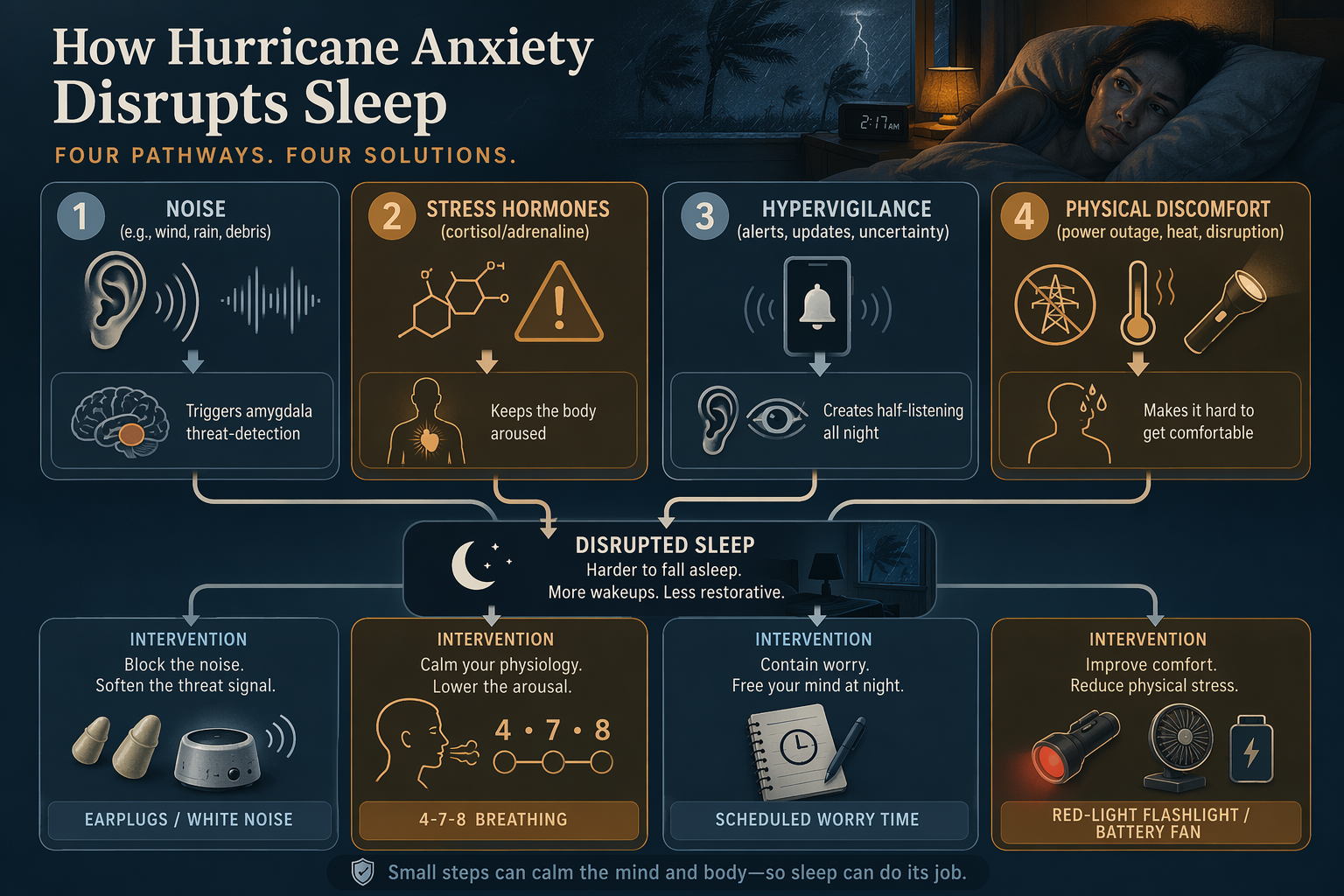
The useful move is to match the countermeasure to the mechanism. Earplugs are not going to stop rumination. Breathing exercises will not make a hot, powerless room comfortable. Turning off every alert may improve quiet, but it can also make you less safe. During an active storm, the goal is not perfect sleep. It is safer, less-fragmented rest without dulling your ability to respond.
The Wind Is Not Just “Noise” to a Sleeping Brain
Hurricane wind is hard to sleep through because it carries information. The brain is listening for impact, breakage, water intrusion, and changes that might mean a new decision has to be made. Reports used in hurricane sleep-preparedness guidance describe wind noise reaching 100-plus decibels, loud enough to cut through sleep and keep threat-detection systems engaged.[2]
This is where generic advice to “create a quiet sleep environment” misses the point. You may not be able to create quiet. You may only be able to reduce sharp peaks, mask unpredictable rattles, and give the brain a steadier sound field so every gust does not become a separate alarm.
Foam or silicone earplugs can help, but treat the numbers with care. One hurricane sleep guide from a commercial sleep publisher says earplugs may reduce noise by roughly 25 to 30 decibels; actual reduction depends on fit, product, and whether you insert them correctly.[2] That is not a guarantee of silence. It is a way to lower the intensity of the sound while keeping you reachable by a partner, a weather radio, or a high-priority phone alert.
A battery-powered white-noise machine, radio static, or a phone playing downloaded white noise can serve a different purpose. It does not block the storm. It makes the soundscape less jagged, so the brain is not yanked awake by every new scrape or bang. If you use a phone for white noise, keep enough battery reserve for communication, or run the sound from a separate charged device.
| If this is what wakes you | The better-matched response | Safety caveat |
|---|---|---|
| Sudden gusts, rattling shutters, roof or window noise | Earplugs plus steady battery-powered white noise | Do not block the only alert source you depend on |
| Lying awake replaying forecast tracks and worst-case scenarios | Scheduled worry time before dark; breathing after lights out | Use planning time for decisions, not endless feed-refreshing |
| Phone alerts, evacuation concerns, flood warnings | A controlled alert plan with trusted sources and escalation rules | Do not silence life-safety alerts just to make the room calmer |
| Heat, light, dead outlets, medical-device concerns | Battery fan, red-light flashlight, backup power plan | Medical equipment needs a plan before the storm, not at bedtime |
Emergency Alerts Create a Real Safety-Monitoring Problem
Hypervigilance during a hurricane is not automatically irrational. If you are responsible for children, pets, an older adult, medication refrigeration, oxygen, CPAP, or a flood-prone first floor, part of your brain has a legitimate job: keep listening. The mistake is asking that brain to either monitor everything all night or monitor nothing at all.
A safer alert plan is boring on purpose. Decide before dark which alerts matter enough to wake you, which app or radio you trust, who else in the home is also monitoring, and what conditions trigger action. For flood-specific decisions, a separate sleeping during flood warnings framework can be more useful than trying to reason from bed while half-awake.
That may mean leaving Wireless Emergency Alerts on, enabling severe-weather alerts from one trusted weather app, and muting lower-value notifications that only repeat what you already know. It may mean placing the phone across the room at full volume, with a charged weather radio as backup, so you are not scrolling every time you check the screen. The sleep benefit comes from narrowing the monitoring task, not pretending there is no task.
If two adults are present, take shifts when conditions allow. One person lightly monitors for a set block while the other tries to sleep with earplugs. Then switch. This is not elegant wellness advice; it is fatigue management. Even a few protected 90-minute blocks can be worth more than six hours of everyone half-listening at once.
Rumination Belongs Before Dark, Not at 2 A.M.
Storm anxiety often starts hours before the worst weather arrives. Baylor College of Medicine clinicians describe this kind of anticipatory anxiety as the mind and body reacting before the event itself, especially when people are tracking forecasts, remembering prior storms, or preparing for uncertain outcomes.[3] That early activation matters because bedtime is a terrible time to start making the whole plan.
The Anxiety and Depression Association of America recommends setting a daily “worry time” of 10 to 15 minutes at the same time each day for severe-storm anxiety.[4] For hurricane sleep, the timing matters: do it in daylight or early evening, not while you are under the covers. Use it to write the live questions down: Where are the shoes? Who moves the car if water rises? What is the pet carrier plan? What is the threshold for leaving an interior bedroom?
Once a question becomes an action, assign it. Once it cannot be answered until morning, park it. This is not meant to make you unconcerned. It is meant to keep the same loop from reopening every time the wind changes pitch.
A simple pre-bed storm note can be enough:
- Current trusted forecast source and last check time
- Alerts that will wake the household
- Flashlights, shoes, medications, pet supplies, and keys
- Who checks what if an alert sounds
- The next planned update time, unless a life-safety alert arrives first
For readers who know their anxiety spikes during tropical systems, the related hurricane anxiety and sleep pathway is worth separating from ordinary insomnia. The more reactive your sleep becomes to forecast updates, the more important it is to move planning out of bed.
Use Breathing for Arousal, Not for Logistics
Once the plan is set, the body may still act as if it is waiting for orders. Cortisol and adrenaline are useful in an emergency; they are also lousy sleep companions. They raise arousal, sharpen attention, and make small sounds feel more important than they would on a normal night.
This is where breathing can help, as long as it is not asked to do the wrong job. NPR’s January 2026 explanation of the 4-7-8 technique describes it as a way to activate the parasympathetic nervous system, countering stress-driven arousal: inhale for 4 seconds, hold for 7, exhale for 8.[5]
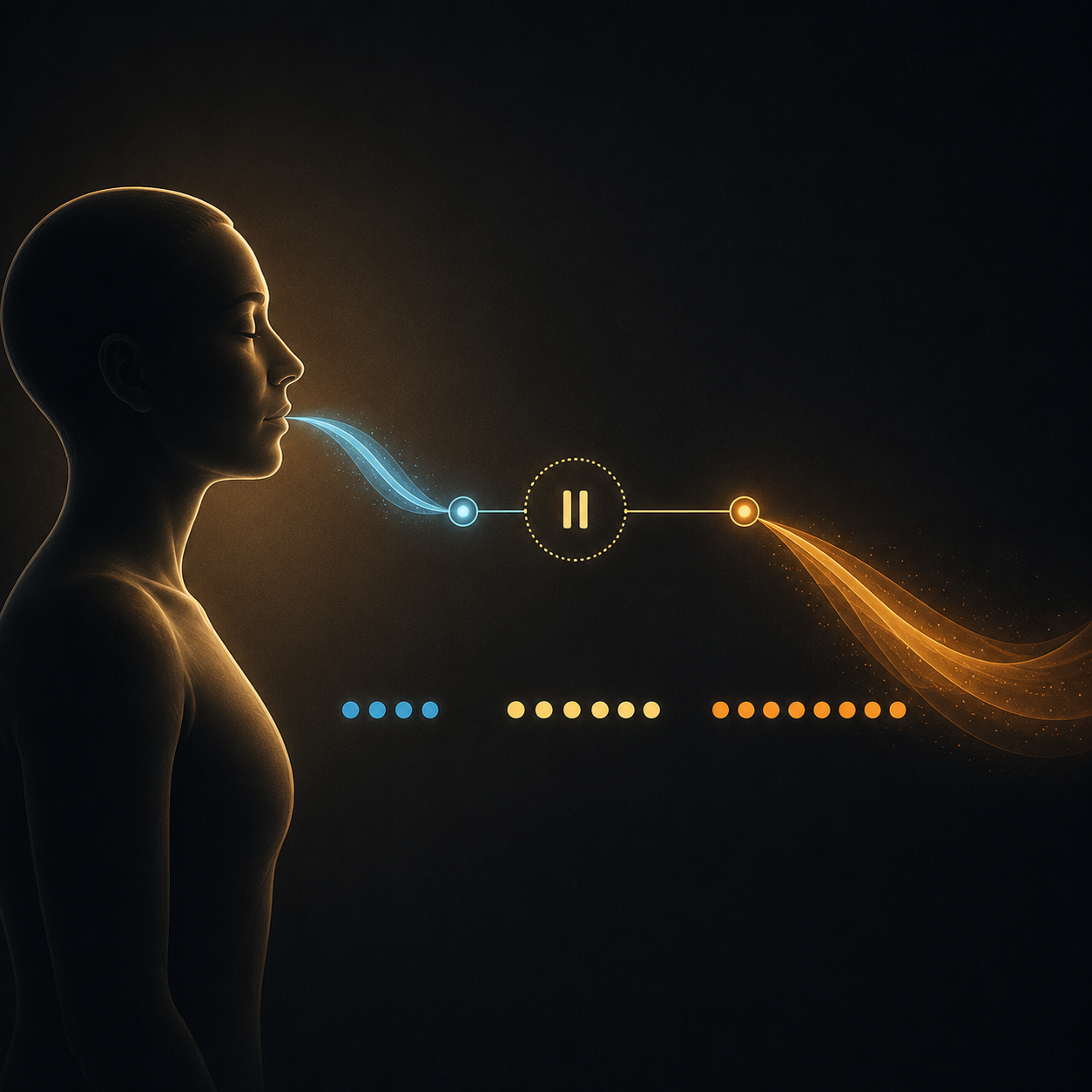
Use it after the actual safety decisions have been made. Try four rounds at bedtime, or after a wake-up when you have checked only what you planned to check. If the 7-second hold feels uncomfortable, shorten the count rather than forcing it. The point is a longer, slower exhale and a repeatable rhythm, not perfect arithmetic.
Pairing worry time with breathing creates a clean sequence: decisions before dark, downshifting at bedtime. Reversing that order is what fails. A breathing exercise cannot compete with an unresolved evacuation question, an uncharged battery, or a missing medication bag.
When the Power Goes Out, Sleep Becomes a Physical Problem
Outage sleep is not just “less comfortable.” Heat, humidity, light from repeated checks, dead outlets, and medical-device worries can keep the nervous system active even after the loudest wind has passed. Hurricane-preparedness sleep guidance commonly treats outages as a multi-day issue, with many lasting 2 to 7 days.[2] That range is not a promise; it is a reminder that the first night is not the only night to plan for.
A battery-powered fan can make a hot room more tolerable and add steady masking sound. A manual-pump air mattress may help if the safest sleeping area is an interior room, hallway, or lower-risk part of the home rather than the usual bed. Neither is glamorous. Both can reduce the number of times discomfort yanks you fully awake.
Light matters too. Weather.gov storm-stress guidance recommends a red-light flashlight for nighttime checks because red light is less disruptive to melatonin production than bright white light.[6] The practical version: keep one red-light flashlight where you actually sleep, not in a drawer across the house, and use it for bathroom trips, quick window checks, or medication access.
CPAP users need a separate plan. A battery backup, charged power station, or other medically appropriate backup should be arranged before storm night, and the device manufacturer or clinician is a better authority than a general sleep-tip article. If your sleep depends on powered medical equipment, this is preparedness, not optional comfort.
Be Careful With Anything That Makes You Less Responsive
The temptation to knock yourself out before landfall is understandable. It is also risky. Stronger sleep medications can make it harder to wake, process an alert, move quickly, drive if evacuation becomes necessary, or help someone else in the home. During active hurricane conditions, that trade-off is usually the wrong one unless a clinician who knows your situation has told you otherwise.
Natural melatonin is sometimes discussed in low doses, such as 1 to 3 mg, in hurricane sleep-preparedness materials.[2] Even there, use caution: melatonin is a timing signal, not a storm sedative, and it can still leave some people groggy. If you have to remain alert for evacuation orders, flood changes, oxygen equipment, children, or an older relative, environmental and behavioral tools are safer first moves.
This is also why alcohol is a poor storm-night sleep aid. Even when it makes sleep start faster, it can fragment the second half of the night and impair judgment. A hurricane night is exactly when judgment still matters.
Set a Lower Bar for Sleep During Active Conditions
Some hurricane sleep guides describe 3 to 5 hours of broken sleep during active conditions as a realistic expectation for many people.[2] That number should not be treated as a medical target or a guarantee. It is useful because it lowers the second layer of anxiety: the panic that you are failing because you are not getting a normal night’s sleep while the house is shaking.
If you can get one solid block and a few lighter fragments, that may be enough to protect next-day functioning better than staying in bed furious for eight hours. SleepHealth.org’s disaster sleep guidance also emphasizes practical sleep protection during and after disasters rather than pretending normal routines will fully hold under abnormal conditions.[7]
During the storm, judge the night by function: Did someone responsible stay able to hear critical alerts? Did everyone get some protected rest? Did heat, light, and noise get reduced where possible? That is a more honest standard than comparing the night to an ordinary Tuesday.
For a more detailed breakdown of how storm noise, light, and anxiety interact, the related guide to sleeping through tropical storm noise, light, and anxiety covers additional targeted countermeasures without treating every bad night as the same problem.
After the Storm, Watch the Timeline
A few bad nights during landfall, cleanup, insurance calls, school closures, or power loss can be a normal response to an abnormal week. The line changes when sleep does not begin to recover after the danger has passed, especially if the night brings recurring nightmares, panic at ordinary rain sounds, or a constant need to monitor weather long after the immediate threat is gone.
Post-storm mental-health effects can last. A PreventionWeb summary of a 2023 study reported that hurricane-affected populations had about 14.5% more poor mental health days per month for years after exposure; the summary is useful as a warning about persistence, though the precise methodology should be checked in the original study before generalizing broadly.[8] Long-term Katrina research also found that 1 in 6 low-income mothers in one studied group still met PTSD criteria 12 years later, which is a specific high-risk population, not a universal hurricane statistic.[9]
Sleep disruption that lasts more than 2 to 4 weeks after the storm, or comes with nightmares and ongoing hypervigilance, belongs on the clinical-care side of the line. Breathing exercises and earplugs can support recovery, but they are not trauma treatment. UAB storm-anxiety guidance identifies cognitive behavioral therapy for insomnia, or CBT-I, as a first-line treatment for disaster-related insomnia.[10] Readers who need that next step can start with a plain-language CBT-I explainer or the related discussion of disaster anxiety and CBT-I.
Broken sleep during an active hurricane is not proof that you handled the night badly. It may be the body doing exactly what danger asks it to do. The work is to reduce unnecessary arousal, protect necessary alertness, and know when the storm has ended but the nervous system has not gotten the message.
References
- Sleep Prioritization Survey, American Academy of Sleep Medicine
- How to Sleep During a Hurricane, Amerisleep
- Managing anxiety before a storm, Baylor College of Medicine
- Severe Storms: How to Reduce Your Anxiety, Anxiety and Depression Association of America
- 4 ways to calm your mind in stressful times, NPR, January 2026
- Storm Stress, National Weather Service
- Sleep and Disasters, SleepHealth.org
- The psychological toll of hurricanes can last for years, PreventionWeb, 2023
- Long-term effects of Hurricane Katrina on the psychological well-being of low-income mothers, National Library of Medicine
- Dealing with storm anxiety, University of Alabama at Birmingham
Comments
Join the discussion with an anonymous comment.