
The frustrating part of an average sleep apnea result is that no one sleeps at the average. A trial can say that tirzepatide reduced apnea-hypopnea index, or AHI, by 51% to 59% across adults with obesity and moderate-to-severe obstructive sleep apnea, and that is clinically important. It still leaves the person in the exam room asking a more personal question: does my airway, my breathing control, and my sleep pattern look like the people who improved a lot, or the people who improved more modestly?
That is why the most interesting 2026 story about Zepbound for sleep apnea treatment in adults with obesity is not simply that the medication was approved. It is a secondary analysis of SURMOUNT-OSA data presented at the American Thoracic Society International Conference in May 2026, which identified a “strong response endotype” among tirzepatide-treated patients. In that analysis, patients with a particular mix of traits had nearly double the AHI reduction seen in the overall trial averages.[1][2]

The distinction matters. Zepbound is now part of the obstructive sleep apnea conversation for eligible adults with obesity, but medication response is not the same as medication eligibility. A patient may qualify, start treatment, lose weight, and still need follow-up sleep testing to learn whether the airway obstruction itself has improved enough to change therapy. If the practical question is eligibility, that belongs in a separate discussion of who qualifies for weight loss medication for sleep apnea. The question here is narrower: among eligible adults, who appears most likely to have a large sleep apnea response?
What the 2026 analysis adds to the Zepbound sleep apnea story
The baseline story is already well known. In December 2024, the FDA approved Zepbound, the tirzepatide injection marketed by Eli Lilly, as the first medication for obstructive sleep apnea in adults with obesity.[3] The approval followed SURMOUNT-OSA, two phase 3 trials in adults with moderate-to-severe OSA and obesity, including one trial in people not using positive airway pressure and one in people using it.[4][5]
In the original reporting of the phase 3 results, tirzepatide reduced sleep apnea severity substantially. Lilly described reductions in AHI of nearly two-thirds, and the FDA described a statistically significant and clinically meaningful reduction in AHI compared with placebo.[3][4] The American Academy of Sleep Medicine treated the approval as an important development while still emphasizing that OSA diagnosis and treatment selection require medical evaluation.[6]
Those trial-wide results are useful, but they are still averages. The 2026 secondary analysis tries to explain why some patients did especially well. The strong-response group was characterized by younger age, lower BMI within the studied population, greater upper-airway collapsibility, high loop gain, and low arousal threshold.[1][2]
That list is more clinically interesting than a generic “lose weight, breathe better” explanation. Age and BMI are familiar variables, though they need to be handled carefully: lower BMI here does not mean absence of obesity, and younger age does not make older patients poor candidates. The more revealing traits are the three sleep-breathing physiology markers: collapsibility, loop gain, and arousal threshold.
The strong-response endotype, in plain clinical terms
An endotype is not a symptom checklist. It is a pattern of underlying physiology. Two people can both have moderate-to-severe obstructive sleep apnea, both snore, both wake unrefreshed, and both carry excess weight, while the mechanical and neurological reasons for their airway events differ. That is the gap the 2026 analysis is trying to narrow.
| Strong-response trait | What it means clinically | Why it may matter for tirzepatide response |
|---|---|---|
| Younger age | The patient is younger within the trial population. | Age may track with airway tissue behavior, neuromuscular responsiveness, and reversibility, but it is not a stand-alone predictor. |
| Lower BMI | The patient has obesity but is at the lower end of BMI among the studied patients. | A smaller mechanical load may leave more room for airway improvement, though BMI alone cannot describe OSA physiology. |
| Greater upper-airway collapsibility | The throat airway closes more readily during sleep. | If treatment reduces mechanical loading or changes airway behavior, a highly collapsible airway may show a larger measurable AHI change. |
| High loop gain | The breathing-control system overreacts to changes in oxygen and carbon dioxide. | If tirzepatide affects ventilatory stability, patients with unstable control may have more to gain. |
| Low arousal threshold | The sleeper wakes easily in response to breathing disturbance. | Reducing instability or obstruction may prevent repeated arousals before events escalate. |
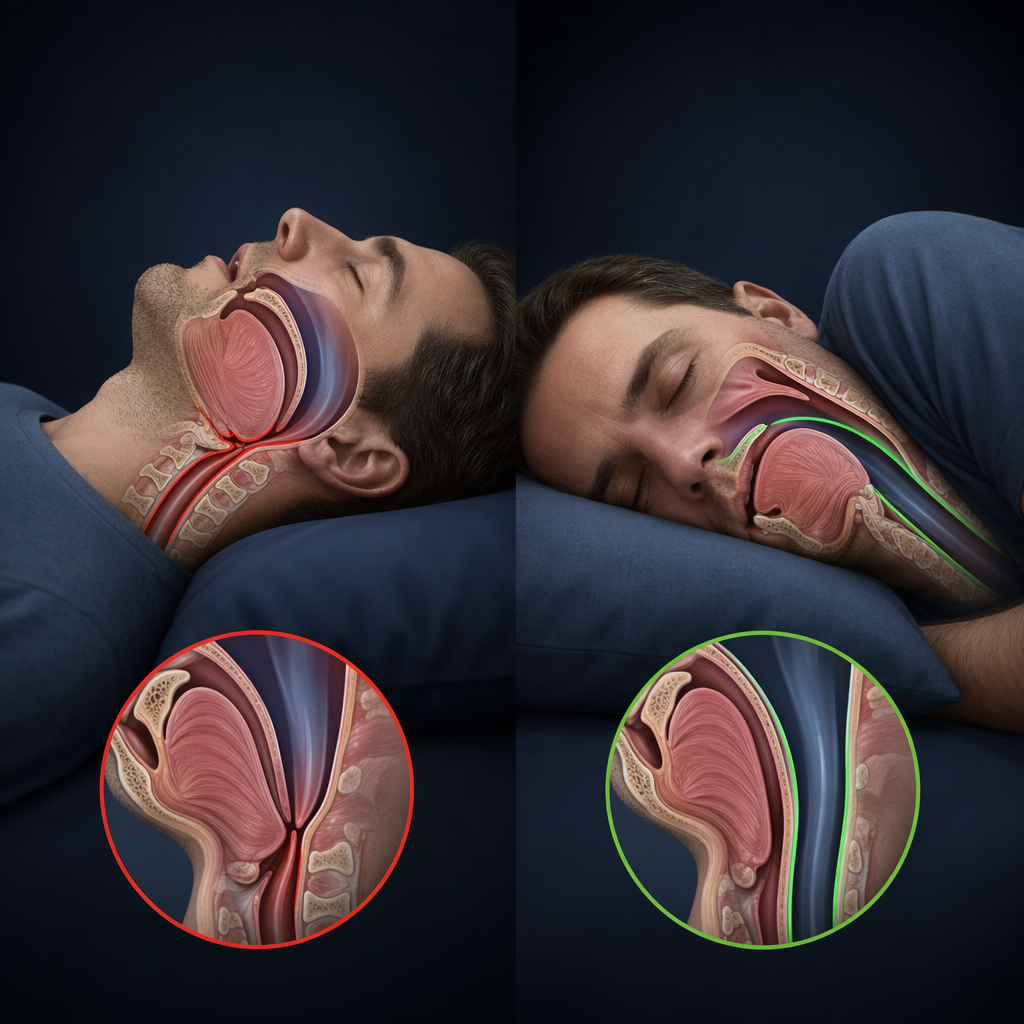
Upper-airway collapsibility is the mechanical part most patients can picture. During sleep, the muscles supporting the throat relax. In OSA, the airway narrows or closes repeatedly, reducing or stopping airflow. A more collapsible airway is one that requires less pressure or less disturbance to close. If body weight, fat distribution, inflammation, fluid shifts, or airway wall behavior change, that airway may cross from “closes repeatedly” to “stays open more often.”
The catch is that collapsibility is not the same as snoring volume or how tired someone feels. Loud snoring can be a clue that an airway is vibrating or narrowing, but it does not measure how easily the airway collapses during sleep. A person trying to separate ordinary snoring from possible OSA still needs diagnostic evaluation, not a guess based on bedroom sound. That broader distinction is covered in how to tell the difference between snoring and sleep apnea.
Loop gain is less intuitive but central to the analysis. It describes how strongly the body’s breathing-control system responds to a disturbance. A high loop gain system behaves like an overcorrecting thermostat: a small shift can trigger a large response, which then causes another correction in the opposite direction. In sleep apnea, that instability can help perpetuate cycles of reduced breathing, over-breathing, carbon dioxide shifts, and recurrent events.
A high loop gain profile suggests that OSA is not only a blocked-pipe problem. It is also a control-system problem. If tirzepatide’s effect were purely a matter of weight reduction, loop gain would be a less satisfying signal. The fact that loop gain appears in the strong-response pattern is one reason the 2026 analysis is more than a BMI story.[1][2]

Arousal threshold adds a third layer. Some sleepers wake easily when breathing becomes strained; others tolerate more obstruction before the brain triggers arousal. A low arousal threshold means the person wakes with relatively little disturbance. That can sound protective, and sometimes waking does reopen the airway. But repeated early arousals can also fragment sleep and destabilize breathing, feeding the same cycle OSA treatment is trying to interrupt.
Together, these traits describe a patient whose OSA may be especially modifiable: an airway that collapses readily, a ventilatory control system that swings too hard, and a brain that wakes quickly when breathing becomes unstable. The secondary analysis suggests that tirzepatide’s largest AHI improvements clustered in that physiology, not simply in everyone with the highest starting weight.[1][2]
Why the improvement may not be explained by weight loss alone
Weight loss still matters. In obstructive sleep apnea, excess weight can increase pressure around the upper airway, reduce lung volume, and worsen collapsibility. Tirzepatide produces weight loss in many patients, and it would be strange to discuss its OSA effect as if weight were incidental.
But the 2026 discussion around the endotype analysis includes a more cautious and more interesting possibility: some OSA improvement may not be mediated only through weight loss. Atul Malhotra, MD, and Francavilla were reported as discussing potential effects on airway collapsibility and loop gain that could be independent of weight change, although the mechanism remains under investigation.[1][2]
That is not proof that tirzepatide directly treats airway physiology apart from weight reduction. It is a reason to avoid a flattened explanation. If the strongest responders are partly identified by collapsibility and loop gain, then future research may need to ask not only how much weight changed, but which breathing traits changed, when they changed, and whether those changes persisted.
This also keeps treatment hierarchy in view. Zepbound does not replace the need to diagnose OSA, measure severity, choose therapy, and reassess. CPAP or other positive airway pressure therapy remains a core treatment for many patients, and alternatives depend on severity, anatomy, tolerance, and goals. For milder cases and non-CPAP options, the relevant comparison is better handled in what works for mild sleep apnea besides CPAP, not by treating medication response as the whole care plan.
Nearly double the AHI reduction does not mean a patient can self-identify
The phrase “nearly double” is powerful, and it needs guardrails. The secondary analysis found that patients in the strong-response endotype had nearly twice the AHI reduction compared with the overall tirzepatide-treated trial population.[1][2] That does not mean a patient can look at age, BMI, snoring, or sleepiness and calculate a personal AHI drop.
AHI itself is a measurement from sleep testing: the number of apneas and hypopneas per hour of sleep or recording time, depending on the test method. If treatment is working, AHI may fall, oxygenation may improve, symptoms may change, or pressure needs may shift. But the only way to know what happened to OSA severity is to measure it. The practical details of home versus lab testing are separate from this endotype question and are covered in home sleep test vs. lab study cost.
Scott Sands, PhD, framed the clinical value as a move toward personalized expectation-setting, saying clinicians can now tell some patients that they have characteristics placing them in a group that “respond remarkably.”[1] That is a useful shift. It changes the conversation from “the average patient improved by this much” to “your physiology may resemble a subgroup that improved more.”
The word “may” is doing real work. This was a secondary analysis, not a prospectively validated prediction rule. As of July 2026, the endotype findings had been presented at a conference and reported by medical news outlets, but had not yet appeared as a peer-reviewed full publication.[1][2] That does not make the analysis unimportant. It does mean it should not be used as a bedside guarantee.
What a clinician can reasonably do with this now
For now, the endotype analysis is best used to sharpen questions, not to close decisions. A sleep clinician can review the patient’s diagnostic study, OSA severity, weight history, comorbidities, PAP use, medication eligibility, and treatment goals. In some settings, more advanced sleep-study interpretation may give clues about collapsibility, ventilatory instability, or arousal threshold. But this is not the same as a widely validated clinical calculator.
- A reasonable expectation-setting question: “Do my sleep-study features suggest I resemble the strong-response group?”
- A reasonable monitoring question: “When will we repeat objective testing to see whether my AHI actually changed?”
- A reasonable treatment question: “Should I continue PAP, adjust it, or use another therapy while medication effects are being assessed?”
- A reasonable safety question: “What happens if I stop tirzepatide, regain weight, or my sleep apnea symptoms return?”
The last question matters because medication effects are not necessarily permanent after discontinuation. Weight regain and possible return of OSA benefit remain concerns regardless of whether someone fits the strong-response profile. A large early AHI improvement still needs a maintenance plan.
It is equally important not to misread the strong-response profile as an exclusion rule. Patients outside that pattern still had clinically meaningful AHI reductions in SURMOUNT-OSA, just not at the same magnitude reported for the strong-response group.[1][2] Older patients, patients with higher BMI, or patients whose physiology is less neatly aligned with the endotype should not be written off from a medication discussion if they otherwise meet clinical criteria.
Nor should anyone substitute a shortcut for diagnosis or treatment. Mouth taping, for example, is not a safe workaround for suspected or known sleep apnea; the safety concerns belong in a different conversation, but they are real enough to mention here. If that is on the table, start with why mouth taping is unsafe for sleep apnea before treating it as a treatment alternative.
The conservative takeaway
The 2026 SURMOUNT-OSA secondary analysis suggests that clinicians may soon be able to identify adults with obesity and obstructive sleep apnea who are especially likely to have large AHI improvements on tirzepatide. The strongest signal points to a patient profile marked by younger age, lower BMI within the eligible population, greater upper-airway collapsibility, high loop gain, and low arousal threshold.[1][2]
That is a meaningful step beyond quoting the trial average. It is not yet a validated prediction tool, and it should not be used to promise a specific result. For an individual patient, the better question is not “Am I guaranteed to respond?” It is: “Do my clinical and sleep-study features suggest I resemble the strong-response group, and how will we measure whether treatment is actually improving my OSA?”
References
- Which Patients Benefit Most from GLP-1 for Sleep Apnea, Respiratory Therapy, https://respiratory-therapy.com/disorders-diseases/sleep-medicine/breathing-disorders/patient-benefit-glp-1-sleep-apnea-obesity/
- Some Patients With Sleep Apnea Benefit Most From Tirzepatide, Medscape, July 2026, https://www.medscape.com/viewarticle/some-patients-sleep-apnea-benefit-most-tirzepatide-2026a1000mv2
- FDA Approves First Medication for Obstructive Sleep Apnea, U.S. Food and Drug Administration, https://www.fda.gov/news-events/press-announcements/fda-approves-first-medication-obstructive-sleep-apnea
- Tirzepatide Reduced Sleep Apnea Severity by Nearly Two-Thirds, Eli Lilly and Company, https://investor.lilly.com/news-releases/news-release-details/tirzepatide-reduced-sleep-apnea-severity-nearly-two-thirds
- Tirzepatide for the Treatment of Obstructive Sleep Apnea and Obesity, New England Journal of Medicine, https://pubmed.ncbi.nlm.nih.gov/38912654/
- Zepbound approved by FDA as first sleep apnea medication, American Academy of Sleep Medicine, https://aasm.org/zepbound-approved-fda-first-sleep-apnea-medication/




Comments
Join the discussion with an anonymous comment.