
When the Air Quality Index is hazardous, the usual bedroom advice has to be suspended. Do not crack the window for “fresh air.” Do not use an outdoor fan to cool the room. Do not run an ionizer or ozone-producing device because the room feels stale. At AQI 301 or higher, and especially when local readings push into the red-purple or maroon range, the safer question is not how to make the bedroom feel naturally aired out. It is how to make one room behave like a controlled air space long enough for people to sleep.
That distinction is no longer theoretical. In mid-July 2026, smoke from Canadian wildfires pushed AQI above 500 in Detroit, Chicago, and other Midwestern cities, according to reporting from The New York Times on July 16, 2026.[1] Those readings sit beyond ordinary “unhealthy” guidance. They are the kind of night when closing a window is only the first move, not the plan.
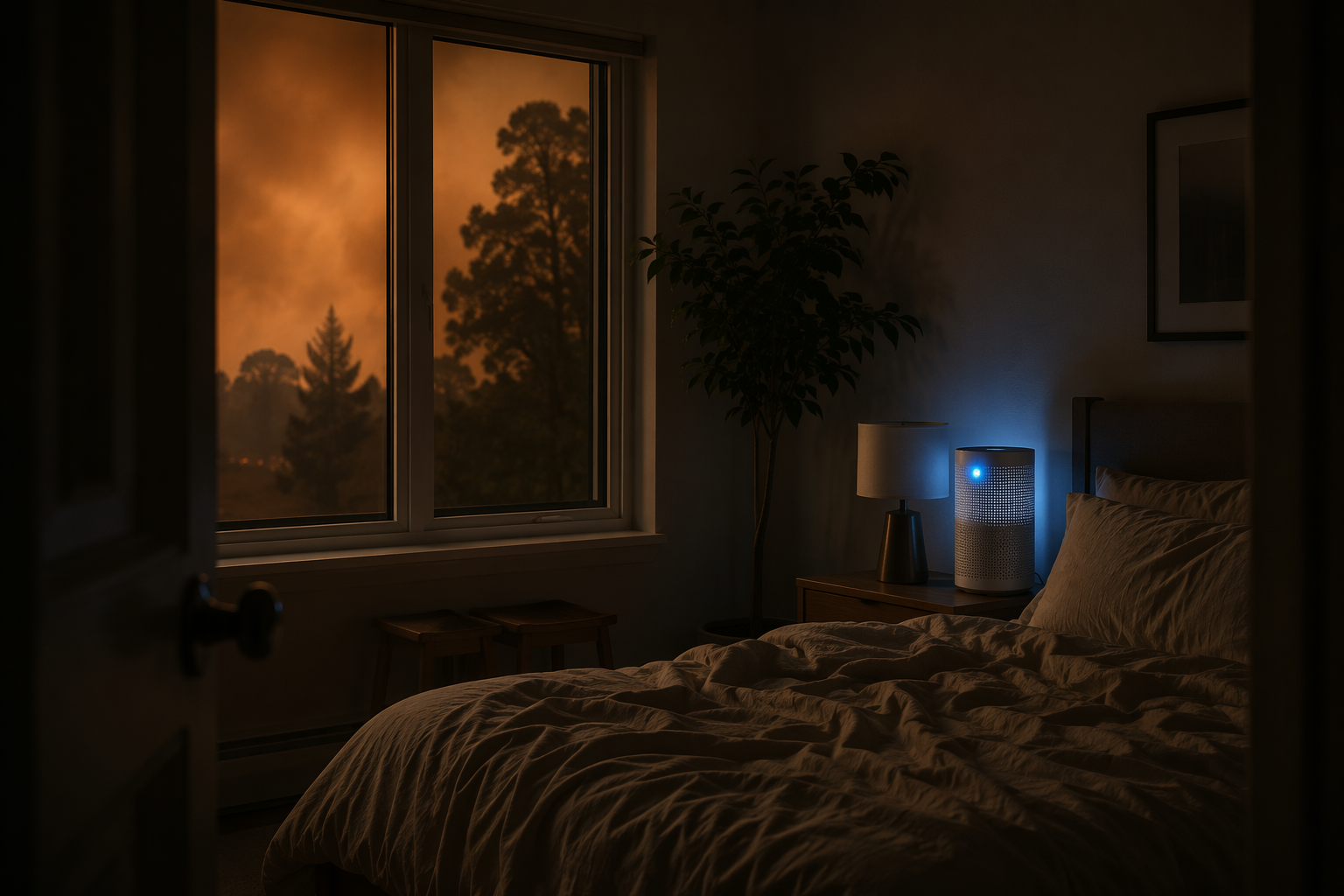
The 10 p.m. protocol
If you are trying to sleep tonight while outdoor air is hazardous, start with the room where the most vulnerable sleeper will spend the night. That may be the bedroom of a child, an older adult, someone with asthma, or the person who already wakes coughing. If one purifier is available, it belongs there.
- Close windows and exterior doors in the sleep room and nearby rooms. Lock windows if that improves the seal.
- Block obvious smoke leaks with towels, painter’s tape, or weatherstripping around window edges, door gaps, and unused vents.
- Run a true HEPA purifier on the highest tolerable setting before bedtime, then keep it running overnight.
- Stop indoor particle sources: no candles, incense, smoking, vaping, frying, broiling, vacuuming, or wood-burning appliances.
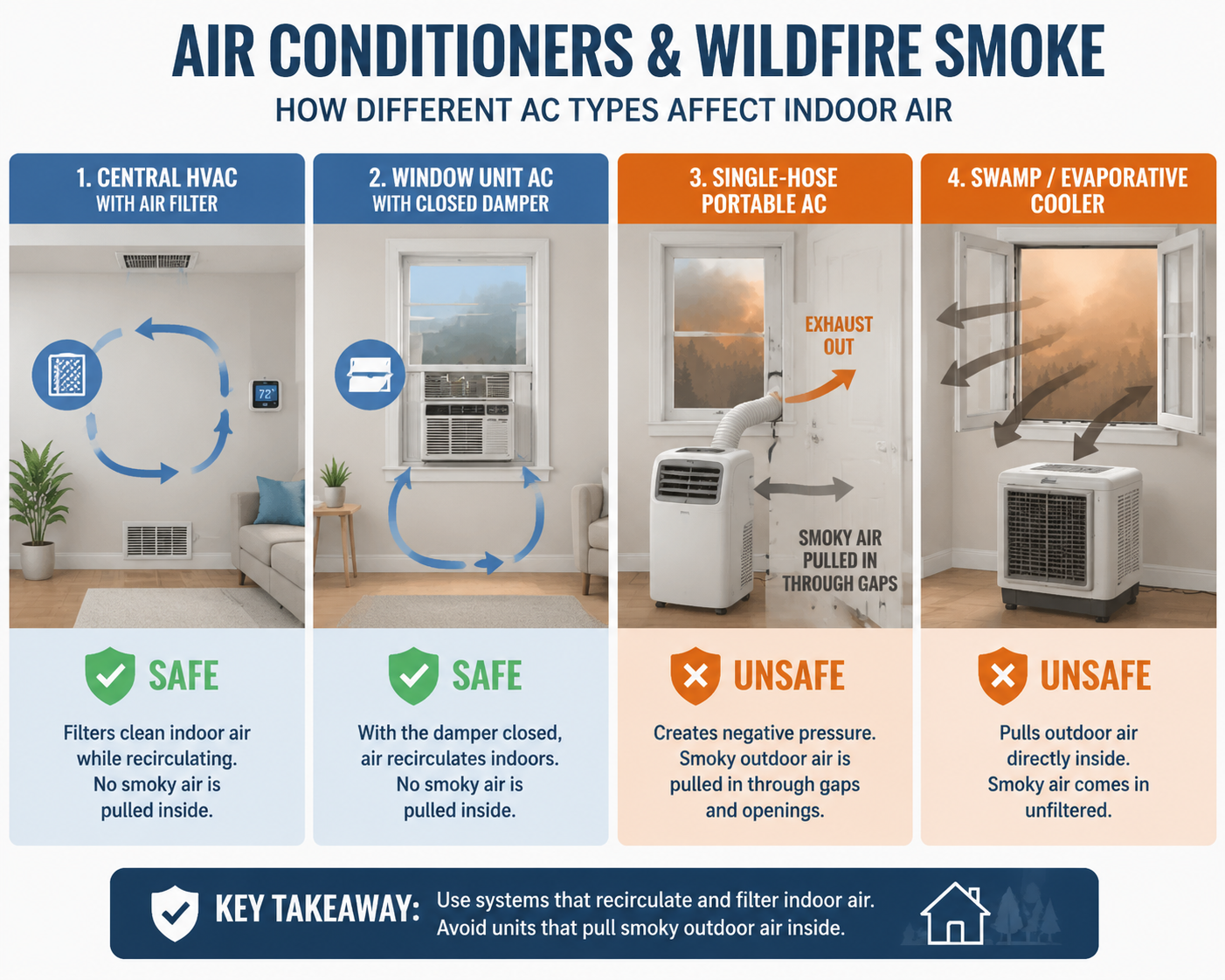
- Use recirculation mode if the room depends on central air or a window air conditioner that can avoid pulling outdoor air.
- Plan for stuffiness and CO₂ rather than ignoring it. A sealed bedroom with sleeping bodies is not automatically a healthy bedroom.
For readers whose AQI is above 100 but not hazardous, the escalation may not need to be this aggressive. A lower-severity plan belongs in How to Sleep Well During an Air Quality Health Advisory. Once the AQI reaches hazardous territory, however, “a little ventilation” can mean deliberately inviting the exposure you are trying to avoid.
Close the room, then make filtration do real work
A closed bedroom without filtration can still fill with fine particles that slip through cracks, under doors, and through mechanical systems. The goal is not just to shut the outside out. The goal is to reduce the particle load inside the room faster than new particles can enter.
Fine-particle exposure is the reason AQI ≥ 301 changes the operating rules. For hazardous AQI, PM2.5 concentrations above 250 µg/m³ are the relevant extreme-pollution threshold. A 2020 systematic review in Environmental Pollution found that 21 of 22 included studies reported positive associations between air pollution and adverse sleep outcomes across age groups.[2] Most of that evidence does not come from people spending a single night inside a smoke emergency, so it should not be oversold as a perfect map of tonight. It is still enough to justify low-risk controls that reduce exposure while people are sleeping.
For a bedroom, that usually means a portable HEPA purifier with enough clean-air delivery for the room. The EPA describes HEPA filters as removing at least 99.97% of airborne particles that are 0.3 microns in diameter, a size used in filter testing because it is especially difficult to capture.[3] Wildfire smoke includes particles smaller and larger than that test size; the practical point is that a real HEPA unit gives you a defined filtration standard. An ionizer with vague “freshening” claims does not.
Size matters. A purifier that works in a small nursery may not keep up in a large primary bedroom with a leaky window and two adults breathing overnight. Check the unit’s CADR rating and the room size it is rated to cover. If the room is larger than the rating, treat the purifier as underpowered: move sleep into a smaller room, run two units if you own them, or reduce the room volume by closing adjoining doors. During hazardous AQI, a quiet low setting may be too little air movement to matter.
| If this is your room tonight | Choose the more protective move |
|---|---|
| One purifier, several bedrooms | Put it in the room of the child, older adult, pregnant person, or person with asthma, COPD, heart disease, sleep apnea risk, or active symptoms. |
| Large bedroom, small purifier | Sleep in a smaller room if possible, or place the purifier close to the breathing zone without blocking intake or output. |
| Leaky window or door | Seal visible gaps first, then run filtration continuously. |
| No purifier available | Close and seal the room, reduce indoor particle sources, use recirculated cooling if available, and follow local public-health guidance about cleaner-air shelters. |
| Purifier has an ionizer button | Turn the ionizer function off if the unit allows it, especially in a small sealed bedroom. |
Be especially skeptical of anything marketed as producing ozone, “activated oxygen,” or a sharp post-storm smell. The EPA warns that ozone is a lung irritant and that ozone generators sold as air cleaners can produce indoor ozone levels that are unsafe.[4] A bedroom during a smoke event is not the place to add another respiratory irritant and hope the label’s vocabulary solves the problem.
CADR is not a luxury detail
Clean Air Delivery Rate, or CADR, tells you how much filtered air the purifier can deliver. In a normal week, a slightly undersized unit may still be useful. During hazardous AQI, the margin shrinks because outdoor particles keep pressing into the room and sleep lasts for hours. If the purifier cannot exchange enough air for the space, the bedroom may feel protected while still carrying a high particle load.
Research on portable HEPA filtration shows why setup differences matter. In the Lamport et al. randomized crossover trial, HEPA air purifiers reduced indoor PM2.5 by a wide range, from 22.6% to 92%, depending on conditions such as CADR and room size.[5] That range is the practical lesson. “Has a purifier” and “has a purifier that can keep up in this room” are different statements.
The same pilot trial reported about 12 additional minutes of sleep per night with HEPA filtration in 30 healthy adults.[5] That is encouraging, but it is not a treatment claim. It is a small study in healthy adults, not proof that a purifier treats insomnia, snoring, sleep apnea, asthma, or the stress of watching smoke roll across a city map. The stronger argument for filtration on a hazardous night is exposure control: fewer fine particles in the air a sleeper breathes for the next several hours.
The CO₂ problem in a sealed bedroom
The uncomfortable part is that sealing works against particles and can still make the room worse in another way. People exhale carbon dioxide all night. In a tightly closed bedroom with the door shut, CO₂ can accumulate, and that can make sleep feel heavy, restless, or unrefreshing even while particle levels are improving.
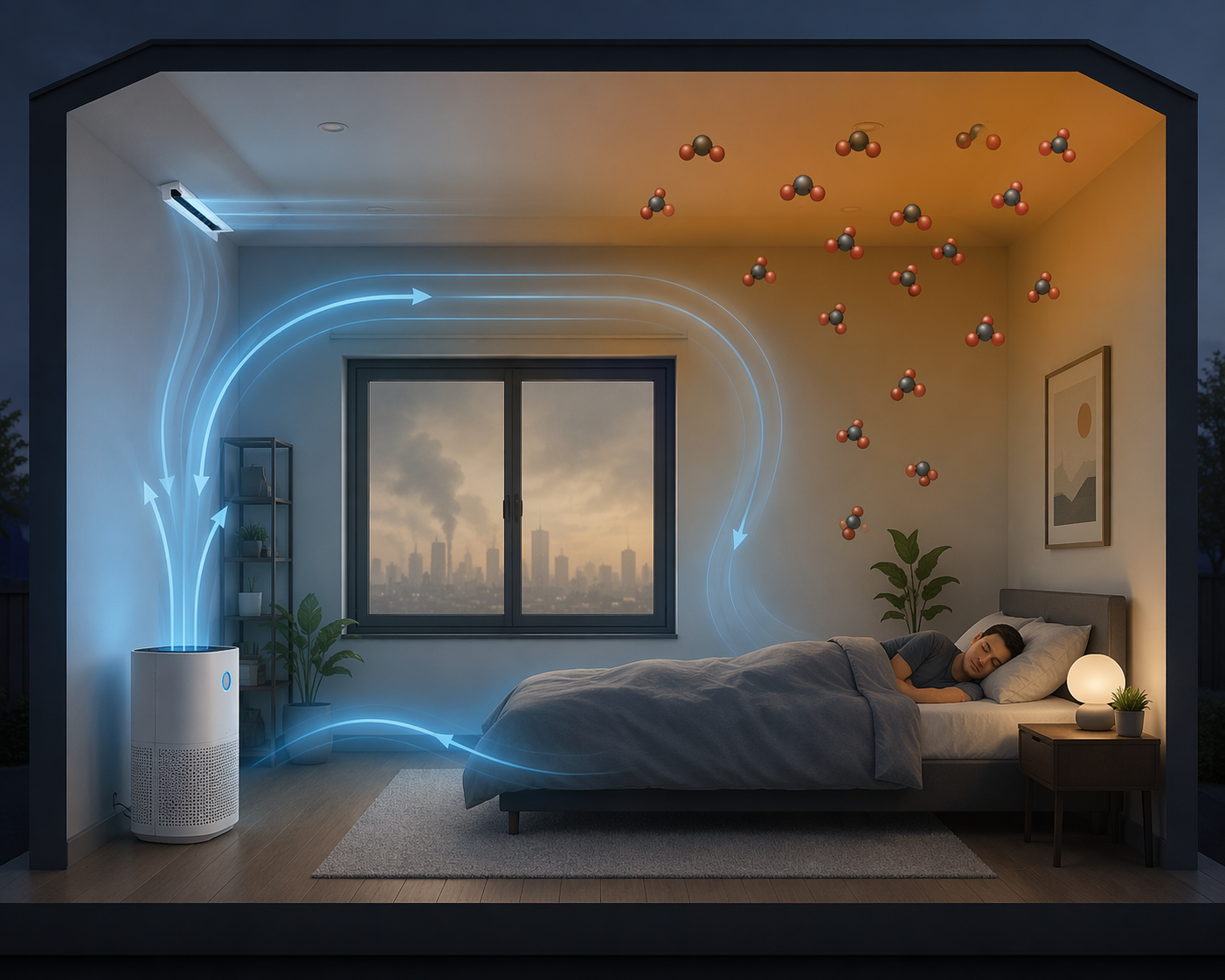
A 2023 Science of the Total Environment study found that increasing bedroom ventilation reduced both CO₂ and PM while improving sleep quality.[6] That result creates the central tension during hazardous AQI: ventilation can improve indoor air chemistry, but direct outdoor ventilation can bring in smoke. The answer is not to throw open the window. It is to look for the least smoky way to dilute CO₂ without sacrificing particle protection.
If you have a CO₂ monitor, use it as a decision tool rather than a gadget to stare at all night. If levels climb and the room feels stuffy, first try indirect dilution: open the bedroom door to a hallway or larger interior space that is also closed to the outdoors and, ideally, being filtered. Keep the purifier running in the sleep room. If there is a central HVAC fan with a good filter and recirculation mode, running the fan can help mix indoor air without intentionally pulling smoky air from outside.
If you do not have a CO₂ monitor, use the room setup. One adult sleeping alone in a larger room with a purifier has a different CO₂ risk than three people sleeping in a small sealed bedroom with the door closed. More sleepers, smaller room, tighter seal, and longer sleep window all push toward more CO₂ accumulation. In that case, the better compromise may be a filtered larger room, an open interior door, or moving the purifier to a shared sleeping space rather than sealing several people into the smallest room in the home.
Heat complicates the decision. If the only way to keep the room cool is to open a smoky window, the problem is no longer just sleep hygiene. Use safe cooling options that do not draw outdoor air when possible, and consider cleaner-air public spaces if the room becomes unsafe from heat. For the combined problem, see Summer Heat and Wildfire Smoke Create a Triple Threat to Sleep.
What pollution does to sleep, and what the evidence can’t prove
Air pollution can disturb sleep through several overlapping routes: irritated airways, coughing, nasal congestion, inflammation, cardiovascular strain, and changes in breathing stability during sleep. For readers who want the mechanism rather than the emergency protocol, How Air Quality Silently Affects Your Sleep Quality and Why Does Wildfire Smoke Disrupt Your Sleep? go deeper.
The large human studies are not a perfect match for a single hazardous-AQI night, but they point in the same direction. In the MESA study of 1,974 older adults, long-term exposure to PM2.5 and NO₂ was associated with greater sleep apnea risk after adjustment for demographics, comorbidities, and socioeconomic factors.[7] In the Sleep Heart Health Study, which included 6,441 adults, summer PM10 exposure was associated with a higher respiratory disturbance index and lower sleep efficiency.[8]
Those findings do not mean smoke exposure is the only reason someone snores, wakes gasping, or feels unrefreshed. They do mean that on a hazardous-air night, polluted air can add load to a breathing system that may already be strained. Filtration may reduce one environmental stressor; it does not diagnose or treat sleep apnea. If breathing pauses, choking awakenings, severe snoring, or daytime sleepiness continue after the smoke clears, that belongs with a clinician, not with a bigger purifier.
Medical red lines and vulnerable sleepers
A hazardous AQI night is harder on people who have less respiratory reserve or more airway reactivity. Children, older adults, pregnant people, and people with asthma, COPD, heart disease, recent respiratory infection, or known sleep-disordered breathing deserve the cleanest room, the best filtration, and the least experimentation.
- Seek medical guidance urgently for chest pain, severe shortness of breath, blue lips, confusion, fainting, or symptoms that are rapidly worsening.
- Follow the person’s asthma, COPD, heart, or sleep-apnea care plan rather than replacing it with filtration advice.
- Do not stop prescribed CPAP, oxygen, inhalers, or other therapies because a purifier is running.
- If CPAP equipment is used, keep the room air as clean as possible and follow the device manufacturer’s filter and maintenance instructions.
- If the home cannot be cooled or filtered safely, look for local cleaner-air shelters, cooling centers, or public-health instructions.
The psychological side also matters. Canceled plans, school closures, and the low-grade vigilance of checking smoke maps can unsettle bedtime routines even when the bedroom air improves. If the disruption is mostly behavioral after the acute air risk passes, How Wildfire Smoke Event Cancellations Affect Your Sleep may be the more useful next read.
When the AQI improves
When outdoor AQI drops out of hazardous range, do not immediately undo the whole setup. Smoke can linger indoors, and local readings can swing. Keep filtration running while you reassess. If outdoor air is clearly better and local guidance supports ventilation, brief airing may help reduce indoor CO₂ and indoor-generated pollutants, especially if you can continue filtering afterward.
The standard sleep advice comes back gradually: cooler room, steady bedtime, darkness, wind-down routine. Fresh outdoor air only belongs in that list when the outdoor air is actually safe enough to invite inside.
Hazardous AQI cannot be made harmless by a bedroom routine. It can be made less dangerous for sleep when the room is treated as a controlled air space: sealed against particles, filtered with enough capacity, watched for CO₂ and heat tradeoffs, and backed by clear medical red lines.
References
- Hazardous Air Quality Grips Midwest as Canadian Wildfire Smoke Spreads, The New York Times, July 16, 2026.
- Air pollution and sleep: A systematic review, Environmental Pollution, 2020.
- What is a HEPA filter?, U.S. Environmental Protection Agency.
- Ozone Generators that are Sold as Air Cleaners, U.S. Environmental Protection Agency.
- Air purification effects on sleep: A randomized crossover pilot trial, Journal of Sleep Research, 2022.
- Bedroom ventilation, CO₂ and sleep quality study, Science of the Total Environment, 2023.
- The association of ambient air pollution with sleep apnea: The Multi-Ethnic Study of Atherosclerosis, Annals of the American Thoracic Society, 2019.
- Associations of PM10 with sleep and sleep-disordered breathing in adults from seven U.S. urban areas, American Journal of Respiratory and Critical Care Medicine, 2010.

Comments
Join the discussion with an anonymous comment.