
For adults 65 and older, the Beers Criteria answer is straightforward before it is comfortable: avoid benzodiazepines, Z-drugs, first-generation antihistamines such as diphenhydramine and doxylamine, strongly anticholinergic tricyclic antidepressants including amitriptyline and doxepin above 6 mg, and barbiturates when they are being used as sleep aids. The concern is not that sleep does not matter. It is that the same pill that helps someone get through the night can leave them confused, unsteady, or cognitively dulled the next morning, and those consequences become more expensive with age.[1]
| Sleep aid or class | Beers Criteria direction for adults 65+ | Recognizable examples | Safer direction to discuss |
|---|---|---|---|
| First-generation antihistamines | Avoid because of anticholinergic effects, confusion, dry mouth, constipation, urinary retention, falls, and delirium risk | Diphenhydramine in Benadryl, Tylenol PM, Advil PM; doxylamine in Unisom SleepTabs | CBT-I first; if medication is needed, ask about options with a better older-adult safety profile |
| Benzodiazepines | Avoid because older adults have increased sensitivity and higher risks of cognitive impairment, delirium, falls, fractures, and motor vehicle crashes | Lorazepam, temazepam, alprazolam, clonazepam, diazepam | Do not stop abruptly if used regularly; discuss tapering and alternatives |
| Z-drugs | Avoid because harms are similar to benzodiazepines and benefits are limited | Zolpidem, eszopiclone, zaleplon | Medication review, taper planning when appropriate, CBT-I |
| Tricyclic antidepressants with strong anticholinergic activity | Avoid; low-dose doxepin at 6 mg/day or less is treated differently | Amitriptyline; doxepin above 6 mg | Low-dose doxepin 3-6 mg may be considered for selected patients |
| Barbiturates | Avoid because of physical dependence, tolerance, overdose risk, and poor safety profile | Phenobarbital and related sedative barbiturates | Specialist-guided review; abrupt stopping can be dangerous |
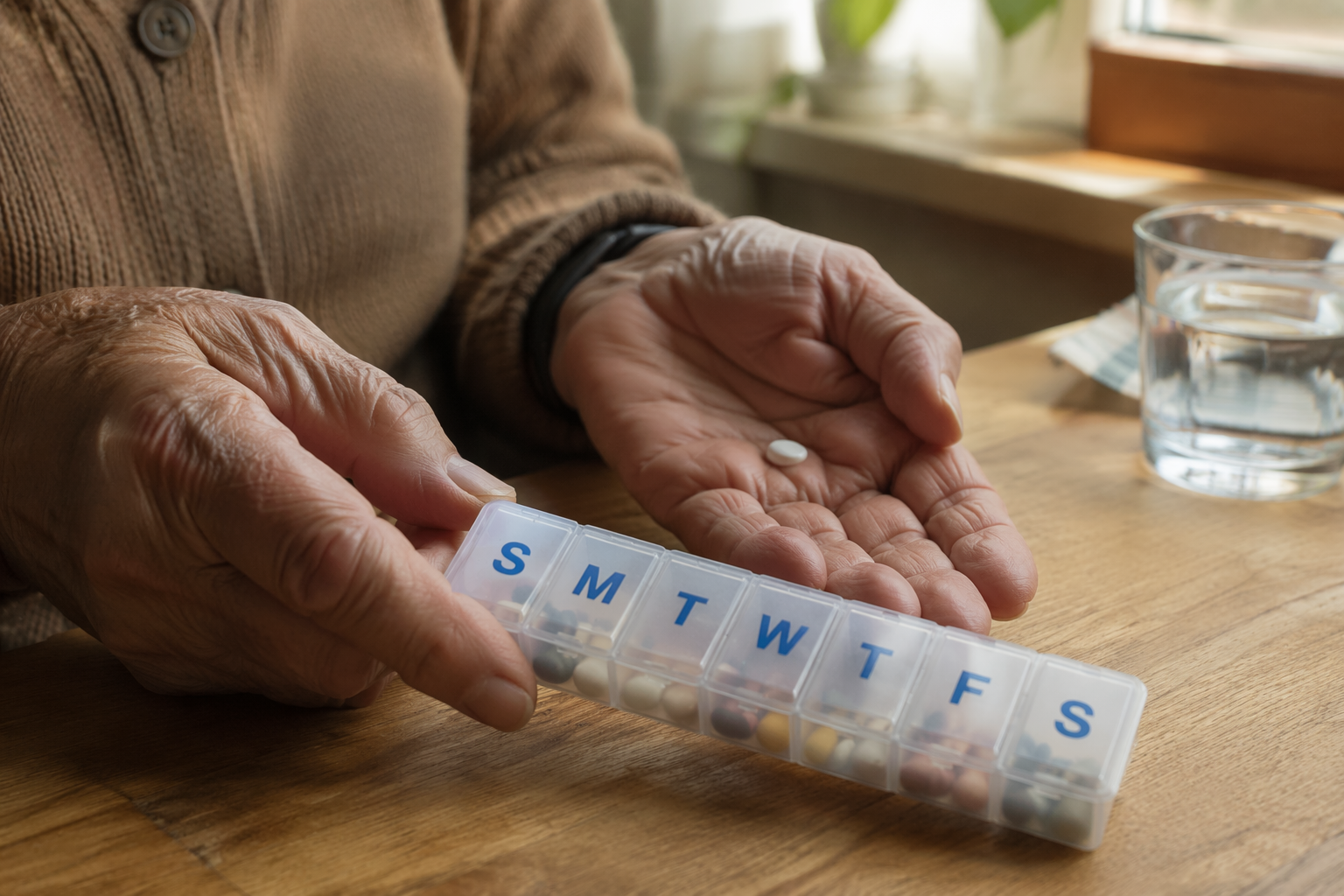
This is a common problem, not a niche medication-safety puzzle. In 2024 National Health Interview Survey data, 15.8% of adults 65 and older reported using some type of sleep aid most days or every day, and 8.8% reported using prescription sleep medication specifically.[2] That means the Beers Criteria is not only for hospitals and nursing homes. It belongs at the kitchen table, next to the weekly pill organizer and the half-remembered question of whether the “PM” pill was really just acetaminophen, ibuprofen, or something else.
Why Age Changes the Risk Calculation
A sleep aid can look familiar for years before it becomes a poor fit. Aging changes drug handling, brain sensitivity, balance, and the ability to recover from a bad night or a bad morning. A younger adult may describe next-day grogginess as annoying. An older adult may experience the same effect as a missed step, a fall, a new delirium episode during an illness, or a medication cascade that starts with “she seemed more confused this week.”
The Beers Criteria is built for that shift. It identifies medications whose risk-benefit balance is often unfavorable in adults 65 and older, especially when safer choices exist.[1] It is not a list of “bad patients” or “bad doctors.” It is a warning label for situations where habit, marketing, and short-term relief can outrun what the older body can safely tolerate.
The OTC Sleep Aids People Underestimate
The easiest drugs to underestimate are often the ones that do not require a prescription. Diphenhydramine and doxylamine are first-generation antihistamines. They can make people sleepy, which is why they appear in many nighttime products, but their sleepiness comes with anticholinergic effects that matter more after 65.
- Diphenhydramine is the sedating antihistamine in Benadryl and in many “PM” pain relievers, including products such as Tylenol PM and Advil PM.
- Doxylamine is the sedating antihistamine in Unisom SleepTabs and is also a first-generation antihistamine of concern.
- Both can contribute to confusion, constipation, urinary retention, dry mouth, blurred vision, and falls in older adults.
- The label may emphasize “nighttime” or “non-habit-forming,” but that does not mean the drug is low-risk for an older brain or body.
This is where the phrase “just a sleep aid” does real damage. A person may think they are choosing a gentle over-the-counter option when they are actually adding anticholinergic burden to a medication list that may already include bladder drugs, antidepressants, nausea medicines, or other sedating agents. For a deeper ingredient-level look at doxylamine, see Doxylamine as a Sleep Aid.
Prescription Sedatives on the Beers List
Benzodiazepines are the classic Beers Criteria sleep-aid warning. Lorazepam, temazepam, clonazepam, alprazolam, and diazepam can reduce anxiety, and their sedating effect can feel like relief, but older adults are more sensitive to these drugs and have elevated risks of cognitive impairment, delirium, falls, fractures, and motor vehicle crashes.[1]
Z-drugs were once marketed and perceived as cleaner sleep medicines than benzodiazepines. The Beers Criteria does not give them that pass. Zolpidem, eszopiclone, and zaleplon are recommended to avoid in older adults because they can cause benzodiazepine-like adverse events, including delirium, falls, fractures, emergency department visits, hospitalizations, and motor vehicle crashes, while offering limited improvement in sleep outcomes.[1]
Barbiturates sit in a different risk category: physical dependence, tolerance, and overdose danger make them poor sleep choices for older adults. If one appears on a medication list, it deserves careful clinical attention rather than casual renewal or abrupt discontinuation.[1]
The Doxepin Distinction: Above 6 mg Is Not the Same as 3-6 mg
Tricyclic antidepressants can be confusing because one name may appear in both the avoid column and the safer-alternative conversation. Amitriptyline and doxepin at doses above 6 mg/day are considered strongly anticholinergic and are listed as potentially inappropriate for older adults.[1] That warning should not be blurred into “all doxepin is the same.”
The 2025 AGS Alternatives Panel identifies low-dose doxepin, specifically 3-6 mg, as a pharmacologic option with a better safety profile for insomnia in older adults.[3] At these very low insomnia doses, doxepin is used differently from higher-dose tricyclic antidepressant treatment. For readers comparing the low-dose formulation with the higher-dose tricyclic concern, Can Silenor for Sleep Help 3 AM Wake-Ups? goes deeper into that narrower use case.
What the AGS Alternatives Panel Points Toward Instead
When a medication is on the Beers list, the next question cannot simply be “so what do I buy instead?” The better question is what problem is being treated: trouble falling asleep, waking at 3 a.m., anxiety, pain, restless legs, untreated sleep apnea, nocturia, grief, caregiving stress, or a hospital habit that accidentally became permanent.
For insomnia itself, the 2025 AGS Alternatives Panel lists several pharmacologic options with more favorable older-adult safety profiles: low-dose doxepin 3-6 mg, dual orexin receptor antagonists, and ramelteon.[3] Dual orexin receptor antagonists include suvorexant, lemborexant, and daridorexant. They work through the orexin wakefulness system rather than through broad sedation, which is part of why they are discussed differently from benzodiazepines and first-generation antihistamines.
| Option to discuss | Where it may fit | Important caution |
|---|---|---|
| Low-dose doxepin 3-6 mg | Sleep maintenance insomnia, especially waking during the night | This is not the same risk category as higher-dose doxepin or amitriptyline |
| Dual orexin receptor antagonists | Insomnia when a prescription option is still needed after evaluation | Can still cause next-day effects and should be reviewed against the full medication list |
| Ramelteon | Sleep-onset insomnia, especially when circadian timing is part of the issue | Usually modest rather than dramatic; expectations matter |
| CBT-I | First-line treatment for chronic insomnia | Requires access, time, and participation, but benefits are more durable than a nightly sedative strategy |
None of these options should be treated as risk-free. The point is comparative safety and fit. An older adult taking four sedating medicines, drinking alcohol at night, or falling twice in the past year needs a different conversation from someone with isolated sleep-maintenance insomnia and a clean medication list.
Melatonin Is Not a Simple Replacement
Melatonin deserves a careful middle position. The AGS Alternatives Panel found insufficient evidence to recommend melatonin as an insomnia alternative for older adults.[3] A 2025 clinical review, however, describes a meta-analysis in older adults showing modest benefits: sleep onset about 14 minutes faster and total sleep time about 21 minutes longer.[4] That is not nothing, but it is also not the same as a proven substitute for a discontinued sedative.
The practical reading is simple: melatonin may help some older adults, especially when timing is part of the sleep problem, but it should not be sold as the universal safe answer to every Beers-listed sleep aid. Dose, timing, product quality, interactions, and the actual sleep complaint still matter. For broader context on options often marketed as gentle or non-habit-forming, see Non-habit-forming sleep aids.
CBT-I Is the First-Line Treatment, Not a Consolation Prize
Cognitive behavioral therapy for insomnia, or CBT-I, is easy to understate because it does not look like the thing people are searching for at 3 a.m. It is not a sedative. It is a structured treatment that changes the learned patterns, timing, behaviors, and anxious conditioning that keep insomnia going.
The evidence base is why guidelines keep returning to it. A meta-analysis comparing behavioral and pharmacologic treatments for insomnia reported a mean effect size of 0.96 for behavioral treatment and 0.87 for pharmacotherapy.[5] Another review found CBT-I benefits to be more durable than medication effects after treatment ends.[6] That durability matters for older adults because the goal is not merely one better night; it is fewer years spent balancing sleep against falls, confusion, and medication dependence.
CBT-I can include sleep restriction, stimulus control, cognitive work, and rhythm stabilization. It is more involved than a sleep hygiene handout. If the main question is whether insomnia can actually improve without nightly sedatives, Is There a Cure for Insomnia? explains the CBT-I path in more detail.
If You Are Already Taking One, Do Not Turn This Into a Sudden Stop
Finding a medication on the Beers list can feel like finding a warning sign after years of use. The next move is not to panic and stop overnight, especially with benzodiazepines, Z-drugs, or barbiturates. Abrupt stopping can cause rebound insomnia, anxiety, withdrawal symptoms, and in some cases serious medical risk. The safer response is a medication review.
Deprescribing.org’s benzodiazepine receptor agonist guidance uses gradual tapering rather than sudden discontinuation. Its algorithm describes dose reductions in the range of 20-25%, with holding periods at each dose, and reports deprescribing success rates of 25-85% in older patients depending on the intervention and setting.[7] Those numbers are encouraging, but they are not a personal taper schedule. The right pace depends on the drug, dose, duration of use, medical conditions, fall history, cognition, and what support is available when sleep worsens temporarily.
- Bring the actual bottles or photos of the labels, not just memory of the brand name.
- Identify the ingredient: diphenhydramine, doxylamine, zolpidem, lorazepam, amitriptyline, doxepin dose, or another sedative.
- Ask whether the medication is still treating the original problem or only preventing withdrawal or rebound insomnia.
- Review other fall-risk and cognition-risk medications at the same visit.
- Ask what safer sleep plan will replace the pill before the taper starts.
This is also where adult children and caregivers can help without taking over. A discharge list, a pharmacy printout, and a short description of morning fogginess or falls can give a clinician information that the medication name alone does not carry.
The Scale of the Harm Is Larger Than One Bad Night
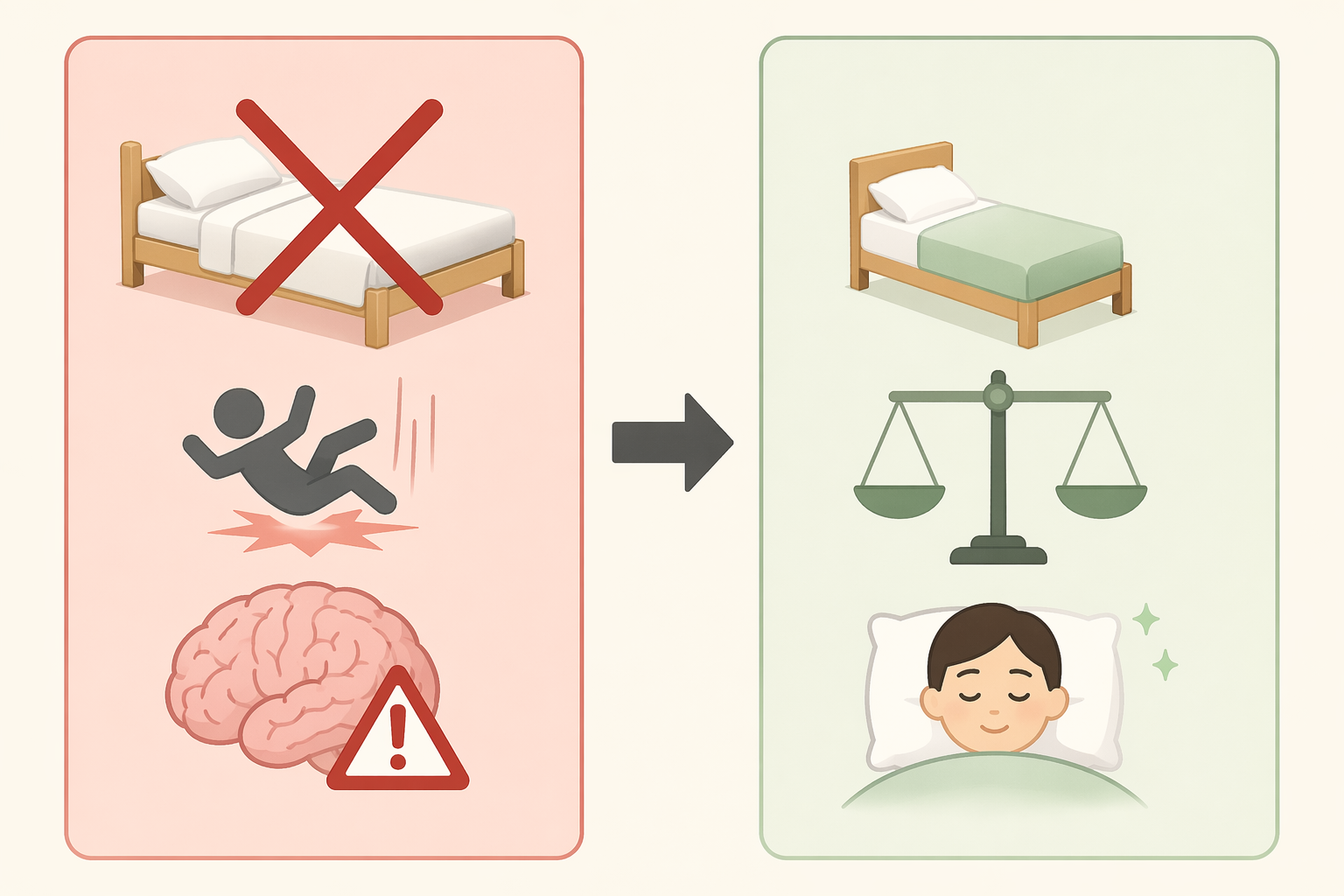
A 2025 microsimulation study in The Lancet Regional Health - Americas estimated that eliminating future sleep medication use in adults 50 and older could reduce lifetime fall incidence by 8.5% and cognitive impairment by 2.1%.[8] That is modeled evidence, not a randomized trial proving that every individual will avoid a fall or cognitive decline by stopping a specific drug. Still, it helps put the Beers Criteria concern in proportion: small nightly medication decisions can accumulate into population-level harm when exposure is common.
The individual version is more concrete. A sedative does not have to cause disaster every night to be the wrong choice. It only has to add enough fog, imbalance, slowed reaction time, or confusion at the wrong moment: the bathroom trip at 4 a.m., the icy front step, the new infection, the hospital bed alarm, the first morning after surgery.
A Practical Way to Read the Label Tonight
If you are holding a bottle and trying to decide whether it belongs in the Beers Criteria sleep-aid conversation, start with the active ingredient rather than the front label. “PM,” “nighttime,” “allergy,” “non-habit-forming,” and “extra strength” are marketing or product-positioning words. The active ingredient tells you the risk class.
- If it says diphenhydramine or doxylamine, treat it as a first-generation antihistamine concern for adults 65+.
- If it says zolpidem, eszopiclone, or zaleplon, treat it as a Z-drug concern.
- If it says lorazepam, temazepam, alprazolam, clonazepam, or diazepam, treat it as a benzodiazepine concern.
- If it says amitriptyline or doxepin above 6 mg, treat it as an anticholinergic tricyclic concern.
- If it is long-term or nightly, do not stop abruptly without a clinician-guided plan.
For a shorter, product-oriented overview of safer choices, see What is the best sleep aid for older adults?. If trazodone is the medication in question, it sits in a different, off-label discussion; Trazodone for insomnia covers that separately.
After 65, the question changes. It is no longer only whether a pill causes sleep. It is whether the next-day and longer-term risks are worth the sleep it provides, and many familiar sleep aids fail that test. Identify the ingredient, avoid sudden stops after long-term use, ask a clinician or pharmacist about tapering and safer alternatives, and put CBT-I on the table as the durable first-line treatment rather than the thing to try only after every bottle has disappointed you.
References
- American Geriatrics Society 2023 updated AGS Beers Criteria® for potentially inappropriate medication use in older adults, Journal of the American Geriatrics Society, 2023.
- Sleep Medication Use in Adults Age 18 and Older: United States, 2024, CDC National Center for Health Statistics, 2024.
- Alternatives to medications listed in the American Geriatrics Society Beers Criteria® for potentially inappropriate medication use in older adults, Journal of the American Geriatrics Society, 2025.
- Insomnia in older adults: A review of treatment options, Cleveland Clinic Journal of Medicine, January 2025.
- Comparative meta-analysis of pharmacotherapy and behavior therapy for persistent insomnia, American Journal of Psychiatry, 2002.
- Comparative effectiveness of cognitive behavioral therapy for insomnia: a systematic review, BMC Family Practice, 2012.
- Deprescribing benzodiazepine receptor agonists algorithm, Deprescribing.org, 2019.
- The potential impact of sleep medications on falls and cognition in older adults: a microsimulation study, The Lancet Regional Health - Americas, 2025.



Comments
Join the discussion with an anonymous comment.