
Watching something before bed is not a fringe habit, and it is not automatically a confession of poor discipline. In a Sleep Foundation survey, 52.7% of U.S. adults said watching TV was their bedtime ritual, and 73.1% of those TV-watchers said they did it purely out of habit.[1] That sounds about right: many people are not building a polished relaxation protocol. They are tired, overstimulated, sharing space, avoiding one more scroll through work messages, or letting an old movie soften the edge of the day.
So the useful question is not whether free movies to stream for sleep are “good” or “bad.” The better question is whether you can change the conditions enough that the movie helps you downshift without stealing the first hour of sleep. Usually, that means using a real timer, warming and dimming the screen, choosing familiar low-arousal content, keeping a small warm light on instead of watching in a pitch-dark room, and getting strong light early the next day.
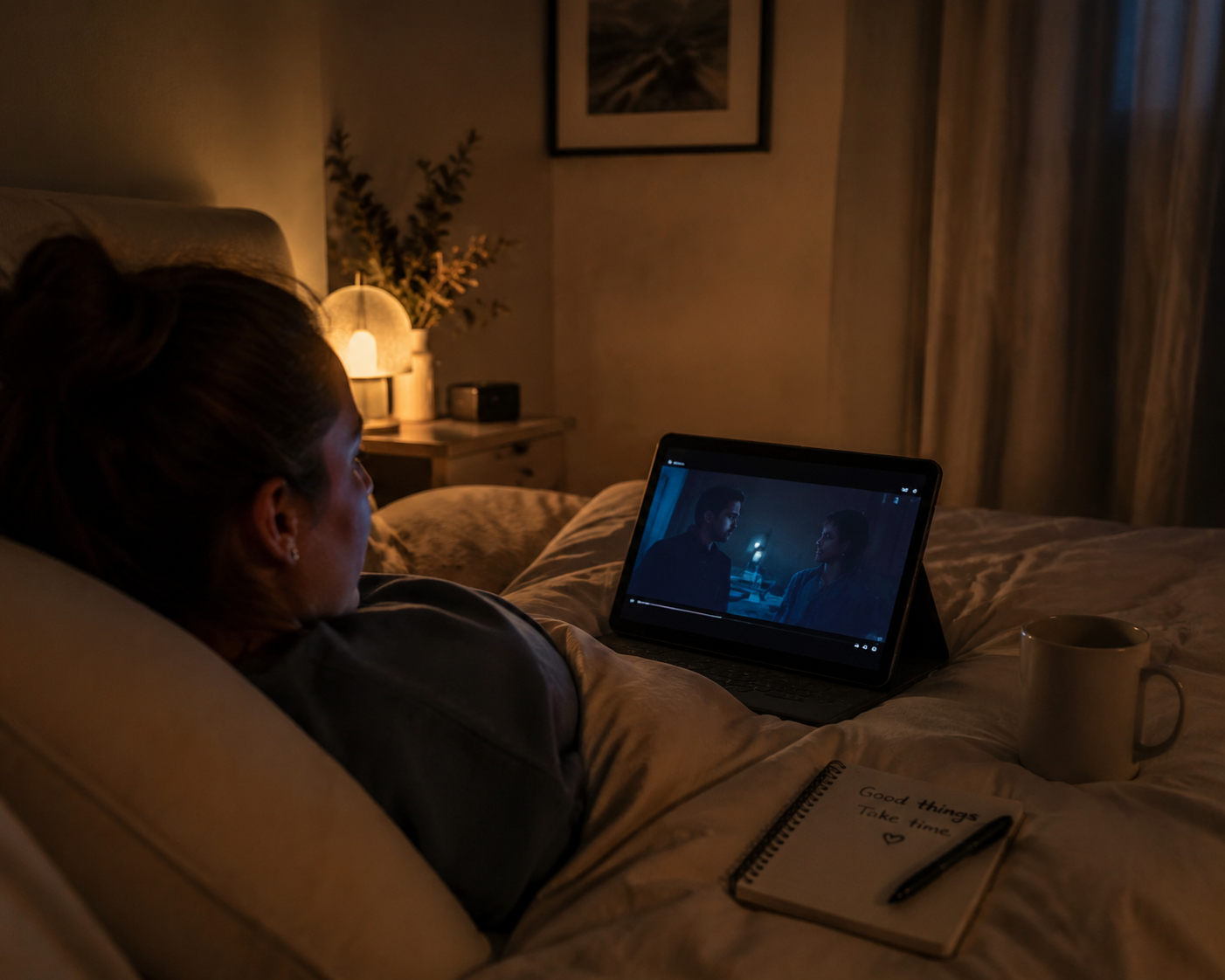
Make the Habit Smaller Before You Try to Make It Perfect
The most reliable bedtime-streaming setup is boring on purpose. It removes decisions, reduces stimulation, and ends without asking for willpower at midnight. If you are going to watch, make these choices before you are sleepy:
- Set a device-level sleep timer before pressing play, not after the movie starts.
- Turn on Night Shift, Night Light, blue-light filter, or the warmest display mode your device allows.
- Pick something familiar enough that you do not need to know what happens next.
- Keep the room dim, not blacked out around a bright screen.
- Put the remote or phone out of easy reach once the movie is running.
- Get outside or near bright morning light the next day, especially if your evening was screen-heavy.
None of that makes bedtime streaming biologically neutral. It makes the routine less likely to turn into bright-light exposure, a suspense loop, and a delayed bedtime all at once. That distinction matters, because people often quit the whole plan after one imperfect night. A lower-risk routine you can actually repeat is more useful than a strict rule you abandon by Thursday.
The Three Ways a Bedtime Movie Can Keep You Up
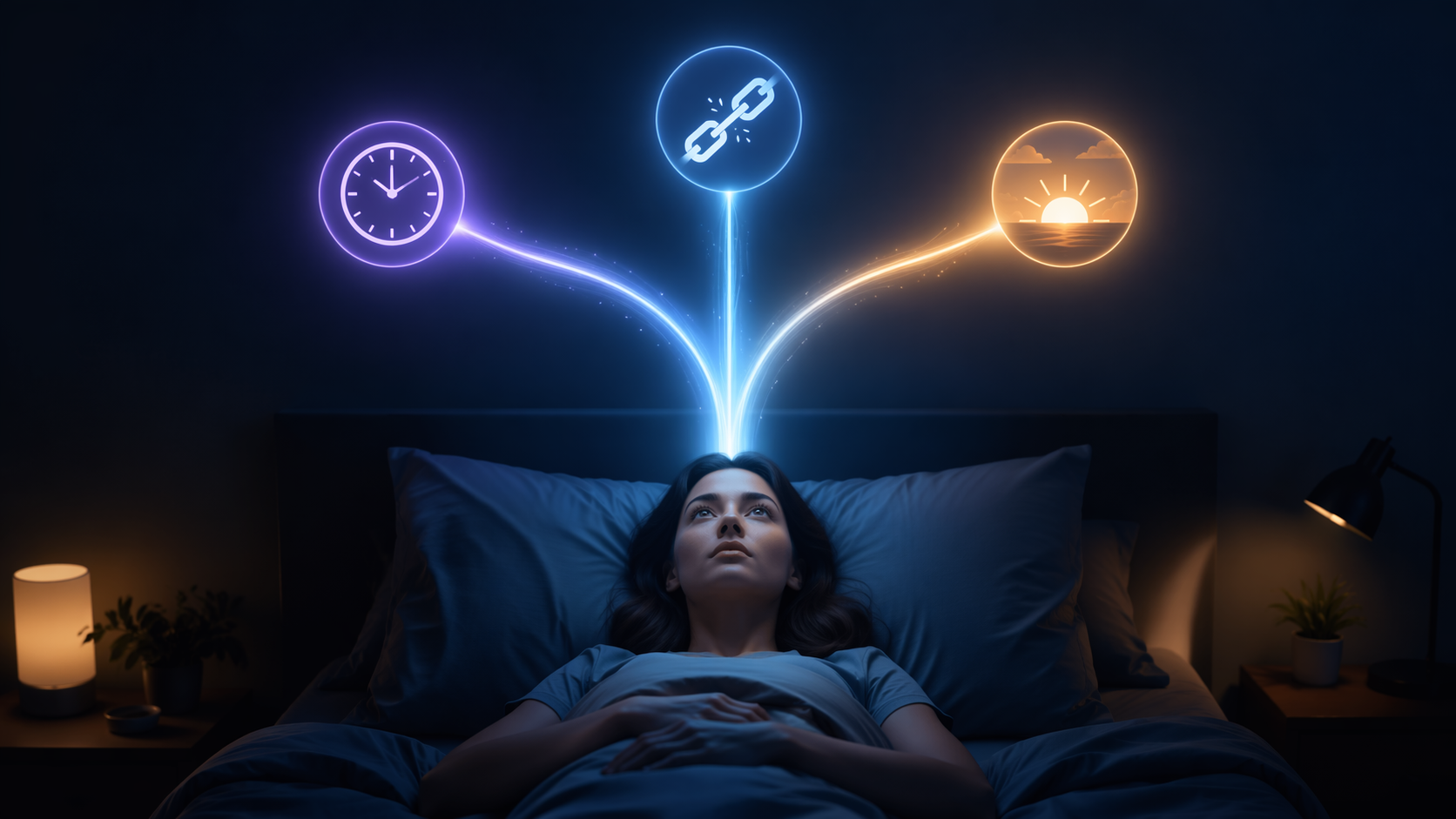
Screens get blamed mostly for light, but light is only one part of the problem. A movie can also keep the brain narratively engaged, and a streaming app can quietly push bedtime later. Those three mechanisms need different countermeasures.
Light: warm it, dim it, and stop making the room a cave
Evening light can tell the body that night has not fully arrived. Harvard Health summarizes lab evidence showing that blue light suppressed melatonin for about twice as long as green light in one comparison, which is why warm display settings are not just cosmetic.[2] They are not magic shields, either. A bright tablet six inches from your face is still a bright object at the wrong time of day.
Use every boring light control available: lower brightness manually, use the warmest screen setting, avoid high-contrast white subtitles when you can, and keep a small warm lamp on nearby. The lamp advice surprises people because “dark room” sounds more sleep-friendly. But watching a glowing rectangle in total darkness increases the contrast your eyes are dealing with. A low bedside lamp can make the whole scene gentler without turning the bedroom into daytime.
Distance helps a little, mainly because a TV across the room is less intense than a phone held close. But distance is not a permission slip for three more episodes. Treat it as one layer, not the whole plan.
Narrative arousal: the plot matters more than people admit
The sleeper’s enemy is not always the screen. Sometimes it is the cliffhanger. In a 2017 Journal of Clinical Sleep Medicine study of 423 young adults, Exelmans and Van den Bulck found that the relationship between binge-viewing and poorer sleep quality, fatigue, and insomnia was fully mediated by cognitive pre-sleep arousal.[3] In plain terms: the mental activation around the viewing mattered, not just the fact that a screen had been on.
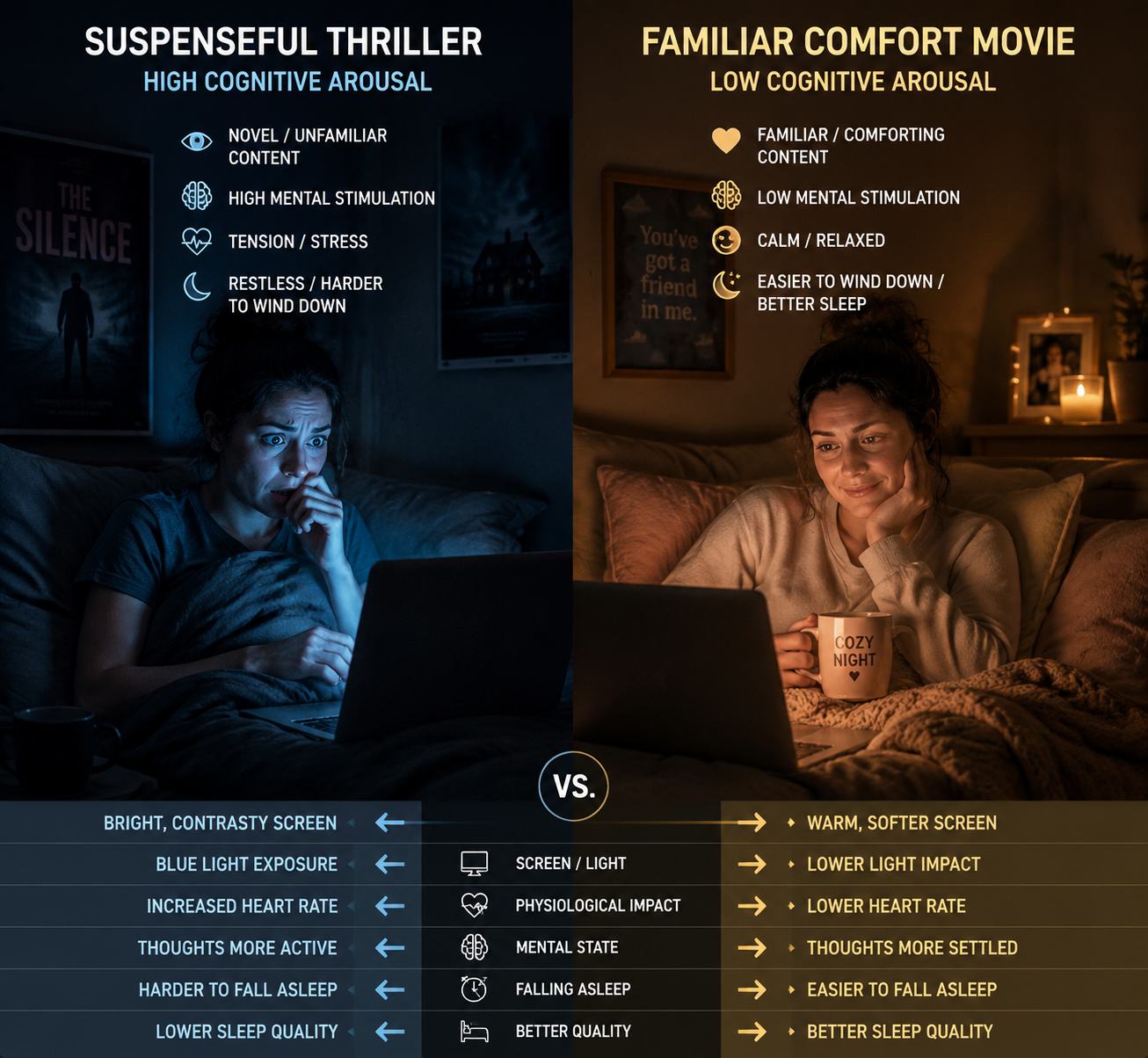
That finding changes the practical advice. A familiar movie you have seen a dozen times is different from a new thriller, a true-crime documentary, a finale, or anything that makes you negotiate with yourself for “just ten more minutes.” Familiar fictional worlds can be comforting precisely because they ask less of you. You know the emotional weather. You know which scene is coming. You are not trying to solve the plot while brushing your teeth.
For bedtime, “low-arousal” does not have to mean dull. It means low stakes for you at that hour. Rewatchable comedies, gentle dramas, nature-heavy films, old musicals, and slow-paced classics often work better than novelty. The key test is simple: if the movie makes you sit up, search the cast, argue with the plot, or promise yourself one more scene, it is doing too much.
This is also why sports, late breaking news, and suspense can be rough bedtime companions. If you want a deeper look at that kind of mental revving, Restful Ground’s guide to falling asleep after a late soccer match covers the same pre-sleep arousal problem from a different angle.
Time displacement: the app wins when the timer is only in your head
The most ordinary way streaming damages sleep is not dramatic. You start at a reasonable hour, let autoplay handle the next decision, then discover that bedtime moved. The American Academy of Sleep Medicine reports that 91% of people have stayed up later than intended to binge-watch.[4] That number is less about weakness than design. Streaming platforms reduce stopping points.
A sleep timer is the least glamorous and most important countermeasure. Use the TV’s built-in sleep timer, a streaming stick timer if available, or the iOS Clock app’s “Stop Playing” option. On a tablet or phone, set the timer before opening the app. On a television, set it before choosing the movie. The order matters because tired people are poor negotiators.
If your bedtime has been sliding later for weeks, the screen may be part of a broader timing problem rather than the only cause. The connection between late sleep timing and mood is worth taking seriously, and this guide to sleep timing and mental health is a better next read than another list of platforms.
A Bedtime Streaming Setup That Does Not Depend on Willpower
| Control point | Lower-risk choice | What it prevents |
|---|---|---|
| End time | Device or TV sleep timer | Autoplay and bedtime drift |
| Light | Warm display, low brightness, dim lamp | Bright evening light exposure and harsh screen contrast |
| Content | Familiar, low-stakes movie | Cognitive pre-sleep arousal |
| Interaction | Choose before bed; avoid searching in bed | Recommendation rabbit holes |
| Next morning | Bright outdoor or window light early | A weaker day-night signal after a screen-heavy evening |
The morning-light piece is easy to skip because it does not feel connected to last night’s movie. It is connected. A strong daytime light signal helps anchor the body clock, and that can make the evening routine less fragile. If you are trying to manage both light and anxiety at night, Restful Ground’s article on sleeping with storm noise, light, and anxiety is useful even if there is no storm outside.
One caution about newer screen-sleep findings: recent studies continue to point toward worse sleep when screens follow people into bed, including research summarized by the AASM, but the most recent papers should be checked for corrections before being treated as settled guidance.[4] The practical advice does not need to wait for a perfect verdict. If the screen makes the night later, brighter, or more mentally active, reduce those three things.
How the Free Platforms Behave at Bedtime
For sleep, the best free streaming service is not the one with the most exciting catalog. It is the one that makes it easiest to stop, easiest to avoid ads, and easiest to choose something familiar without searching for twenty minutes. Movie availability changes often, so treat specific titles as temporary. Search by mood and pacing more than by a permanent recommendation list.
Tubi
Tubi is useful when you want a large free library and do not mind ads. The sleep problem is that abundance creates choice overload, and ad breaks can be louder, brighter, or simply more alerting than the movie you chose. Tubi also should not be treated as your timer. Set the TV or device timer outside the app.
Best use: search earlier in the evening, add a few familiar low-stakes options to your watchlist, then choose from that short list at bedtime. Do not browse the full catalog from bed unless you enjoy discovering it is suddenly tomorrow.
Kanopy
Kanopy is the most sleep-friendly of the group if your library gives you access and you are willing to live with monthly viewing limits. The main advantage is not prestige; it is the absence of ad breaks. For bedtime, that matters more than a giant catalog. Slow cinema, older films, quiet documentaries, and familiar art-house favorites tend to fit the low-arousal target well.
Best use: save Kanopy for nights when you want fewer interruptions and less algorithmic nudging. The ticket limit can even help if it makes you choose intentionally rather than grazing.
Pluto TV
Pluto TV’s live-channel format can be surprisingly helpful for people who get trapped choosing. You turn on a channel, accept what is already in progress, and stop treating bedtime like a programming meeting. The tradeoff is that live channels and ads still create interruptions, and there is no reason to trust your sleepy self to stop at the next break.
Best use: pick a predictable channel before bed and pair it with a TV sleep timer. Pluto works better as background familiarity than as a place to hunt for the perfect movie.
YouTube
YouTube is accessible and familiar, and its mobile app includes a sleep timer on iOS and Android. That is a real advantage. The problem is everything around the movie: ads, comments, recommendations, shorts, and the small act of searching that turns into twenty minutes of tapping.
Best use: open the movie directly, start the sleep timer, turn the phone face down or place it out of reach if you are casting, and do not read comments in bed. If you use YouTube as a bedtime tool, the movie is the tool. The feed is not.
What to Watch When the Goal Is Sleep
Specific free titles rotate too often to be worth building a sleep routine around. A better approach is to keep a small personal shelf of categories that work for your nervous system. The movie should be familiar, emotionally settled, and easy to leave unfinished.
- Good candidates: rewatchable comedies, gentle romances, old favorites, slow travel films, calm nature documentaries, quiet period pieces.
- Riskier candidates: thrillers, horror, true crime, competitive reality shows, breaking-news specials, finales, anything you have been waiting all week to watch.
- Personal exception rule: if a supposedly calm movie makes you research, react, argue, or keep watching past the timer, it is not calm for you.
There is no prize for choosing the most tasteful bedtime film. The best choice is the one that asks the least from your attention and lets sleep become more interesting than the screen.
When the Movie Is No Longer the Main Issue
A bedtime movie can be a reasonable wind-down cue if it stays timed, familiar, dim, and non-interactive. It is more concerning when streaming repeatedly pushes bedtime later, when you need increasingly stimulating content to avoid your thoughts, or when lying quietly feels intolerable without a screen.
That does not mean you have done something wrong. It may mean the movie has become a patch for insomnia, anxiety, stress, pain, loneliness, or a sleep schedule that no longer fits your life. If the pattern is persistent, broader evidence-based sleep hygiene may help, and so can looking at the physical sleep environment, including temperature. Restful Ground’s guide to cooling the body for sleep without AC is a practical companion if heat is part of the bedtime struggle.
Free movies before bed are not automatic sleep sabotage. The default streaming environment, however, is built to continue. If you redesign the routine so the screen is warmer, the room is softer, the story is familiar, and the ending is handled by a timer instead of willpower, the habit can become less disruptive. If it still keeps taking sleep from you, believe the pattern.
References
- Watching TV Before Sleep Is the Most Popular Bedtime Routine, Sleep Foundation.
- Blue light has a dark side, Harvard Health Publishing.
- Binge Viewing, Sleep, and the Role of Pre-Sleep Arousal, Journal of Clinical Sleep Medicine, 2017.
- Screen Time and Sleep: What New Studies Reveal, American Academy of Sleep Medicine.
Comments
Join the discussion with an anonymous comment.