
If you cannot sleep after an earthquake, start with the least comforting but most useful question: is your sleeping place safe enough for your body to stand down? A regular bedtime, a dark room, and a calming playlist matter later. Tonight, sleep begins with clear exits, fewer hazards, a plan for aftershocks, and permission to rest in pieces instead of trying to perform a normal night.
Post-earthquake sleeplessness is common. Your brain may be replaying the shaking, listening for new sounds, tracking pets or children, checking whether you smelled gas, and rehearsing how to get out. That is not weakness. It is a threat system doing overtime in conditions that are not yet ordinary.
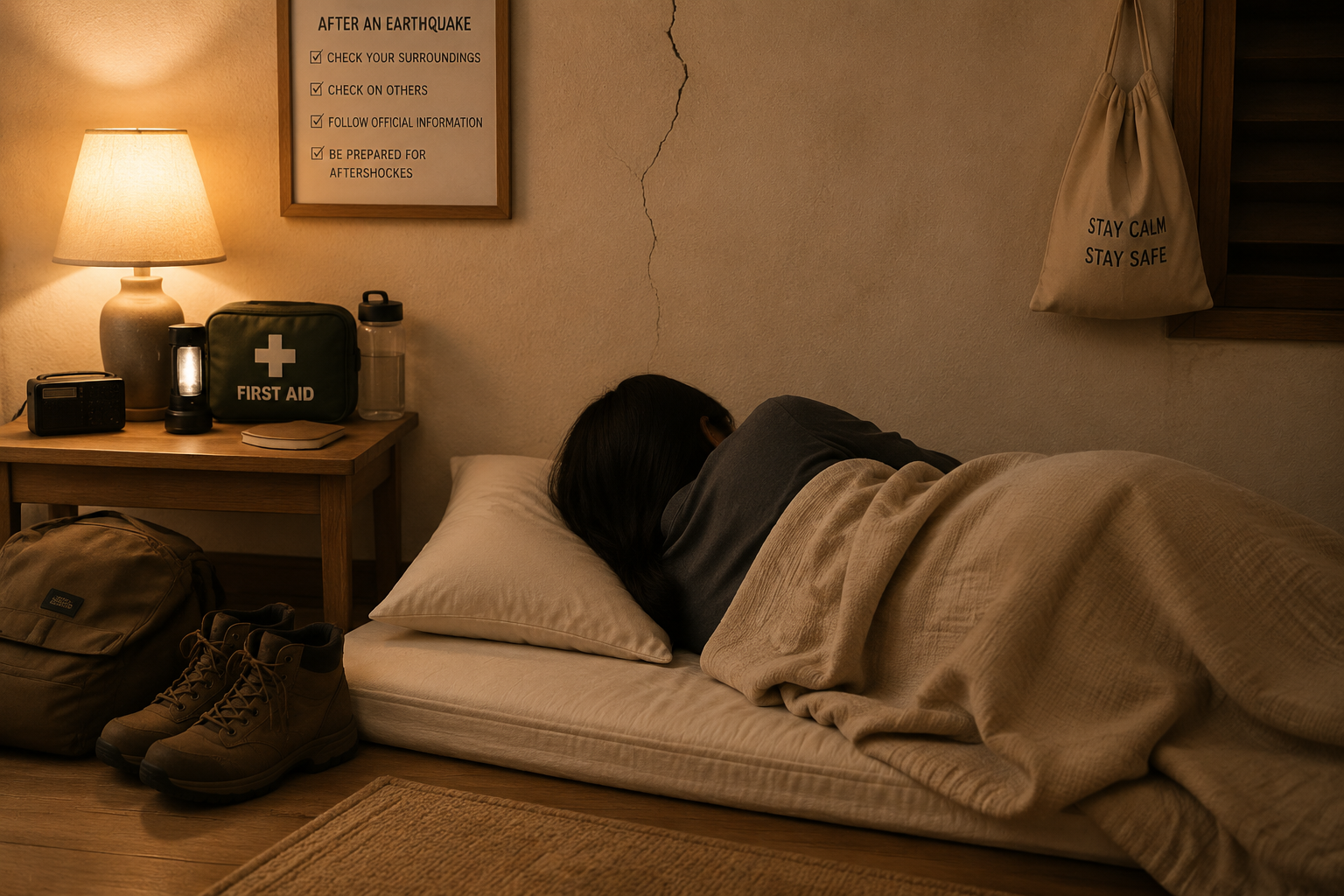
The first night: make the sleep area defensible, then aim for rest
Do not make sleep the first task if the room is still unsafe. Before you lie down, check for obvious hazards: broken glass, fallen objects, blocked doors, unstable furniture, damaged stairs, exposed wiring, spilled chemicals, gas smell, or anything that could fall onto the place where you plan to rest. The CDC advises leaving a damaged building if you hear shifting noises or if the structure seems unsafe, and it warns people to check for injuries and hazards after an earthquake rather than assuming the danger has passed.[1]
If aftershocks are plausible, your sleep setup should assume you may need to move quickly. Keep shoes, a flashlight or headlamp, glasses, phone, charger or power bank, medications, water, keys, and any child or pet essentials within reach. Put them where you can find them in the dark, not where you hope you will remember them. The Earthquake Country Alliance’s basic protective action remains “Drop, Cover, and Hold On” during shaking, so choose a resting spot with that next move in mind rather than one that traps you far from cover or an exit.[2]
- Move glass, heavy frames, lamps, books, and sharp objects away from the sleep surface.
- Clear a path from the bed, couch, cot, or floor mat to the nearest usable exit.
- Sleep in clothes warm enough to leave quickly if the building becomes unsafe.
- Keep shoes on or beside the bed if debris is possible.
- Agree on one short aftershock plan with the people near you, then stop renegotiating it every few minutes.
That last point matters. Hypervigilance gets louder when the plan is vague. It quiets a little when the next action is already decided: “If shaking starts, I cover here; if we evacuate, we meet there; if I smell gas, I leave and call from outside.” The goal is not to convince yourself nothing else will happen. The goal is to reduce the number of decisions your half-asleep brain has to keep rehearsing.
For a more detailed room-by-room setup, use a dedicated bedroom safety guide such as How to Prepare Your Bedroom for Earthquake Safety During Sleep. Tonight, though, do the minimum that changes the risk in front of you: shoes, light, exit, cover, medication, communication.
Use calming techniques as a downshift, not a test
Once the physical setup is reasonable, use a body-calming technique for a few minutes. Deep breathing, progressive muscle relaxation, and mindfulness are recommended for managing post-earthquake anxiety, and they are useful here because anxiety management is sleep care after a quake, not a separate emotional chore.[3]
Try one technique, not all of them. If breathing exercises make you feel trapped or too aware of your body, switch to muscle relaxation. If closing your eyes increases threat scanning, keep your eyes half-open and soften your gaze. If silence makes every creak sound dangerous, use a quiet, steady sound if you can do so without blocking warnings you need to hear.
| If your body is doing this | Try this instead of forcing sleep |
|---|---|
| Scanning every sound | Name the sound if you can, decide whether it requires action, then return attention to one steady cue such as breath, blanket weight, or a low fan. |
| Clenching jaw, shoulders, or hands | Tense and release one muscle group at a time, starting with feet or hands. |
| Replaying the shaking | Orient to the present room: name five visible objects, feel both feet or legs supported, then remind yourself of the aftershock plan. |
| Checking the phone repeatedly | Choose one update interval if conditions allow, then place the phone within reach but out of your hand. |
Rest counts. Lying down safely with your eyes closed for short stretches, sitting against a wall with a blanket, or rotating watch duties with another adult may be the realistic target. Perfect sleep is a poor first-night goal in a building, shelter, car, or relative’s living room that still feels unpredictable.
Why several bad nights do not mean you are broken
Earthquake-related sleep disruption can be widespread and persistent. In one study of earthquake survivors, average Pittsburgh Sleep Quality Index scores were 11.10±3.44, well above the clinical cutoff of 5 for poor sleep quality.[4] Among adolescent survivors studied 9 to 12 months after the 2023 Türkiye earthquakes, high earthquake anxiety was associated with 5.721 times worse sleep quality than mild anxiety.[5]
Other disaster research points in the same direction without making any one number a prediction for you. An AASM report on Haitian earthquake survivors found that 94% reported insomnia symptoms and 42% had clinically significant PTSD two years later in a sample of 165 people.[6] Two years after the L’Aquila earthquake, a large study found higher sleep-quality scores among citizens than before the earthquake, with sleep disturbance observed as far as 70 km from the epicenter.[7]
Those findings do not mean you are destined for months or years of insomnia. They mean the first few nights should be treated as recovery under threat, not as a personal failure to relax. Aftershocks, displacement, damaged rooms, crowding, and uncertainty keep the nervous system on watch. Sleep usually needs both kinds of cues: external cues that the environment is safer, and internal cues that the body can downshift.
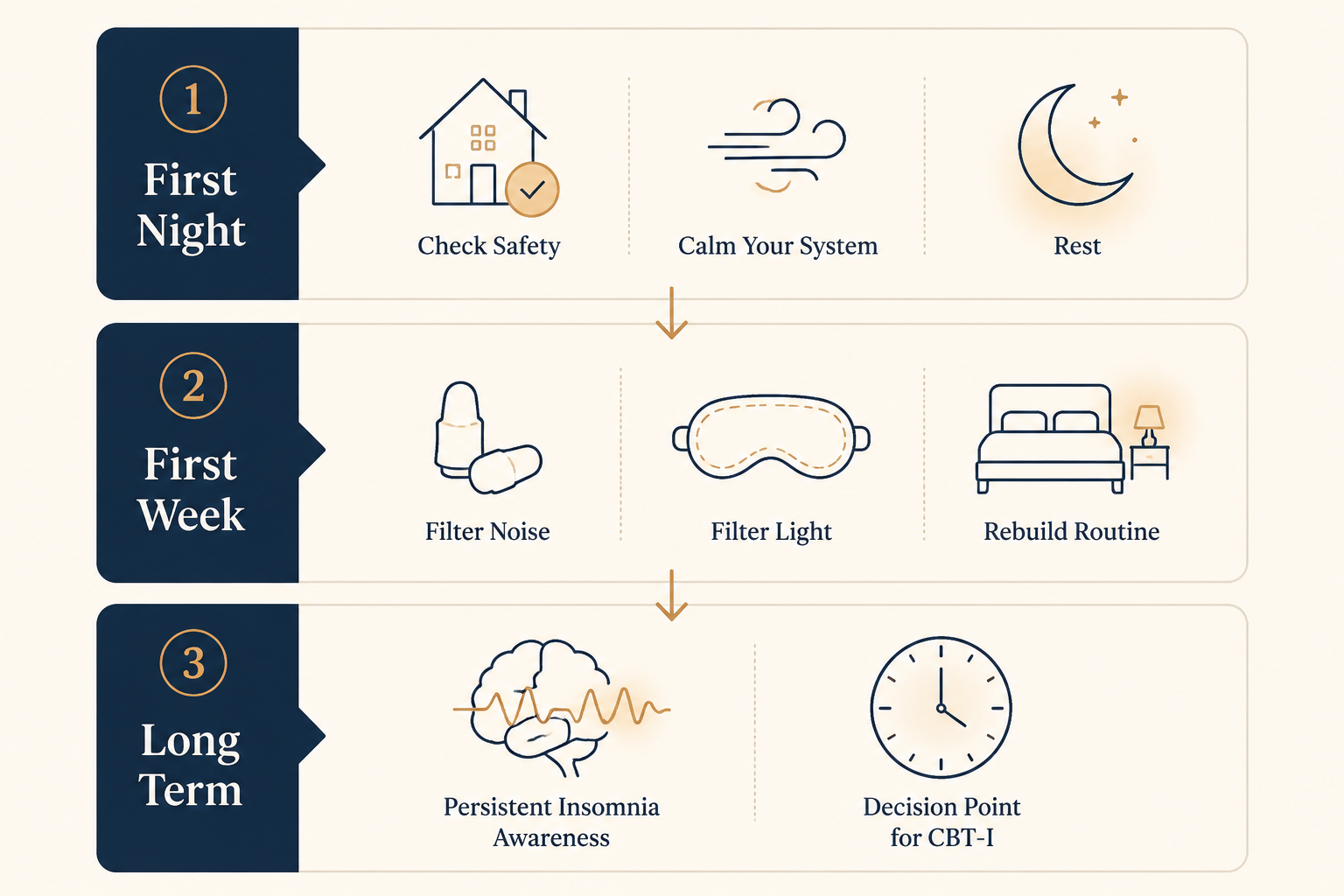
The first week: fix the sleep surface you actually have
By the first week, the problem often changes. The shaking may be over, but the sleep environment may still be loud, bright, cold, crowded, smoky, dusty, or temporary. You may be sleeping in a shelter, a car, a hallway, a friend’s floor, a tent, or a room that technically works but no longer feels trustworthy.
The American Sleep Apnea Association’s disaster sleep guidance places safe sleeping quarters first: dry, comfortable when possible, and protected from environmental disruptions. It also names practical filters for noise, light, and air, including earplugs, white noise, eye masks, and masks or filtration when air quality is poor.[8]
| Problem | Useful first-week adjustment |
|---|---|
| Noise in a shelter or shared home | Use earplugs if safe, place a bag or folded clothing between you and foot traffic, or use low steady sound to reduce sudden-noise spikes. |
| Bright lights or irregular lighting | Use an eye mask, hat, scarf, or hoodie; aim for a repeated dimming cue before rest even if lights cannot fully go off. |
| Cold or damp sleep surface | Layer cardboard, mats, towels, or blankets under the body before adding warmth on top. |
| Dust, smoke, or poor air | Use available masks or filtration, avoid sleeping near visible dust or fumes, and ventilate only when outdoor air is safer than indoor air. |
| Crowding and loss of privacy | Create a small boundary with a bag, blanket edge, or agreed quiet zone; the boundary does not need to be pretty to help. |
These tools are not magic. Earplugs cannot make a shelter private. An eye mask cannot undo fear about aftershocks. But reducing one sensory burden at a time lowers the amount of threat information your brain has to sort through while it is trying to sleep.
Make one small bedtime ritual portable
A full pre-earthquake routine may be impossible. Choose a portable version instead: wash face, take medication, text one check-in, stretch calves and shoulders, read a few pages, say the plan for tomorrow, then lights down or eye mask on. Disaster sleep guidance and crisis-support guidance both point to returning to familiar bedtime rituals, such as reading, stretching, and hygiene, as a way to signal safety and continuity.[3][8]
Keep the ritual short enough that you can do it in bad conditions. If it requires a perfect bathroom, quiet room, clean pajamas, and uninterrupted time, it will collapse on the nights you need it most. A five-minute sequence repeated in the same order is more useful than an ideal routine you cannot access.
If you are rebuilding from scratch, adapt the basics from Sleep Hygiene Fundamentals and an Evidence-Based Bedtime Routine. Treat the advice as materials, not rules. In a disaster week, “consistent” may mean the same wind-down order, not the same bedtime.
Relocation is not a minor inconvenience for sleep
Moving repeatedly can keep sleep from stabilizing. In the Türkiye adolescent survivor study, 74.4% of participants reported that frequent relocations negatively affected their sleep.[5] That finding is especially important for families who feel as if they are “only” moving between relatives, shelters, hotels, or temporary rooms. Each move can reset the brain’s map of exits, noises, people, and risks.
When the address keeps changing, make the sleep kit stable: the same bag, same flashlight pocket, same medication pouch, same comfort item for a child, same earplugs or mask if available. The room changes; the sequence stays recognizable. That is often the most realistic version of routine during displacement.
Use daytime behavior to protect nighttime sleep
During the first week, sleep pressure and fear can get tangled. Long daytime naps may be unavoidable after a sleepless night, especially for children, older adults, shift workers, injured people, and anyone doing cleanup. Still, if you can choose, keep naps brief and earlier in the day so nighttime has a chance to return. Get daylight exposure when it is safe. Eat something predictable before night if food access allows. Reduce late-night disaster scrolling by choosing set update times rather than keeping the nervous system plugged into every rumor and alert.
This is also the week to share the load. One adult staying half-awake all night to monitor every noise is not a sustainable safety plan. If there are multiple capable adults, rotate responsibilities. If you are alone, write the plan down before bed: who you would call, where you would go, what would make you leave. Paper can hold some of the vigilance your brain is trying to hold.
When anxiety is the main thing keeping you awake
Sometimes the room is safe enough and the body still will not release. You may feel a jolt as you drift off, wake at every truck rumble, or avoid the bedroom because it reminds you of the quake. That is a different sleep problem than ordinary bad habits. For more focused help with the fear loop, see How to Sleep When Earthquake Anxiety Keeps You Awake or Earthquake Anxiety Keeping You Awake? How to Finally Sleep.
The practical move is to separate useful checking from fear-driven checking. Useful checking changes an action: you smell gas and leave, you see broken glass and move it, you confirm the child’s medication is packed. Fear-driven checking repeats after nothing has changed. When you notice the second kind, do not scold yourself. Return to the written plan, the cleared exit, and one body cue. The nervous system learns through repetition, not through being argued into calm.
Beyond the first weeks: know when sleep hygiene is no longer enough
As recovery continues, keep adapting the environment and routine to your actual living conditions. That may mean a more stable bed, repaired room, quieter location, more predictable family schedule, or a gradual return to the bedroom you avoided at first. But if insomnia persists, nightmares intensify, or fear-driven avoidance starts organizing your life, the answer is not to keep adding more sleep hygiene rules.
Cognitive behavioral therapy for insomnia, or CBT-I, is the first-line treatment for chronic insomnia. It targets the learned patterns that keep insomnia going: spending too much wakeful time in bed, fearing the night, irregular sleep timing, and trying harder to sleep in ways that backfire. If earthquake-related sleeplessness has become self-sustaining, read What Actually Cures Insomnia? CBT-I Explained or Sleep Anxiety Before Bed? CBT-I Is the Proven Treatment and consider asking a clinician for CBT-I rather than only asking for general sleep tips.
For trauma-related nightmares, treatments need to match the problem. Imagery Rehearsal Therapy is an evidence-based treatment for nightmares, and trauma-focused CBT is used for PTSD-linked sleep disturbance.[9] These approaches do not require pretending the earthquake was not frightening. They work with the way fear, memory, and sleep have become connected.
- Seek clinical help if insomnia continues after the acute disruption has eased and you still cannot sleep on most nights.
- Seek help sooner if nightmares, panic, or avoidance are getting stronger instead of gradually easing.
- Seek urgent support if you feel unable to keep yourself or someone else safe.
- Ask specifically about CBT-I for persistent insomnia and trauma-focused care for PTSD symptoms or recurring nightmares.
After an earthquake, sleep usually returns in stages. First, make the place you are resting safer. Then reduce the sensory load and rebuild a small routine around the sleep surface you actually have. If sleep stays stuck after the danger and displacement begin to settle, treat it as a clinical sleep problem, not a character flaw.
References
- Safety Guidelines: After an Earthquake — CDC
- Step 5: Drop, Cover, and Hold On — Earthquake Country Alliance
- Post-Earthquake Anxiety? It's Normal. And Treatable. — Crisis Text Line
- Sleep and Trauma Effects of the Earthquake: A Cross‐Sectional Study
- Earthquake anxiety and sleep quality among adolescent survivors 9–12 months after the great earthquakes in Türkiye
- Disturbed sleep and mental health problems in disaster survivors — AASM
- Long-Term Impact of Earthquakes on Sleep Quality — PLOS ONE
- How To Manage Your Sleep During And After A Disaster — American Sleep Apnea Association
- Psychiatric comorbidity predicts sleep disturbances among adolescent earthquake survivors: a 10-year cohort study


Comments
Join the discussion with an anonymous comment.