
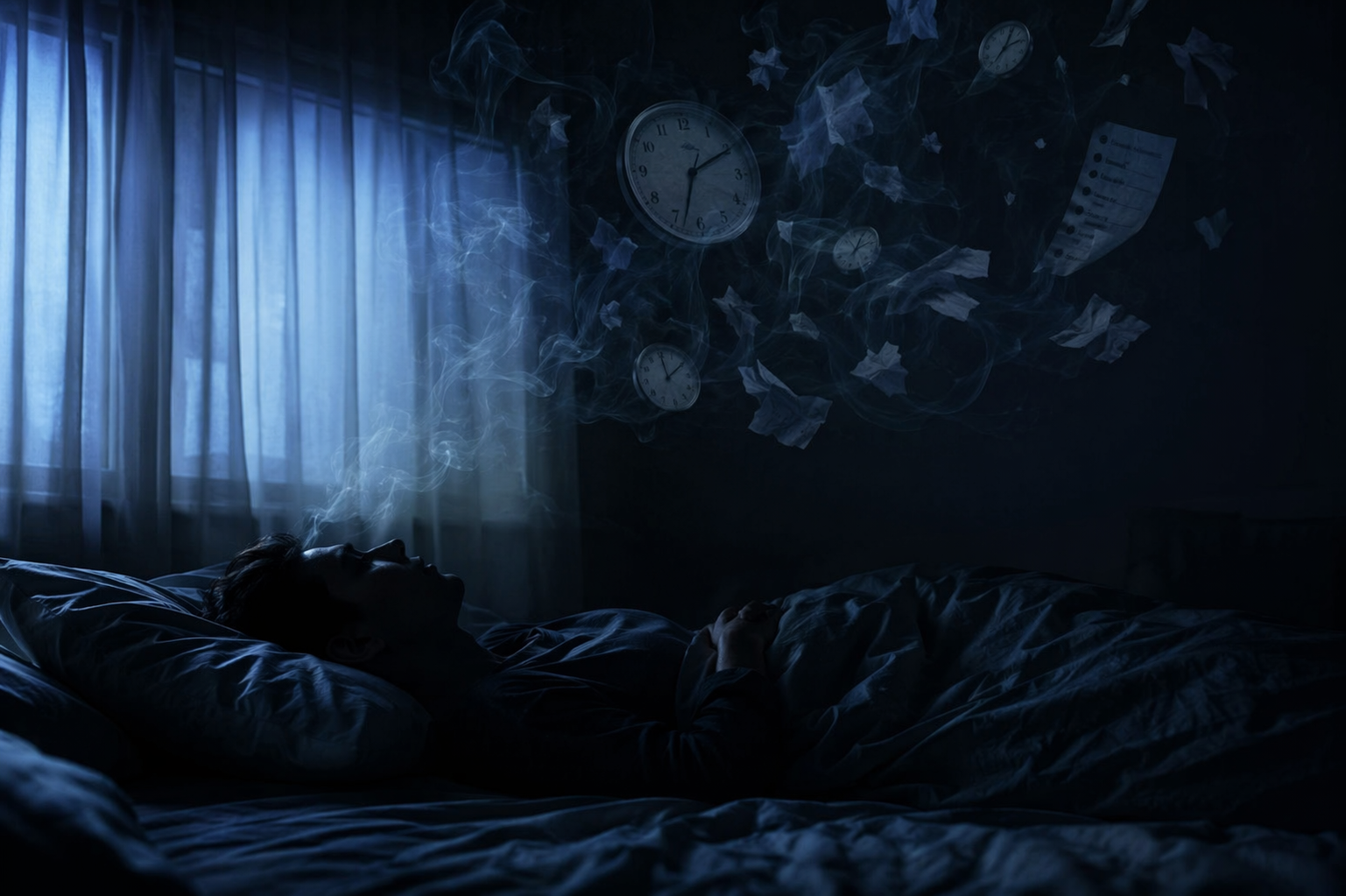
The loud part of a storm is easy to blame. Thunder cracks, lightning flashes, rain hits the windows, and every article seems ready with the same advice: use earplugs, close the curtains, turn on white noise. Those may help after your body has stood down. They rarely work when your heart is already pounding and your mind is treating sleep as a reckless act.
That is the central problem in how to sleep during severe storms: the barrier is often not sound itself, but hyperarousal. Your brain has decided the storm deserves surveillance. Once that happens, the body can stay awake even in a structurally safe home, under blankets, with the forecast already checked twice.
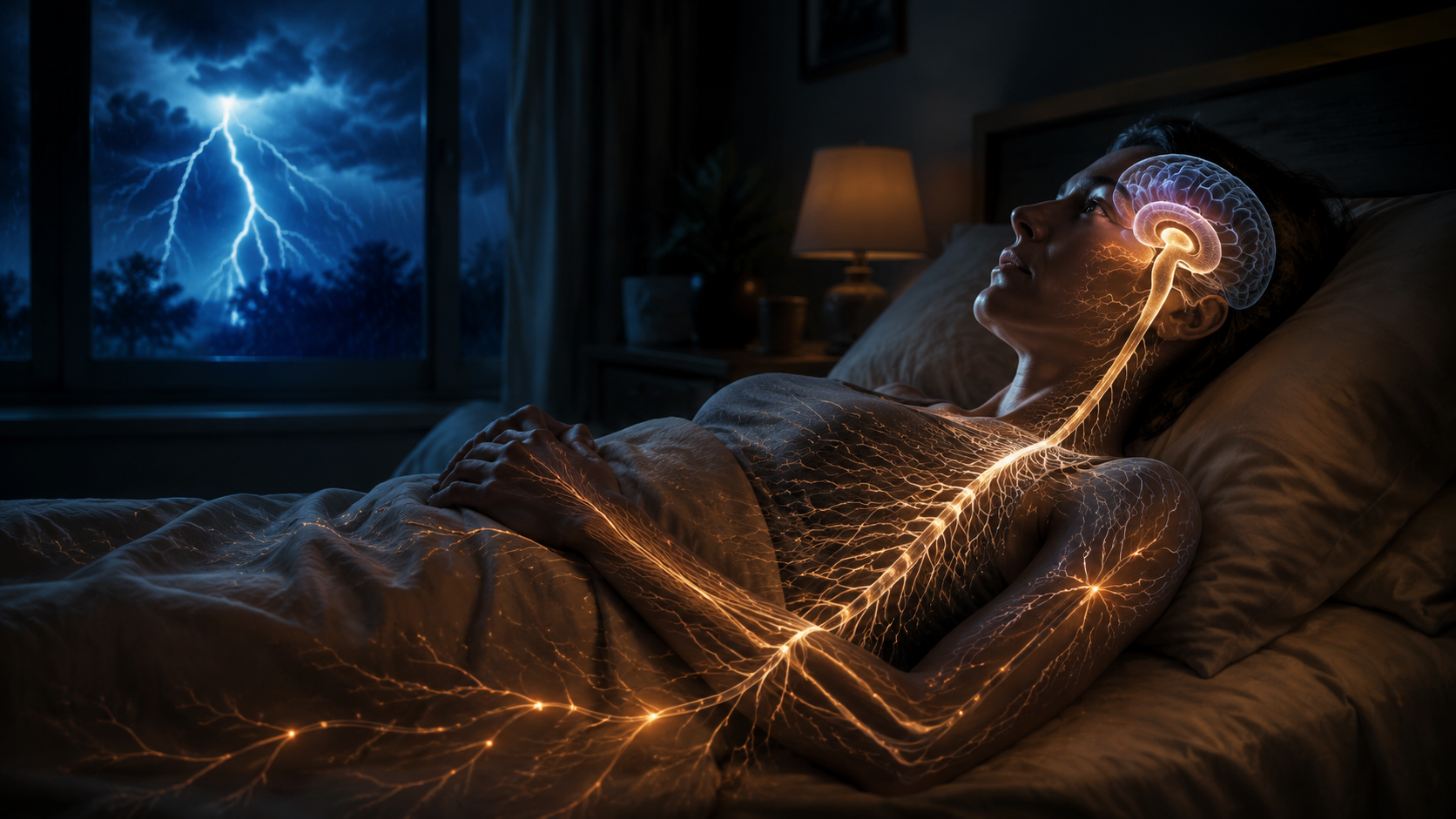
Storm Fear Is Common Enough to Take Seriously
If storms make you feel childish, irrational, or embarrassed, the numbers argue against that shame. A Ball State University study published in 2014, based on about 300 participants across 43 states, found that about 10% of Americans may have severe weather phobia that causes sleep loss. In the same study, 85% reported at least some degree of severe-weather fear, 72% reported anxiety during severe weather, and 62.9% reported increased heart pounding during severe weather events.[1]
The heart-pounding figure matters because it points to the sleep problem. Fear is not only a thought. It is a body state. A person can know, in a reasonable part of the mind, that the storm is outside and the roof is intact, while another system has already raised the alarm.
Cleveland Clinic describes astraphobia, or intense fear of thunder and lightning, as affecting about 8% of adults in a given 12-month period and being roughly twice as common in women.[2] That does not mean every bad storm night is a phobia. It does mean that strong storm fear is a recognized pattern, not a personal failure.
Why Knowing You Are Safe May Not Be Enough
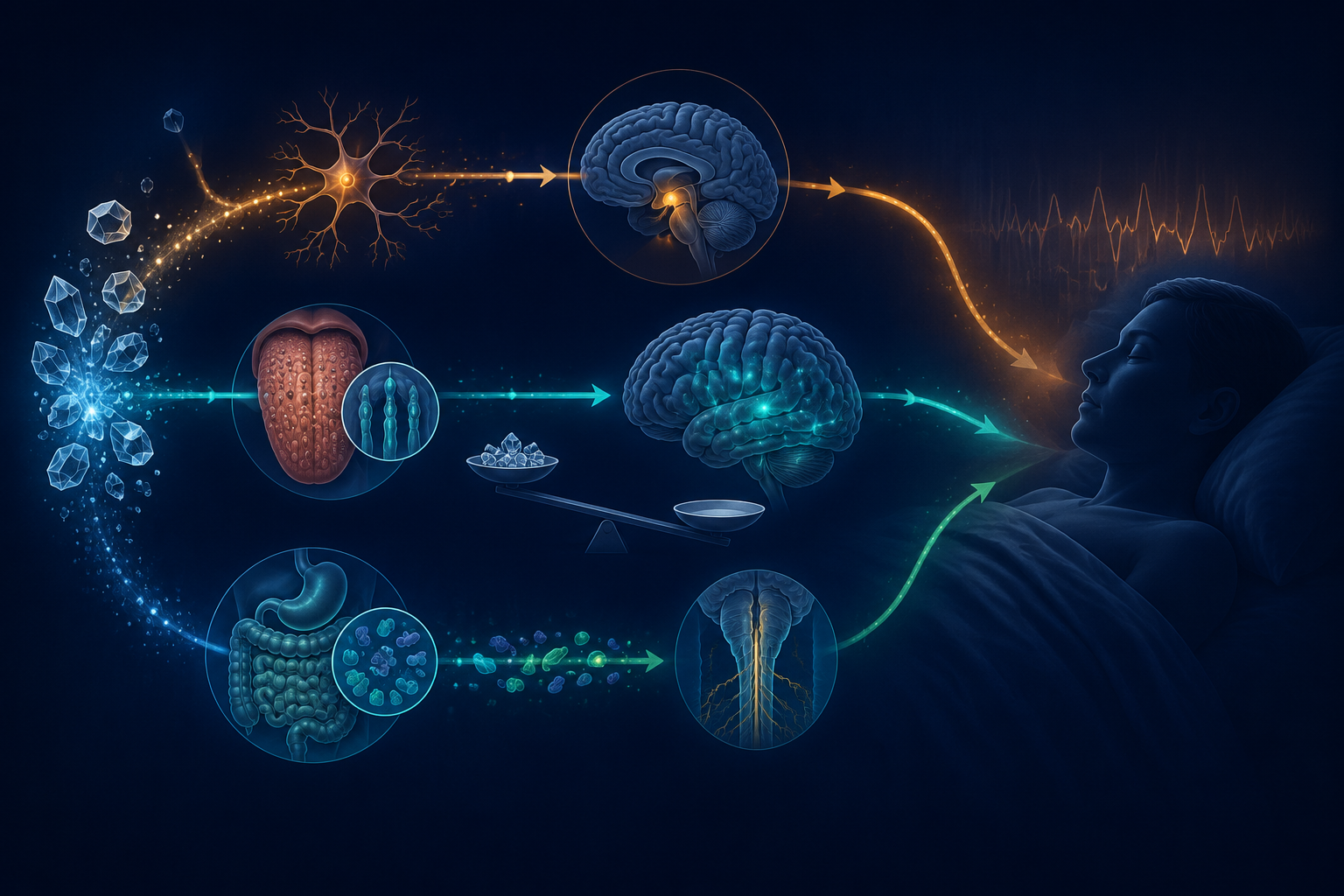
During a storm, the brain is not simply receiving neutral information. A flash, a crack of thunder, the phone alert tone, the sudden shift in wind: these cues can be interpreted as possible threat. The amygdala is heavily involved in detecting threat, and when it treats storm cues as danger, it can signal through the hypothalamus into the sympathetic nervous system. That system prepares the body to act.
The result is familiar: faster heartbeat, shallow breathing, tense muscles, jaw clenching, restless scanning, and the urgent feeling that you should keep checking. Sleep asks for something close to the opposite state. It depends on enough parasympathetic dominance for the body to lower vigilance, loosen control, and stop monitoring the environment.
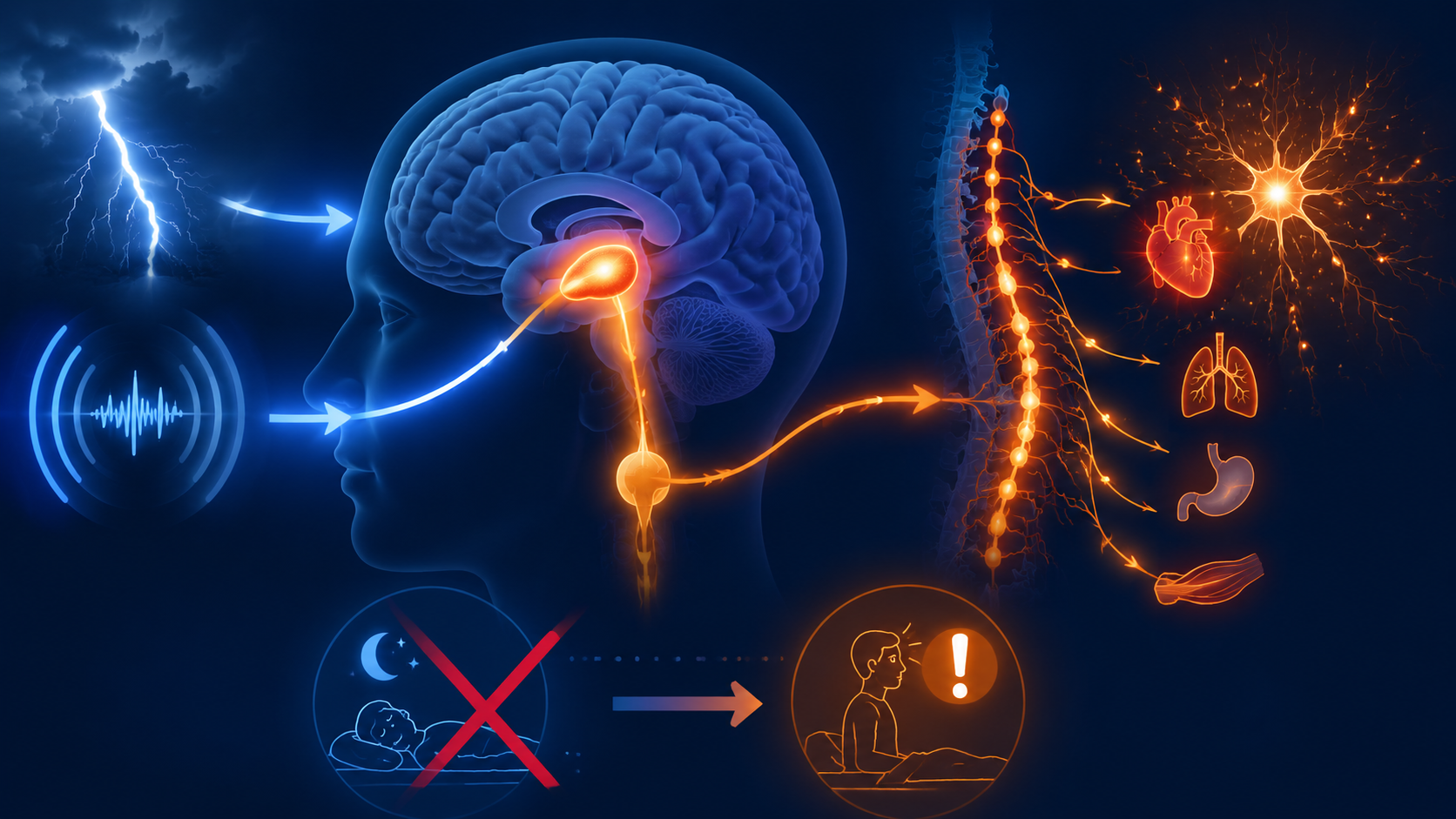
This is why noise-blocking can disappoint. If the brain has already assigned meaning to the storm, reducing decibels may not answer the question the nervous system is asking. It is not asking, "Is the room quiet?" It is asking, "Do I need to stay ready?"
The same mechanism helps explain why trying harder to sleep often makes the night worse. The more urgently you measure whether sleep is happening, the more the body receives wakefulness as a task with consequences. If that pattern feels familiar outside storm nights too, the same anxiety-insomnia loop is covered more directly in What to Do When Anxiety Keeps You Up at Night and Why Trying Harder to Fall Asleep Backfires.
First Decide Whether This Is a Safety Night or an Anxiety Night
Calming down is not the first job if there is an active safety decision to make. Before treating the problem as anxiety, check the practical status of the storm: local alerts, whether there is a warning that requires sheltering, whether your household plan is already in motion, and whether power, flooding, wind, or tornado risk changes where you should be.
Once the safety question is answered, stop re-litigating it minute by minute unless conditions change. This boundary is important. Rechecking can feel responsible, but after a point it becomes the behavior that keeps the threat system active.
For the watch-versus-warning side of the decision, use a dedicated safety framework such as When It's Safe to Sleep Through a Severe Thunderstorm. If the real issue is an outage, heat, cold, or equipment loss rather than fear, How to Sleep During a Power Outage belongs higher on the list than relaxation advice.
Then Stop Feeding the Threat Loop
A storm-night loop usually has two parts: body arousal and information seeking. The body says, "Something is wrong." The mind tries to solve that feeling by checking radar, reading alerts, listening harder, or imagining what could happen next. Each check briefly lowers uncertainty, then teaches the brain that the storm requires more monitoring.
After the safety check, make the next action small and concrete. Put the phone where you can hear emergency alerts if needed, but not where you can keep scrolling radar. Decide what condition would justify another check, such as a new official alert, a change in household safety, or a planned check-in time. Everything else gets treated as a fear signal, not an instruction.
This is not denial. It is stimulus control for a nervous system that has started confusing vigilance with protection.
Use scheduled worry before the storm reaches the bedroom
Scheduled worry works best before you are already under the covers. Earlier in the evening, give storm concerns a contained window: check the forecast, write down the actual concern, write the action attached to it, and stop when the list stops producing new actions. "Tree limbs" may lead to one action. "What if everything goes wrong?" may not.
The point is not to prove that nothing bad can happen. It is to separate solvable preparation from repetitive rehearsal. This is also where hurricane-specific worry often needs its own treatment, because forecasts can create days of anticipatory arousal before weather arrives. For that pattern, see Why Hurricane Season Forecasts Trigger Sleep Anxiety and Why Hurricane Anxiety Wrecks Your Sleep and What Actually Works.
Downshift the Body Before You Optimize the Room
Once safety has been handled and checking has been contained, the next task is physiological. You are not arguing yourself into sleep. You are giving the nervous system repeated evidence that it can leave guard duty.

If thoughts are looping, use cognitive shuffling
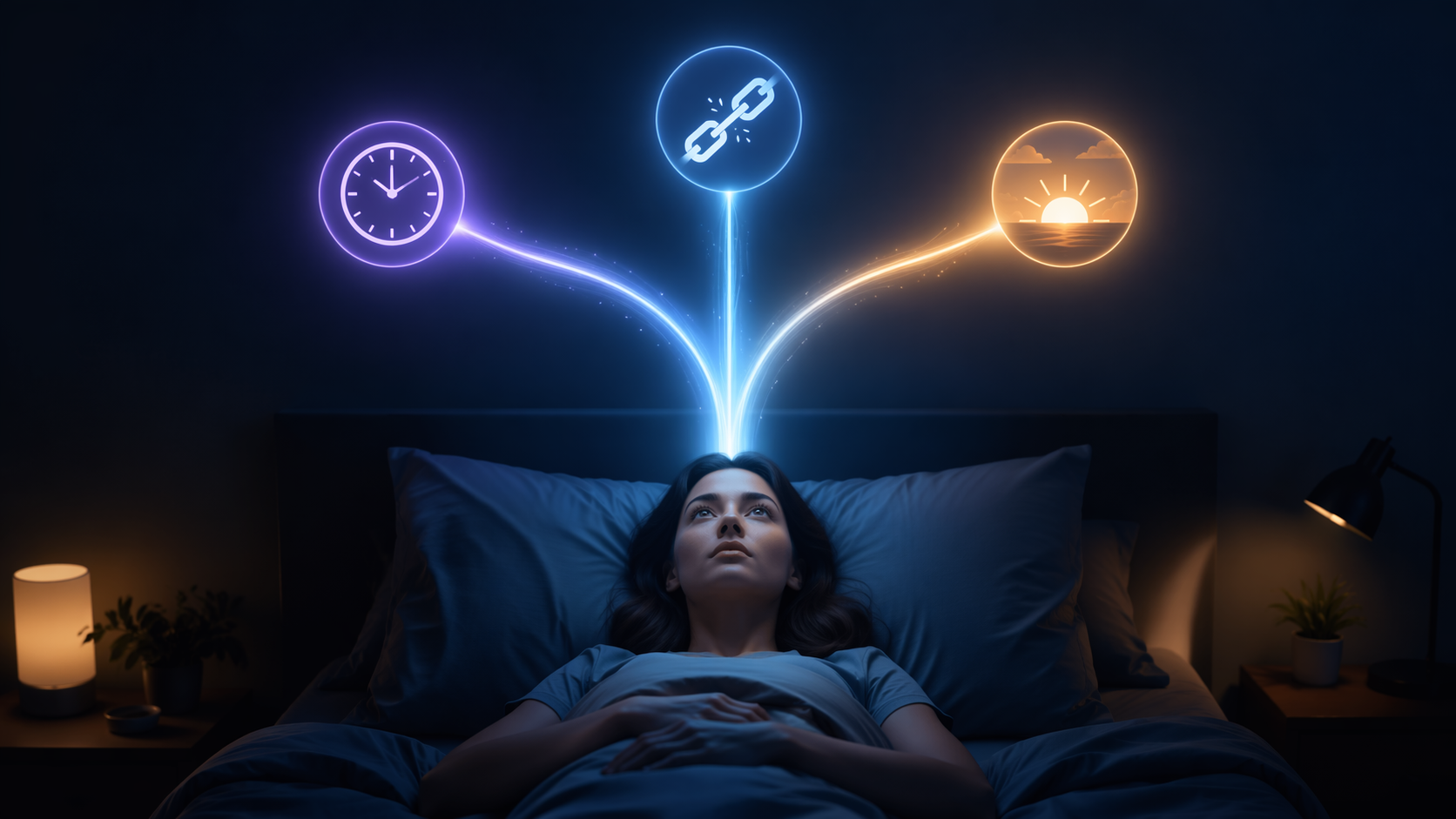
Cognitive shuffling gives the mind a task that is intentionally boring and non-threatening. Pick a neutral word, such as "lamp," and generate unrelated images from each letter: leaf, apple, mailbox, pillow. Do not build a story. Do not make the images meaningful. The usefulness is in the randomness.
That matters on storm nights because anxious rumination has continuity. One thought connects to the next, then to the worst-case version, then to the need to check again. Random imagery breaks that chain without asking you to win a debate against fear.
If your body is surging, lengthen the exhale
The 4-7-8 pattern is often presented like a sleep trick, but its value here is more specific. Inhale for 4, hold for 7, exhale for 8. The extended exhale is the part to respect because it nudges the body away from sympathetic activation and toward parasympathetic tone.
If holding the breath makes you more tense, simplify it. Breathe in gently and exhale longer than you inhale. The goal is not perfect counting. The goal is to stop matching the storm with short, braced breathing.
If you feel unreal or frozen, ground through the room
The 3-3-3 grounding rule is useful when fear pulls attention into imagined scenes. Name 3 things you see, 3 sounds you hear, and 3 body parts you can move. On a storm night, do not force yourself to pretend the thunder is not there. Include it accurately: "rain on the window," "fan," "distant thunder." Then move your toes, shoulders, and hands.
Grounding works by relocating attention from prediction to contact. The room becomes a place you can describe, not only a place from which you monitor danger.
If you are wide awake after a while, leave the sleep fight
If you have been awake long enough that the bed now feels like a command center, get up briefly and do something quiet, dim, and non-scrolling until sleepiness returns. The exact minute matters less than the association you are protecting: bed should not become the place where you rehearse fear for an hour.
This is where standard sleep hygiene can be too thin. A dark room and consistent bedtime are useful, but they do not automatically calm a threat response. If good habits keep failing because anxiety is louder than the routine, The Hidden Limits of Sleep Hygiene may be the more honest next read.
Use Bedroom Tools as Backup, Not the Main Treatment
After the threat loop has been addressed, environmental controls can reduce the number of cues your brain has to process. This is the right place for familiar tools: steady white or brown noise, curtains that reduce lightning flashes, a comfortable room temperature, a charged phone placed out of reach, and earplugs if they do not make you feel more cut off from safety information.
| Storm cue | Backup layer | What it can and cannot do |
|---|---|---|
| Thunder | White noise, fan, earplugs | Can soften contrast; cannot reassure a brain that still believes monitoring is required |
| Lightning | Curtains, sleep mask | Can reduce visual jolts; cannot stop anticipatory checking |
| Phone alerts and radar checking | Emergency alerts on, phone out of reach | Preserves safety access while reducing compulsive updates |
| Physical tension | Breathing, grounding, possibly a weighted blanket | Targets body arousal more directly than sound control alone |
Weighted blankets deserve a cautious mention here. A 2024 review reported that deep pressure touch can stimulate the parasympathetic nervous system and discussed evidence that weighted blankets increased pre-sleep salivary melatonin concentrations, including a 2023 Journal of Sleep Research study in healthy adults highlighted in the review.[3] That is interesting for pre-sleep settling. It is not proof that weighted blankets treat storm anxiety specifically.
If a weighted blanket makes your body feel held rather than trapped, it may be a reasonable optional layer. If it makes you warmer, restricted, or more aware of your heartbeat, skip it. Comfort tools should lower demand on the nervous system, not create another thing to manage.
Make Future Storm Nights Less Novel
The most durable work usually happens in daylight, when there is no pressure to fall asleep and no storm demanding interpretation. Cognitive Behavioral Therapy and exposure therapy are commonly used for phobias, including astraphobia, and the same principles can be adapted carefully for situational storm anxiety.[4][5]
Graduated exposure does not mean forcing yourself to panic in the dark. It means building tolerance in doses small enough that the brain can learn. A person might begin by listening to low-volume rain sounds during the day while relaxed, then later add distant thunder audio, then practice a breathing technique while the sound plays. The exposure is doing its job only if the body has a chance to come down during or after it.
Preparation rituals can also help when they are finite. A storm kit, a shelter plan, charged devices, shoes near the bed if appropriate, and a household agreement about alerts can reduce the feeling that safety depends on staying half-awake. The ritual should end with a clear stop: prepared, alerts on, next action defined.
If the fear is intense, persistent, or life-limiting; if you avoid travel, lose sleep repeatedly, panic during ordinary storms, or cannot stop monitoring weather even when no storm is imminent, self-help should not be the whole plan. Professional CBT or therapy is appropriate at that point. The line is not whether the fear sounds reasonable to someone else. The line is how much of your life it is taking.
The same threat-detection pattern can attach to other rare but frightening events, too. If your sleep is hijacked by structural-collapse fears, earthquakes, or bridge anxiety rather than storms, Earthquake and Bridge Collapse Fears Hijack Your Sleep follows the same body-first logic.
The Practical Order on a Storm Night
- Confirm whether it is safe to sleep, using official alerts and your household plan.
- Define when you will check again, so the phone does not become an anxiety drip.
- Interrupt the loop that is most active: rumination with cognitive shuffling, body surging with longer exhales, dissociation or freezing with grounding.
- Only then add environmental controls such as white noise, curtains, temperature adjustment, or earplugs.
- Seek CBT or therapy if storm fear repeatedly costs you sleep, changes your behavior, or keeps expanding beyond actual weather events.
Sleeping during severe storms is not about proving you are fearless. It is about making the correct distinction: danger gets a safety plan; hyperarousal gets nervous-system care; leftover noise gets bedroom tools.
References
- Severe weather phobia may be common, Ball State study finds, Ball State University, 2014, link
- Astraphobia, Cleveland Clinic, link
- The effects of weighted blankets on sleep and related disorders: A systematic review, PMC, 2024, link
- Exposure Therapy, Anxiety & Depression Association of America, link
- Cognitive Behavioral Therapy for Insomnia, Sleep Foundation, link

Comments
Join the discussion with an anonymous comment.